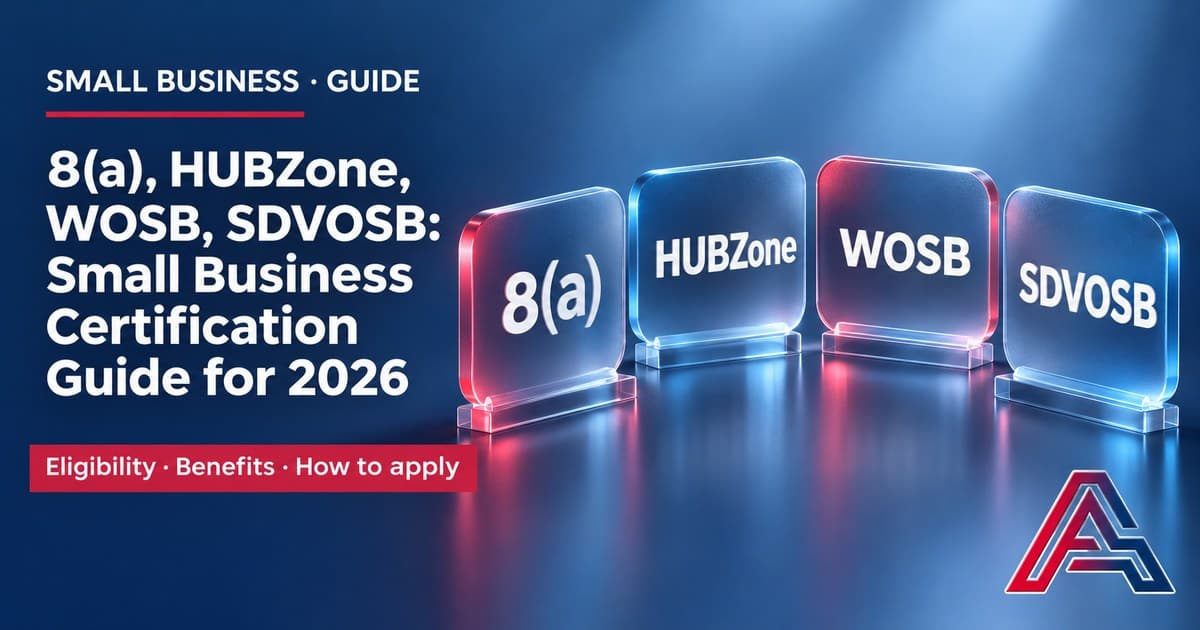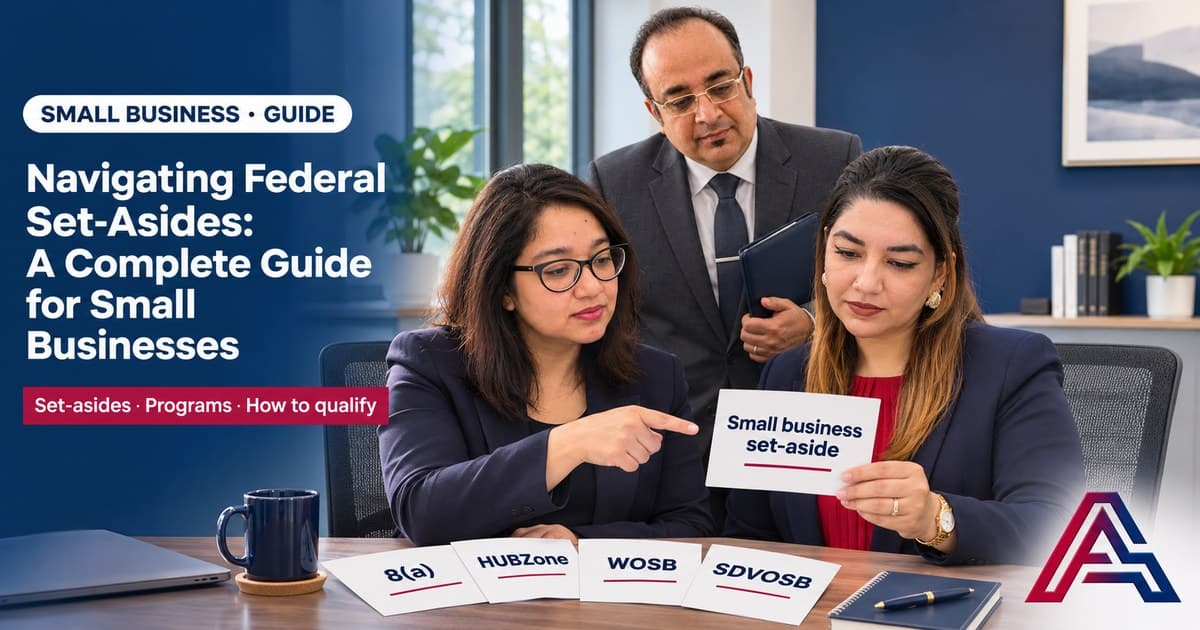
GovCon Intelligence Blog

Federal Contracting Insights

Expert strategies, analysis, and guides to help you win more government contracts. From capture management to compliance.

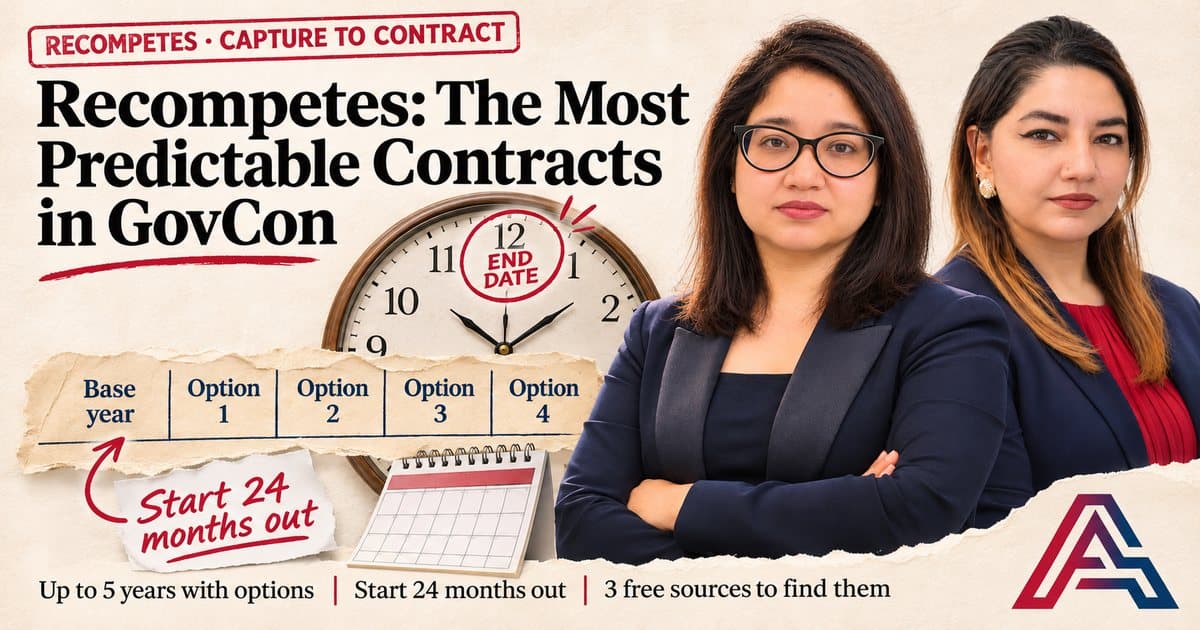
Editorial collage: Sumera Khan and Sana Rehman of Aliff Solutions beside a clock marked End date, a paper strip showing a base year and four option years, and a red note reading Start 24 months out.
RecompetesNovember 17, 20268 min read

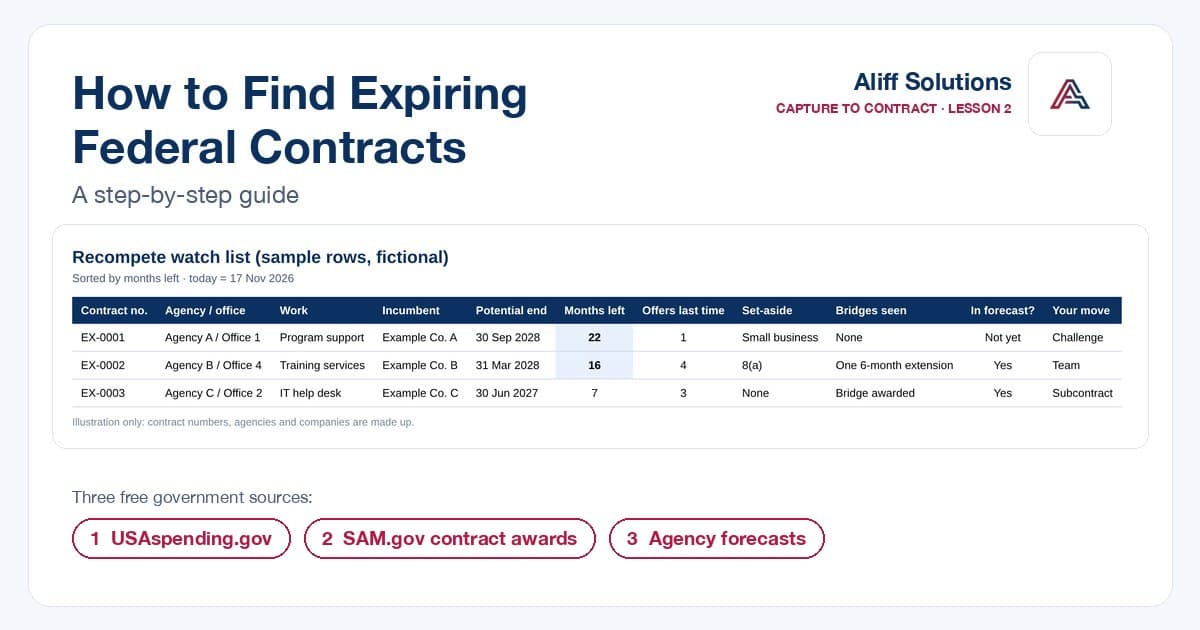
Recompetes: The Most Predictable Contracts in GovCon

Most federal contracts end on a date anyone can look up. Here is how recompetes work, when to start, where to find them for free, and how to decide whether to challenge, team or subcontract.

recompetesfollow-on contractscapture planning
Read Article
Sana Rehman, Sumera Khan and Haroon Haider of Aliff Solutions in a bright daylight office: Sana and Sumera read printed pages and Haroon stands behind them beside a laptop showing SAM.gov published justifications, next to the headline Sole Source Contracts: How the Justification Works.
Business DevelopmentNovember 17, 20266 min read

Sole Source Contracts: How the Justification Works

Sole source contracts are not handshake deals. Skipping competition is a violation of statute unless one of seven named exceptions applies, the reasons must be written down and signed off at a level set by the dollar value, and the justification is then published where anyone can read it.

sole source contractsjustification and approvalJ&A
Read Article
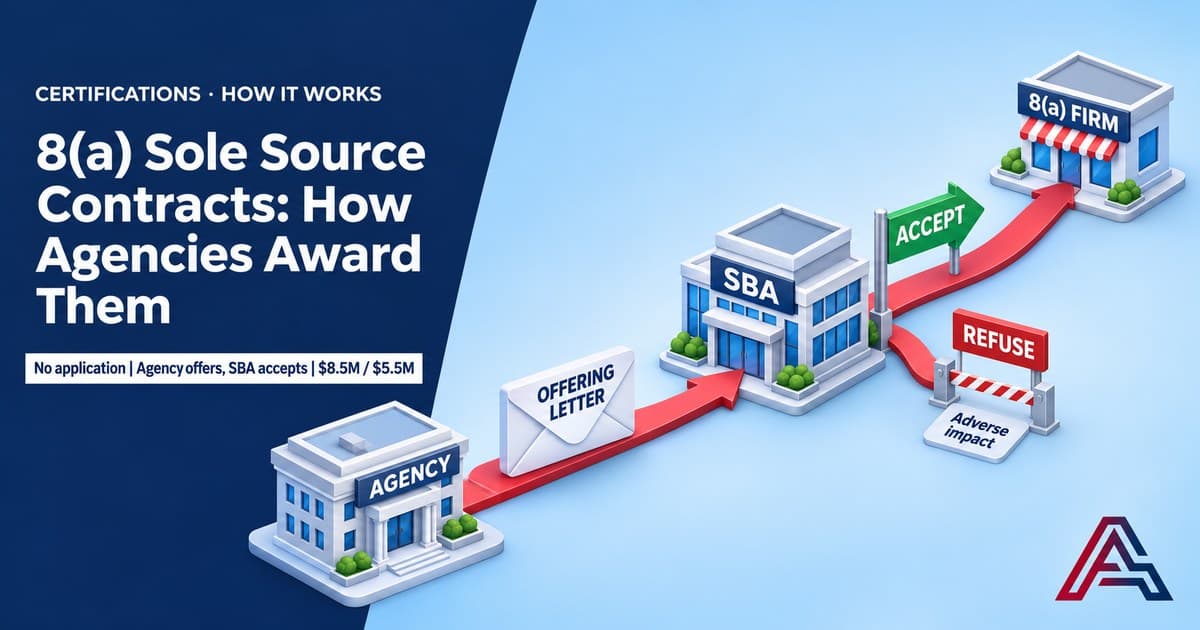
Isometric illustration of an offering letter travelling from an agency building to SBA, where one path marked Accept leads to an 8(a) firm and another marked Refuse is blocked by an adverse impact barrier, beside the headline 8(a) Sole Source Contracts: How Agencies Award Them.
certificationsNovember 15, 20266 min read

8(a) Sole Source Contracts: How Agencies Award Them

An 8(a) sole source contract is awarded without competition, but you cannot apply for one. An agency has to offer the requirement to SBA, and SBA can refuse it. Here is how the offer, the acceptance, the thresholds and the adverse impact rule work.

8(a) program8(a) sole sourceoffering letter
Read Article
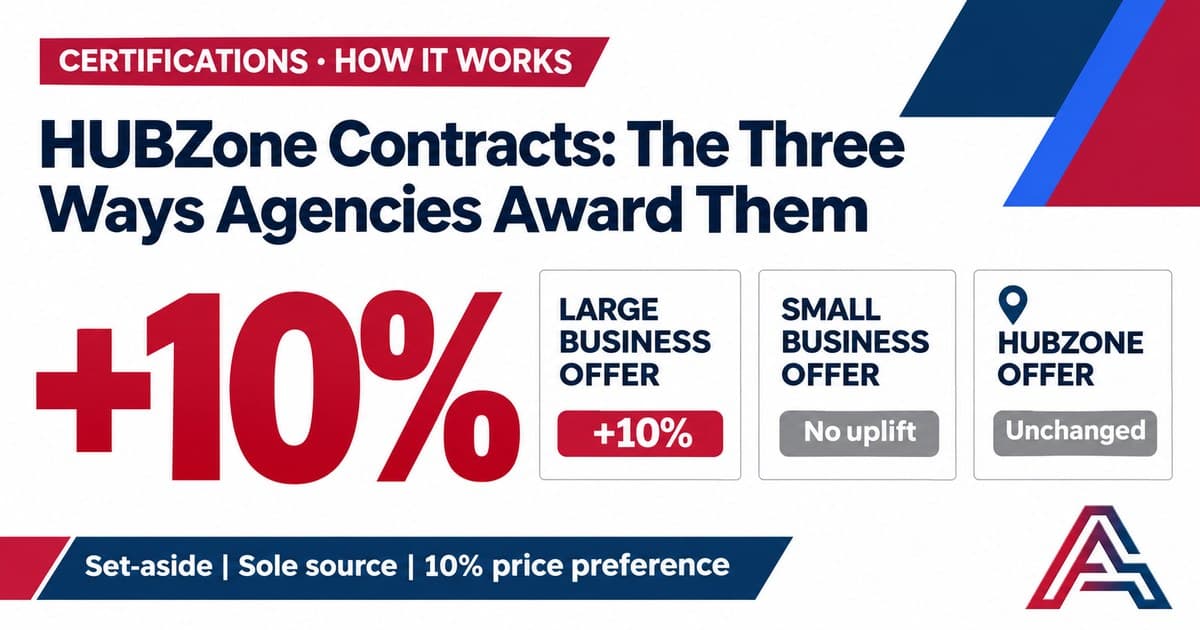
Typographic poster with a large red +10% beside three offer cards: the large business offer carries a +10% tag, the small business offer is marked No uplift and the HUBZone offer is marked Unchanged, under the headline HUBZone Contracts: The Three Ways Agencies Award Them.
certificationsNovember 15, 20266 min read

HUBZone Contracts: The Three Ways Agencies Award Them

HUBZone contracts reach you by three routes: a set-aside, a sole source award, and a 10% price preference in full and open competition. Here is the order a contracting officer follows, the sole source limits, and why the price preference does nothing against other small businesses.

HUBZoneHUBZone set-asideHUBZone sole source
Read Article
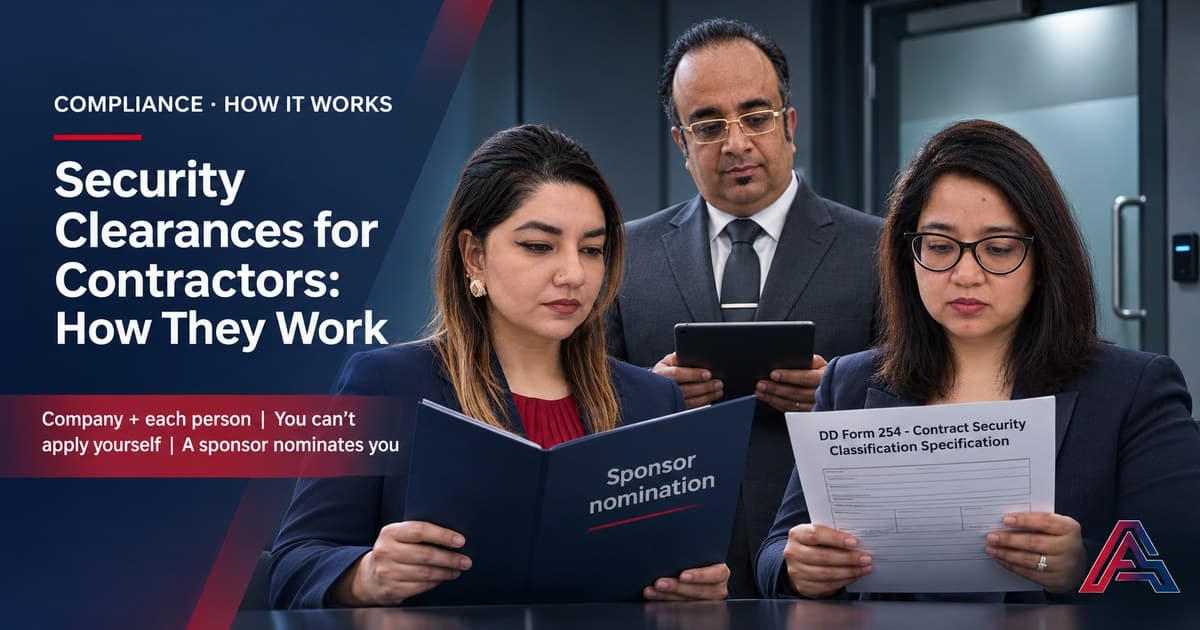
Sana Rehman holds a Sponsor nomination folder and Sumera Khan reads a DD Form 254 while Haroon Haider stands behind them with a tablet in a secure briefing room, beside the headline Security Clearances for Contractors: How They Work.
ComplianceNovember 15, 20267 min read

Security Clearances for Contractors: How They Work

A contractor needs two clearances: one for the company and one for each person who touches classified work. Here is how sponsorship works, why you cannot apply for your own facility clearance, and what the company has to have in place.

security clearancefacility clearanceFCL
Read Article
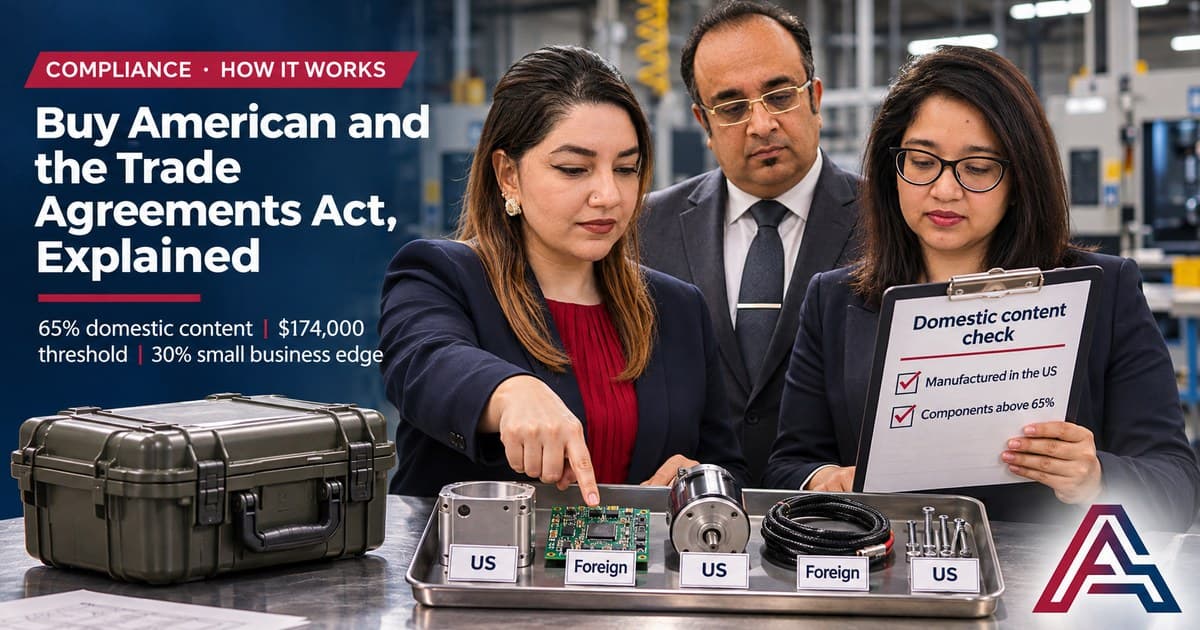
Sana Rehman points at a tray of product components tagged US and Foreign while Sumera Khan holds a "Domestic content check" clipboard and Haroon Haider looks on, beside the headline Buy American and the Trade Agreements Act, Explained.
ComplianceNovember 14, 20266 min read

Buy American and the Trade Agreements Act, Explained

Buy American prefers domestic products; the Trade Agreements Act waives that preference above set thresholds. The 65 percent content test, the $174,000 threshold, and the price edge for small domestic offerors.

Buy AmericanTrade Agreements ActFAR 25.003
Read Article
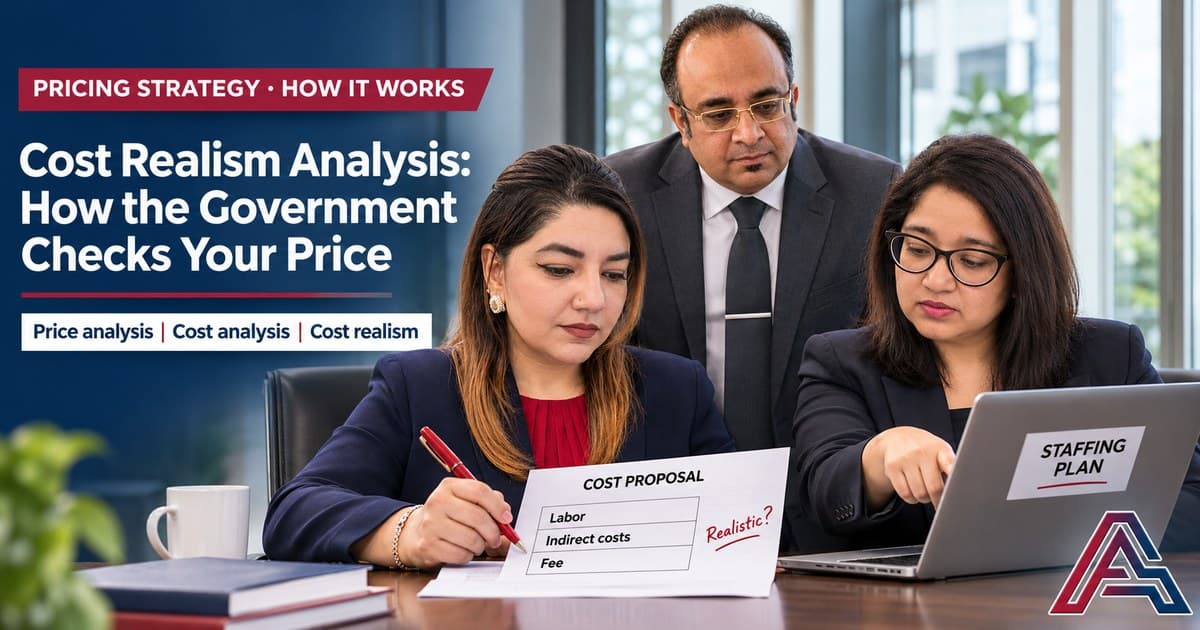
Sana Rehman marks a cost proposal page labelled Labor, Indirect costs and Fee with the note "Realistic?" while Sumera Khan points to a staffing plan on a laptop and Haroon Haider looks on, beside the headline Cost Realism Analysis: How the Government Checks Your Price.
Pricing StrategyNovember 14, 20266 min read

Cost Realism Analysis: How the Government Checks Your Price

The government has three ways to test a proposed price: price analysis, cost analysis and cost realism. On cost-reimbursement contracts, a price that is too low can be replaced with a higher probable cost.

cost realismprice analysiscost analysis
Read Article
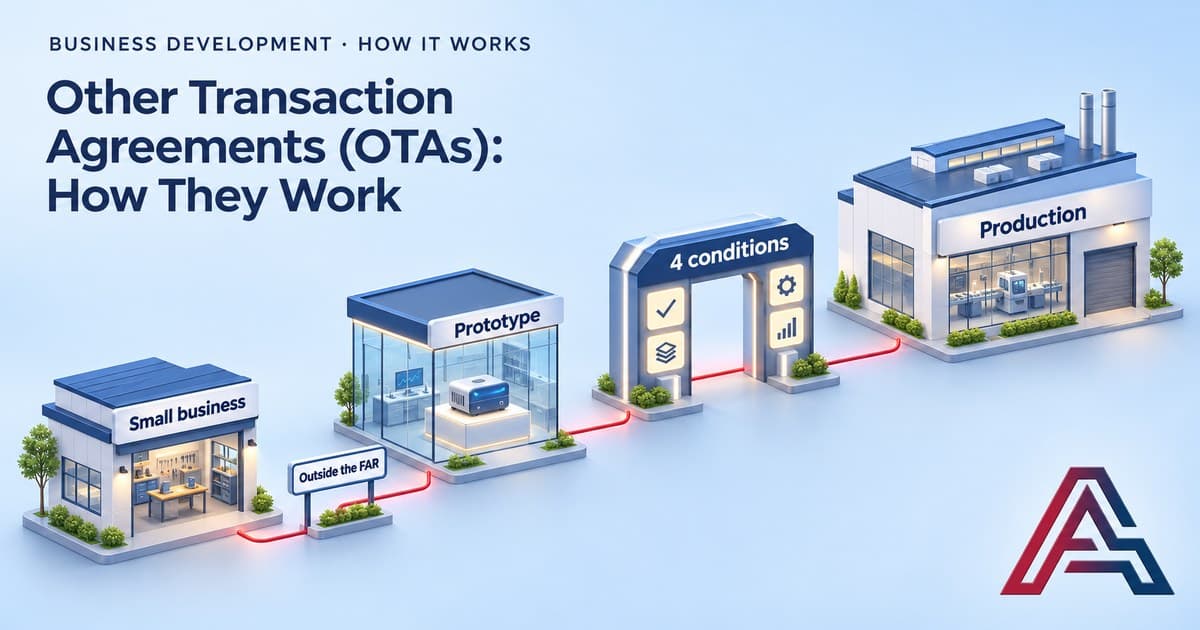
Isometric illustration of a path from a small business workshop to a prototype lab, through a gate labelled 4 conditions, to a production factory, with a sign reading Outside the FAR, beside the headline Other Transaction Agreements (OTAs): How They Work.
Business DevelopmentNovember 14, 20266 min read

Other Transaction Agreements (OTAs): How They Work

Other transaction agreements let the Department of Defense buy prototypes outside the FAR, and the statute is written to pull in companies new to defense work. Here is how the four conditions, the approval tiers and the follow-on production route work.

other transaction agreementsOTA10 U.S.C. 4022
Read Article
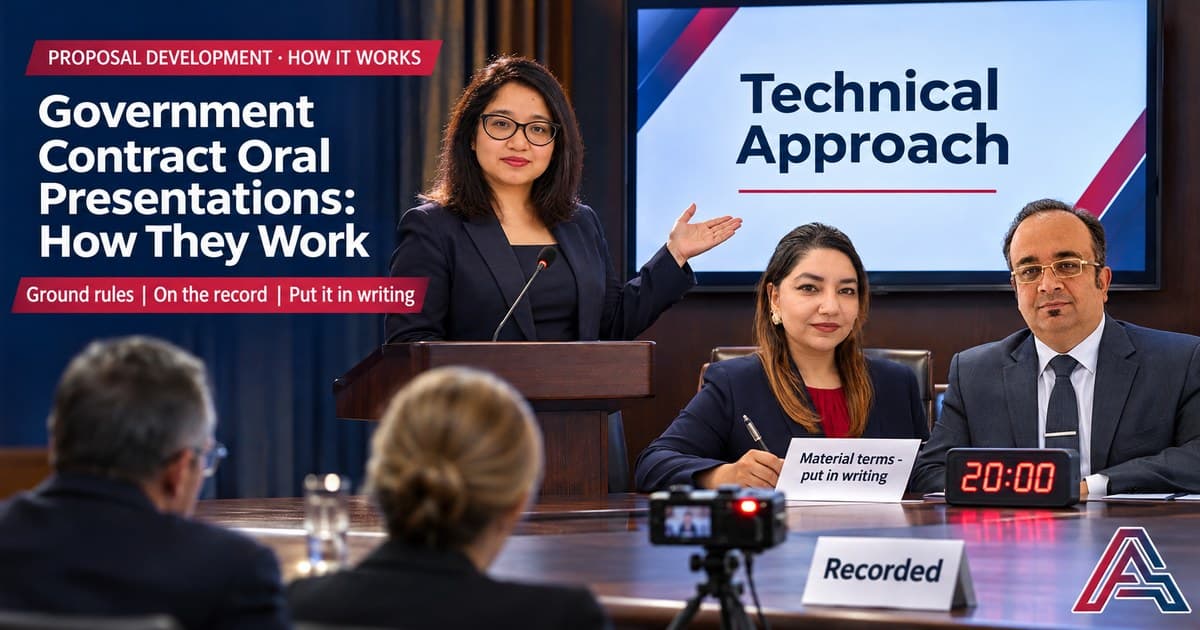
Sumera Khan presents at a lectern beside a screen reading Technical Approach, while Sana Rehman holds a card reading Material terms, put in writing, and Haroon Haider sits next to a countdown timer showing 20:00. Two evaluators are seen from behind, and a camera with a red recording light sits by a card reading Recorded. Headline: Government Contract Oral Presentations: How They Work. Ground rules, on the record, put it in writing.
Proposal DevelopmentNovember 13, 20266 min read

Government Contract Oral Presentations: How They Work

Oral presentations let you present part of your bid live to the evaluators. Here is what the solicitation tells you in advance, what gets recorded, and why anything you promise must still be written down.

oral presentationsFAR 15.102source selection
Read Article
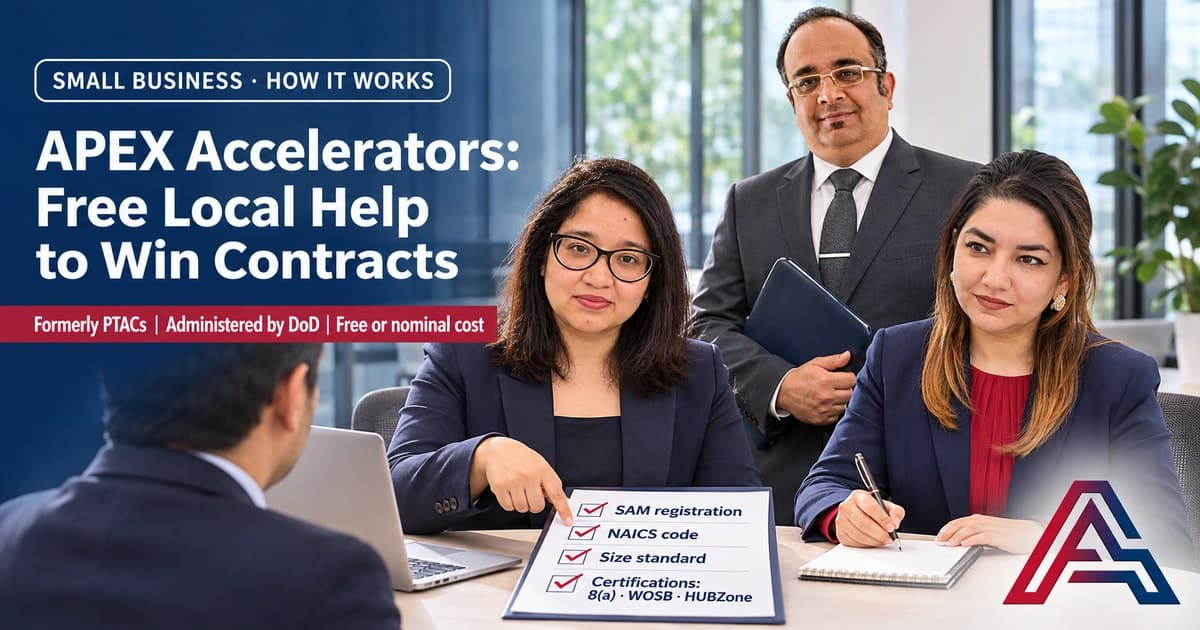
Photo: Sumera Khan and Sana Rehman of Aliff Solutions review a checklist of SAM registration, NAICS code, size standard and certifications with a small business owner while Haroon Haider stands behind them, next to the title APEX Accelerators: Free Local Help to Win Contracts.
Small BusinessNovember 12, 20266 min read

APEX Accelerators: Free Local Help to Win Contracts

APEX Accelerators, formerly PTACs, are local offices that help small businesses sell to federal, state and local governments, free or at a nominal cost. Here is what they do and how to get the most from one.

APEX AcceleratorsPTACfree government contracting help
Read Article
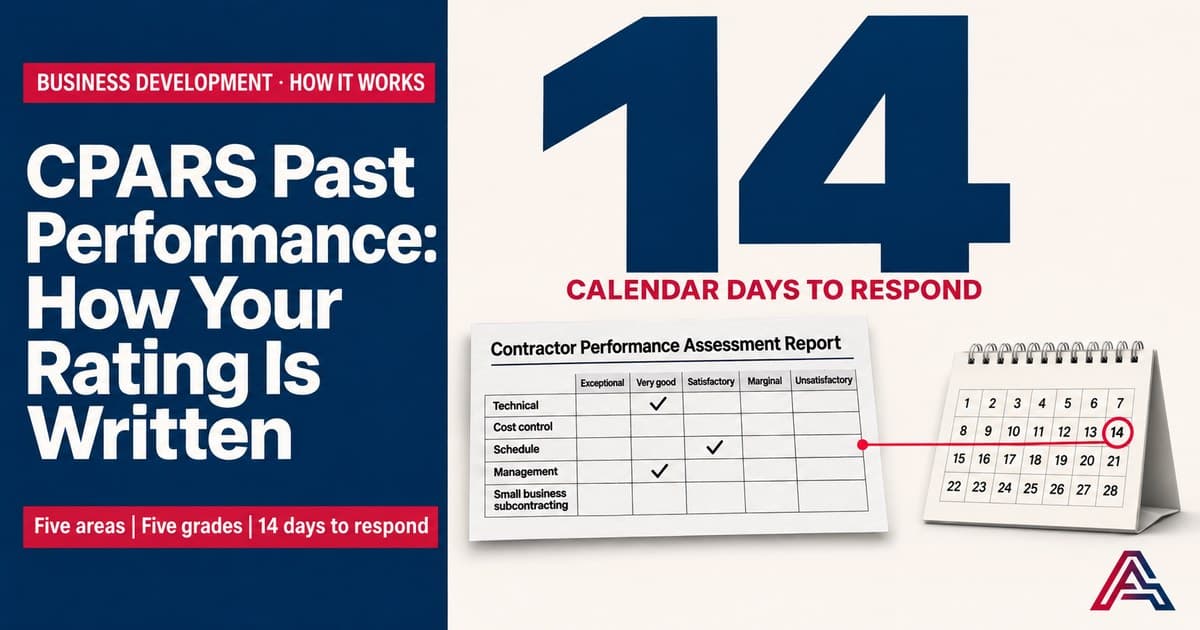
Poster with a large navy number 14 and the words Calendar days to respond, beside a Contractor Performance Assessment Report listing five rated areas (technical, cost control, schedule, management, small business subcontracting) and five grades from exceptional to unsatisfactory, linked by a red line to a calendar with day 14 circled. Headline: CPARS Past Performance: How Your Rating Is Written. Five areas, five grades, 14 days to respond.
Business DevelopmentNovember 12, 20266 min read

CPARS Past Performance: How Your Rating Is Written

CPARS evaluations are the report cards the government writes about your work, and they follow you into every bid. Who writes them, the five areas you are rated on, and your 14 days to respond.

CPARSpast performanceCPARS rating
Read Article
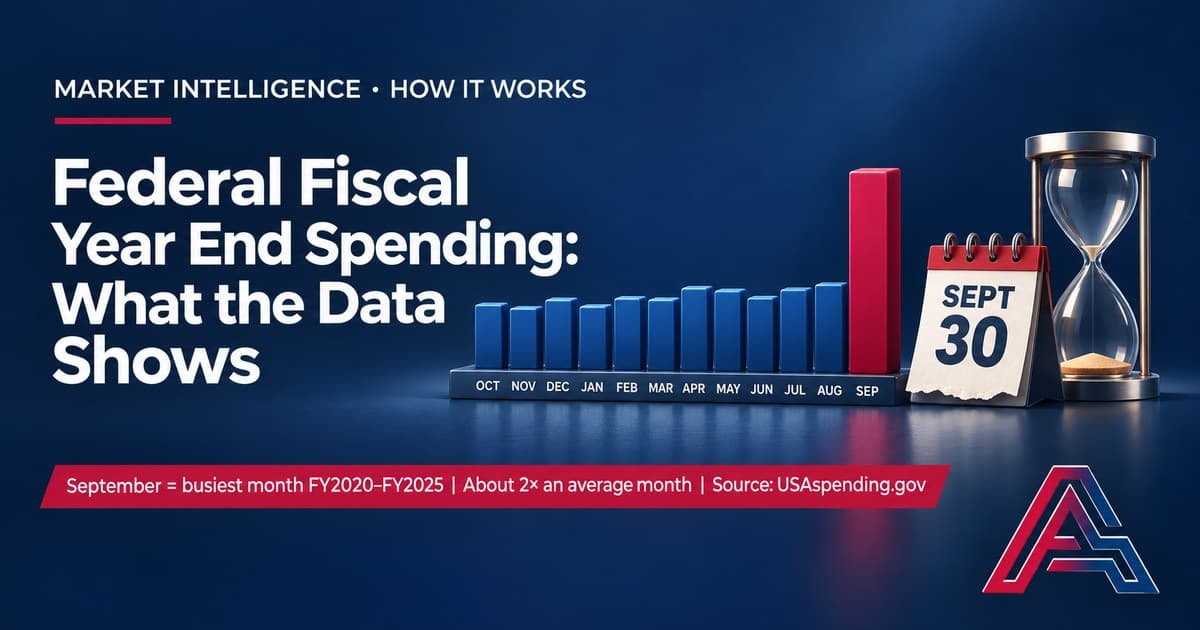
Illustration: a monthly bar chart from October to September in which the red September bar is about twice the height of the others, beside a September 30 calendar page and an hourglass, next to the title Federal Fiscal Year End Spending: What the Data Shows.
Market IntelligenceNovember 12, 20267 min read

Federal Fiscal Year End Spending: What the Data Shows

Is the September rush real? We checked seven fiscal years of USAspending.gov contract data. September was the busiest month every complete year, at roughly double an average month, and here is what that means for you.

federal fiscal year endSeptember spendingUSAspending
Read Article
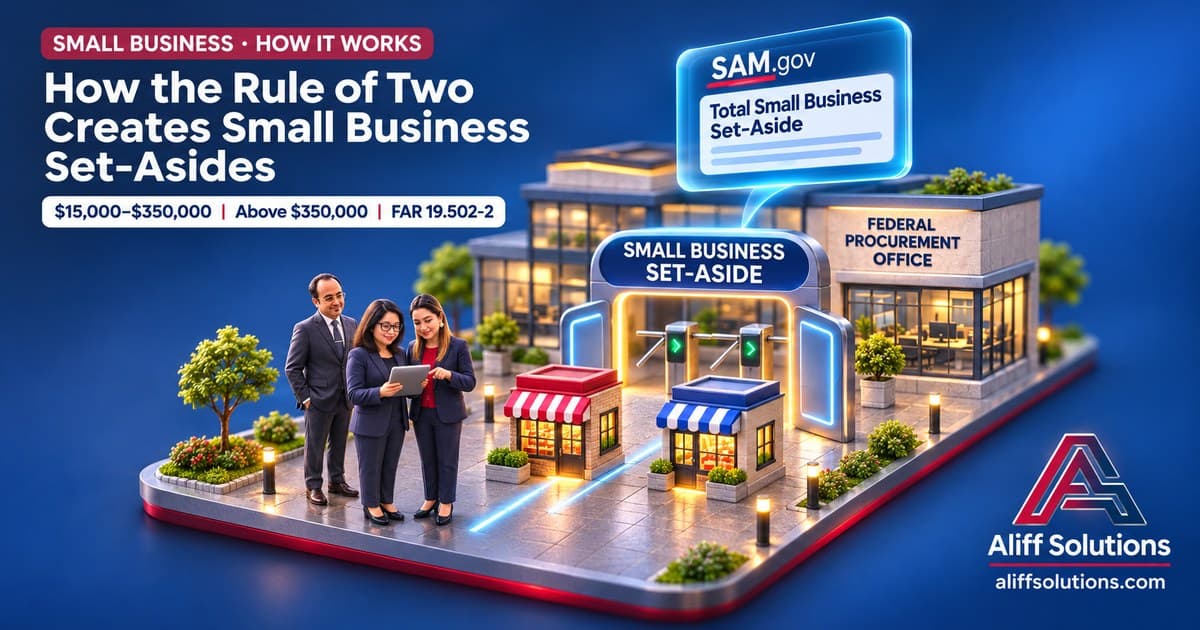
Photo: Sana Rehman of Aliff Solutions points to a Q1 to Q4 forecast timeline on a glass wall while Sumera Khan holds a tablet and Haroon Haider takes notes, next to the title Federal Procurement Forecasts: See Next Year's Contracts.
Market IntelligenceNovember 12, 20266 min read

Federal Procurement Forecasts: See Next Year's Contracts

A federal procurement forecast is an agency's own list of the contracts it expects to award. It is required by statute, free to search and needs no login. Here is how forecasts work and how to use the lead time.

federal procurement forecastForecast of Contracting OpportunitiesOFPP
Read Article
Photo: Sumera Khan of Aliff Solutions draws the five procurement stages, Plan, Research, Notice, Proposals and Award, on a glass wall while Sana Rehman and Haroon Haider sit at the table, next to the title The Federal Procurement Process: 5 Stages to Award.
Market IntelligenceNovember 12, 20266 min read

The Federal Procurement Process: 5 Stages to Award

Every federal contract runs through five stages, from an agency's need to award, and most of them happen before a solicitation is public. Here is what happens at each stage and when to act.

federal procurement processacquisition planningmarket research
Read Article
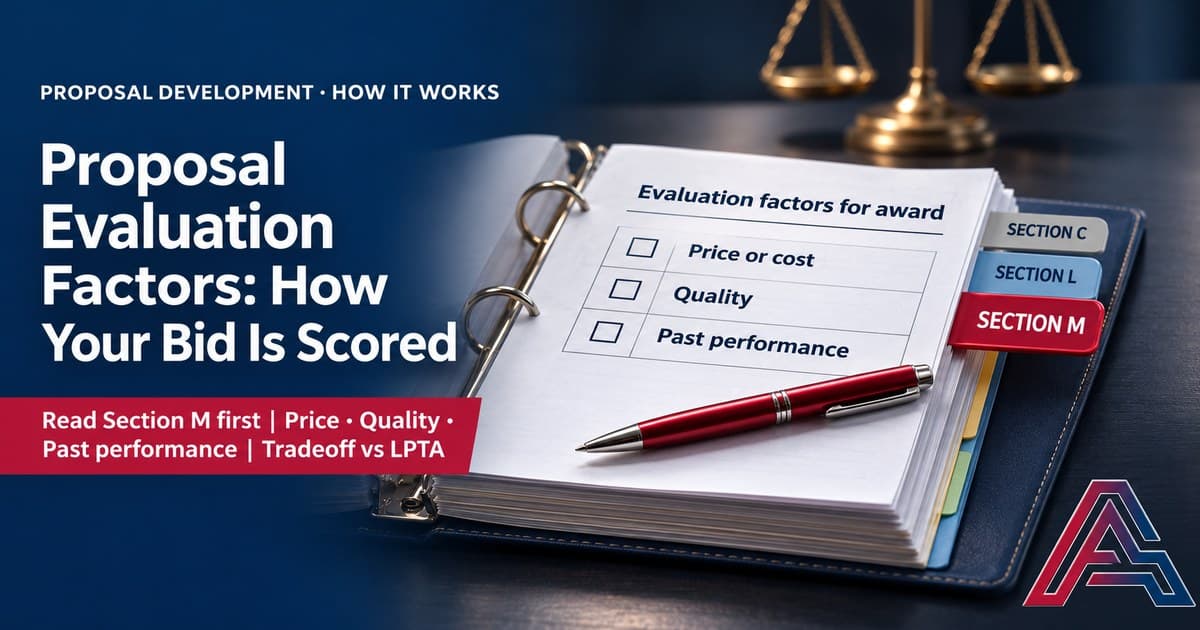
Photo: an open solicitation binder with the Section M tab flagged in red and a scoring sheet listing price or cost, quality and past performance, next to the title Proposal Evaluation Factors: How Your Bid Is Scored.
Proposal DevelopmentNovember 12, 20266 min read

Proposal Evaluation Factors: How Your Bid Is Scored

Every federal source selection scores bids against published evaluation factors: price or cost, quality and past performance. Here is what the FAR requires, where Section M tells you the weights, and how tradeoff and LPTA differ.

proposal evaluation factorsSection Mbest value tradeoff
Read Article
Isometric illustration: Aliff Solutions team members reviewing a tablet beside two small-business storefronts at a Small Business Set-Aside gate, with a SAM.gov notice reading Total Small Business Set-Aside, next to the title How the Rule of Two Creates Small Business Set-Asides.
Small BusinessNovember 12, 20267 min read

How the Rule of Two Creates Small Business Set-Asides

The rule of two is the federal test that turns an ordinary contract into a small business set-aside. Here is how it works below and above $350,000, and how to get counted as one of the two.

rule of twosmall business set-asideFAR 19.502-2
Read Article
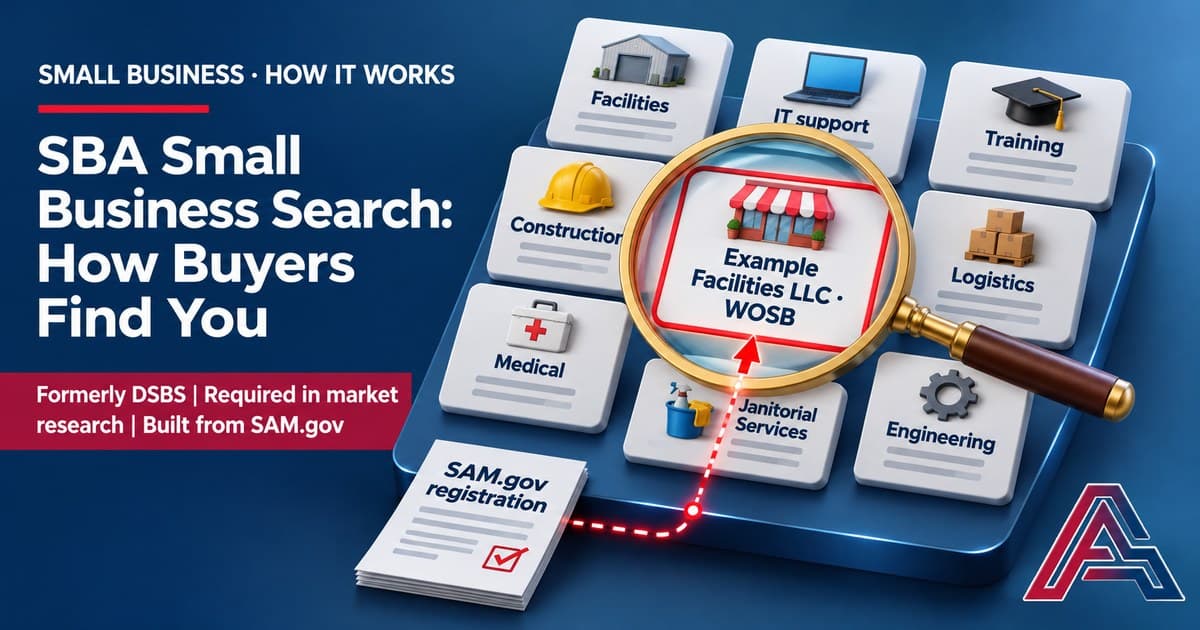
Illustration: a magnifying glass highlights an example small business profile card in a grid of business profiles, linked by a red dotted line to a SAM.gov registration, next to the title SBA Small Business Search: How Buyers Find You.
Small BusinessNovember 12, 20266 min read

SBA Small Business Search: How Buyers Find You

The SBA Small Business Search, formerly DSBS, is the database contracting officers are required to use in market research. Your profile comes from SAM.gov. Here is how buyers find you, and how to be found.

SBA Small Business SearchDSBSDynamic Small Business Search
Read Article
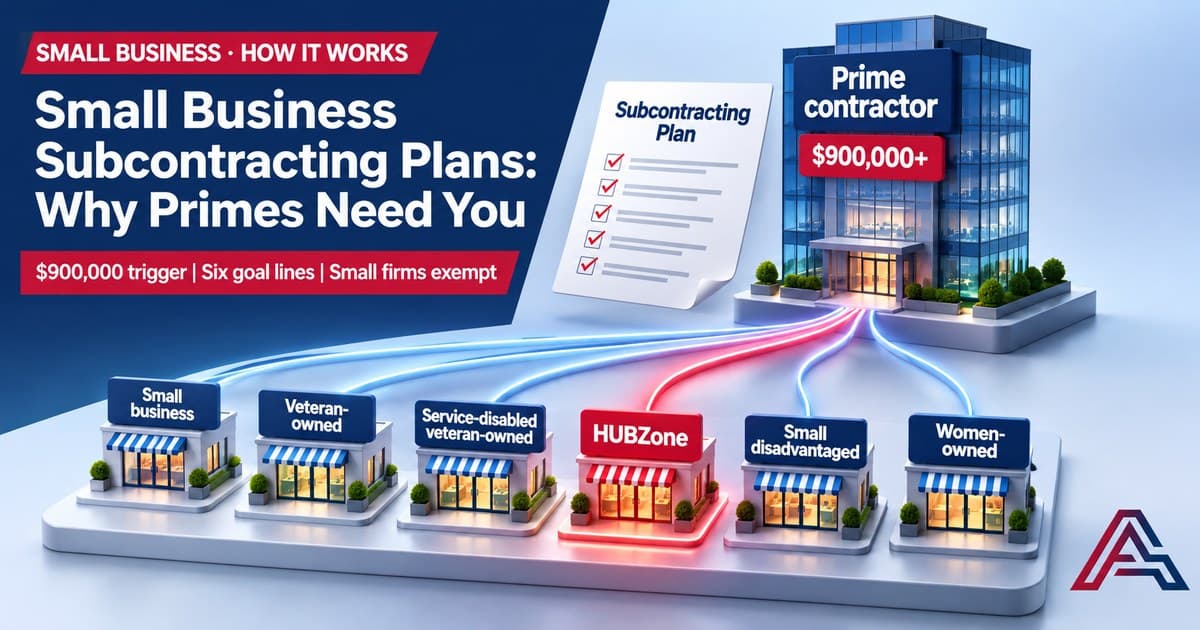
Isometric illustration of a glass office tower labelled Prime contractor, $900,000+, with a Subcontracting Plan document beside it. Six lanes run from the tower to six small storefronts labelled Small business, Veteran-owned, Service-disabled veteran-owned, HUBZone, Small disadvantaged and Women-owned, with the HUBZone lane lit red. Headline: Small Business Subcontracting Plans: Why Primes Need You. $900,000 trigger, six goal lines, small firms exempt.
Small BusinessNovember 12, 20266 min read

Small Business Subcontracting Plans: Why Primes Need You

Large primes bidding federal work above $900,000 must file a subcontracting plan with goals for each small business category. Here is how the plan works, why it makes you useful to primes, and how to find the primes that carry one.

subcontracting plansmall business subcontractingFAR 19.702
Read Article
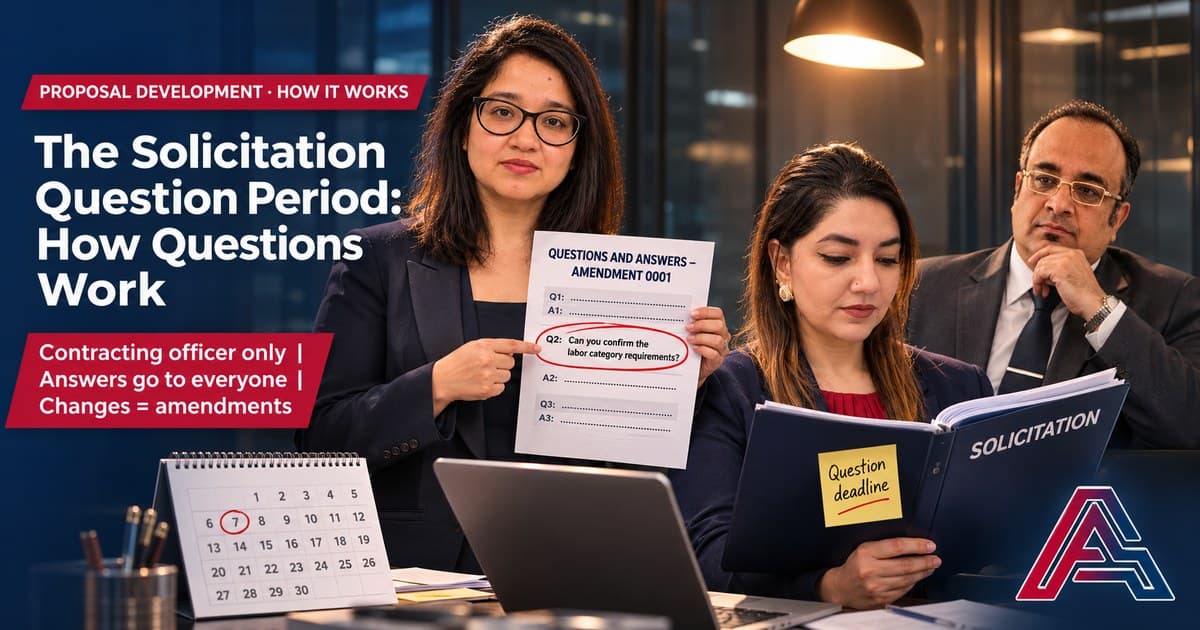
Sumera Khan holds up a page headed Questions and Answers, Amendment 0001, with a question about labor category requirements circled in red, while Sana Rehman reads a solicitation binder marked with a Question deadline note and Haroon Haider looks on. A calendar has the 7th circled. Text reads: The Solicitation Question Period: How Questions Work. Contracting officer only, answers go to everyone, changes are amendments.
Proposal DevelopmentNovember 12, 20266 min read

The Solicitation Question Period: How Questions Work

After a solicitation is released, bidders can ask the contracting officer what it means, but every answer goes to every bidder. Here is how the question period works under the FAR, and which questions are worth asking.

solicitation question periodcontracting officersolicitation amendment
Read Article
The Death of the Gut Instinct: How Data Science is Replacing Guesswork in GovCon
Capture ManagementJune 3, 20267 min read

The Death of the Gut Instinct: How Data Science is Replacing Guesswork in GovCon

The GovCon market is a $2.25T landscape where the industry average federal proposal win rate sits at roughly 4%. Quantitative methodology — recompete prediction, vulnerability scoring, Price-to-Win, and the 8-factor pWin model — is replacing instinct-driven capture with systematic decision support.

capture managementWin ProbabilitypWin
Read Article
8(a) Certification Step-by-Step: A Practical Application Guide for 2026
certificationsMay 20, 20266 min read

8(a) Certification Step-by-Step: A Practical Application Guide for 2026

8(a) is SBA's flagship small business development program — 9 years of sole-source eligibility, mentor-protege access, and competitive set-asides. Here's the practical step-by-step for applying in 2026.

8(a) certificationSBA 8(a)small business certification
Read Article
The Federal Contract Vehicle Decision Tree: Which to Pursue First
contract-vehiclesMay 20, 20266 min read

The Federal Contract Vehicle Decision Tree: Which to Pursue First

GSA Schedule, SEWP VI, CIO-SP4, Alliant 2, OASIS+, Polaris — the choice paralysis is real. Here's the decision tree for picking the right next vehicle based on your firm size, target agencies, and capabilities.

contract vehiclesGSA ScheduleGWAC strategy
Read Article
GSA Schedule Pricing: How to Set Competitive Labor Rates in 2026
Pricing StrategyFebruary 14, 20263 min read

GSA Schedule Pricing: How to Set Competitive Labor Rates in 2026

In 2026, GSA pricing is more competitive than ever. Learn how to conduct salary analysis, map labor categories, and set rates that win task orders without sacrificing margin.

gsa-schedulepricinglabor-rates
Read Article
How to Calculate Win Probability (pWin) for Government Contracts
Capture ManagementFebruary 12, 20264 min read

How to Calculate Win Probability (pWin) for Government Contracts

Stop guessing and start quantifying. Learn the formula for calculating Win Probability (pWin) in government contracting and how to use it to build a winning pipeline.

pwincapture-managementgovernment-contracts
Read Article
Army MAPS $50B IDIQ: What Contractors Need to Know in 2026
Capture ManagementFebruary 10, 20268 min read

Army MAPS $50B IDIQ: What Contractors Need to Know in 2026

The U.S. Army's Marketplace for the Acquisition of Professional Services (MAPS) consolidates RS3 and ITES-3S into a single $50 billion, 10-year IDIQ. Here is what government contractors need to know about the five domains, 250 anticipated awards, and the capture window before proposals are due.

Army MAPSIDIQrecompete
Read Article
How to Win Army MAPS: Self-Scoring Model and Domain Strategy
Proposal DevelopmentFebruary 10, 202611 min read

How to Win Army MAPS: Self-Scoring Model and Domain Strategy

The Army MAPS $50B IDIQ uses a hybrid self-scoring evaluation model that fundamentally changes how proposals are evaluated. Learn how the phase-gate approach, scorecard mechanics, and domain selection strategy determine who wins -- and how to maximize your points.

Army MAPSself-scoringproposal strategy
Read Article
Photo: Sumera Khan of Aliff Solutions draws a capture pipeline, Identify, Qualify, Capture, Proposal and Award, on a glass wall while Sana Rehman holds an opportunity brief and Haroon Haider takes notes, next to the title The Capture Management Lifecycle: From Opportunity to Award.
Capture ManagementFebruary 10, 20267 min read

The Capture Management Lifecycle: From Opportunity to Award

Master the end-to-end capture management process from opportunity identification through contract award. Learn how gate reviews, B&P investment decisions, and quantitative analysis transform each phase of the Shipley capture lifecycle.

capture managementShipley processgate reviews
Read Article
CMMC 2.0 Compliance Timeline: Deadlines, Costs, and Preparation Guide
ComplianceFebruary 10, 202610 min read

CMMC 2.0 Compliance Timeline: Deadlines, Costs, and Preparation Guide

The CMMC 2.0 phased rollout is accelerating in 2026. This guide covers the three-level structure, Phase 2 third-party assessment deadlines, cost estimates by level, C3PAO scheduling, supply chain flow-down requirements, and the concrete steps contractors must take now.

CMMC 2.0cybersecurityNIST 800-171
Read Article
CMMC 2.0 Readiness: What Government Contractors Need to Know in 2026
ComplianceFebruary 10, 20268 min read

CMMC 2.0 Readiness: What Government Contractors Need to Know in 2026

A practical guide to CMMC 2.0 readiness for government contractors. Understand the three maturity levels, assessment requirements, SSP and POA&M documentation, and the concrete steps to prepare your organization for certification.

CMMCCMMC 2.0cybersecurity
Read Article
DOGE and Federal Spending Efficiency: Impact on Government Contractors
Market IntelligenceFebruary 10, 202610 min read

DOGE and Federal Spending Efficiency: Impact on Government Contractors

The Department of Government Efficiency is reshaping the federal contracting landscape through aggressive contract terminations, spending audits, and the defense-civilian spending bifurcation. This guide analyzes which sectors are most affected and how contractors can adapt.

DOGEfederal spendinggovernment efficiency
Read Article
FAR Overhaul 2026: What Every Government Contractor Must Know
ComplianceFebruary 10, 20269 min read

FAR Overhaul 2026: What Every Government Contractor Must Know

The Revolutionary FAR Overhaul is the most significant change to federal procurement in forty years. This guide breaks down the key regulatory shifts, new contracting officer discretion, Strategic Acquisition Guidance, and what contractors must do now to stay competitive.

FAR overhaulfederal acquisition regulationFAR reform
Read Article
Cash Flow Management for Government Contractors: 2026 Playbook
Business DevelopmentFebruary 10, 202610 min read

Cash Flow Management for Government Contractors: 2026 Playbook

Government contractors face unique cash flow challenges driven by 60-90 day federal payment cycles, continuing resolutions, and rising input costs. This 2026 playbook covers DSO optimization, invoice acceleration, working capital strategies, and macro-fiscal factors shaping contractor liquidity.

cash flowgovernment contractorsDSO
Read Article
Assignment of Claims, ABL, and Contract Financing for Federal Contractors
Business DevelopmentFebruary 10, 202612 min read

Assignment of Claims, ABL, and Contract Financing for Federal Contractors

Federal contractors face a structural funding gap between contract performance and government payment. This guide covers the Assignment of Claims Act, asset-based lending, SBA programs, factoring, mobilization funding, and how to choose the right financing instrument for your contract portfolio.

contract financingassignment of claimsasset-based lending
Read Article

How to Calculate Wrap Rates and Optimize GovCon Pricing
Pricing StrategyFebruary 10, 202610 min read

How to Calculate Wrap Rates and Optimize GovCon Pricing

Wrap rates determine the true cost of every billable hour in government contracting. This guide breaks down fringe, overhead, and G&A components, walks through a complete calculation example, explains typical multipliers around 2.7x, and shows how to benchmark against GSA CALC data.

wrap ratesGovCon pricingindirect rates
Read Article
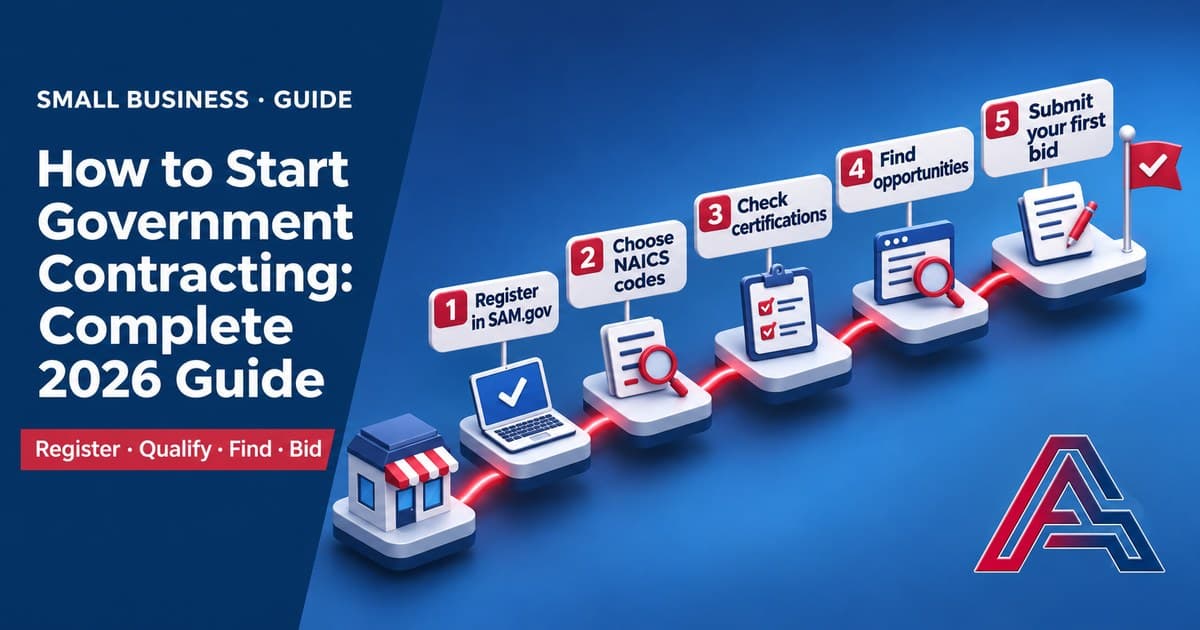
Illustration: an isometric path of five stations, from registering in SAM.gov and choosing NAICS codes to checking certifications, finding opportunities and submitting a first bid, next to the title How to Start Government Contracting: Complete 2026 Guide.
Small BusinessFebruary 10, 202612 min read

How to Start Government Contracting: Complete 2026 Guide

A step-by-step guide to entering the federal contracting market in 2026, covering SAM.gov registration, UEI and CAGE codes, NAICS selection, FPDS research, subcontracting pathways, and the regulatory changes reshaping market entry.

government contractinghow to startSAM.gov
Read Article
Lynx: DoD's Multi-Domain Defense Technology Platform Explained
Market IntelligenceFebruary 10, 20268 min read

Lynx: DoD's Multi-Domain Defense Technology Platform Explained

The Department of Defense LYNX platform is reshaping how small businesses enter the defense industrial base. Learn what DoD LYNX does, how it connects suppliers to mission-aligned opportunities, and what the broader 'Lynx' technology ecosystem means for government contractors.

LynxDoDdefense technology
Read Article
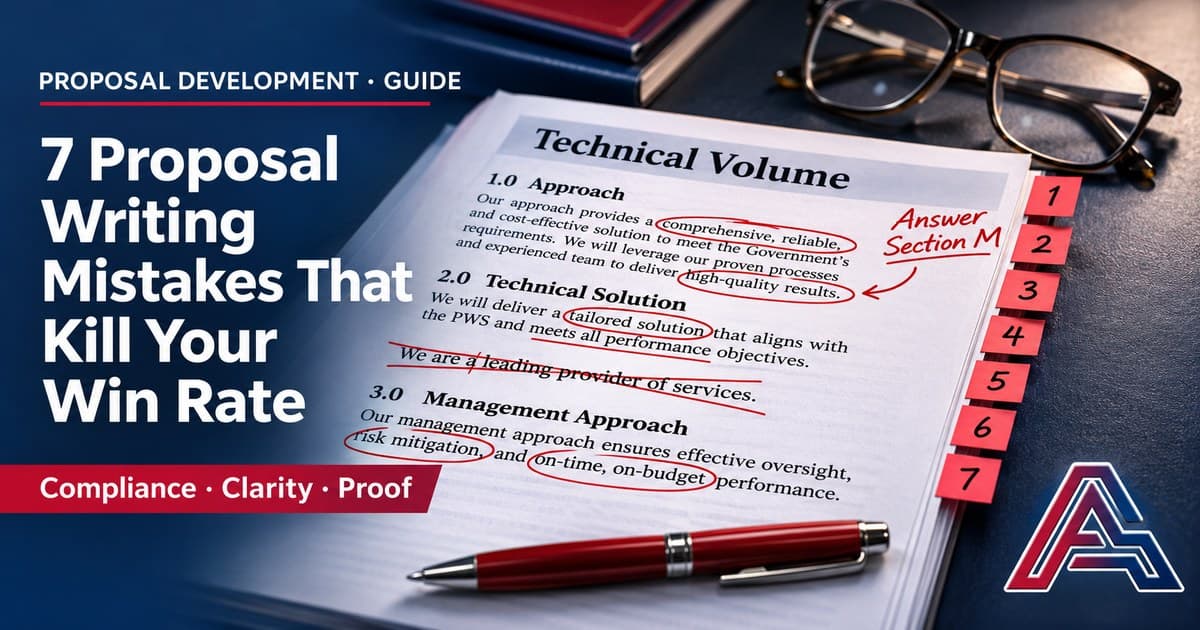
Photo: a printed technical volume marked up in red pen with seven numbered tabs and the note Answer Section M, next to the title 7 Proposal Writing Mistakes That Kill Your Win Rate.
Proposal DevelopmentFebruary 10, 20268 min read

7 Proposal Writing Mistakes That Kill Your Win Rate

Avoid the seven most common proposal writing mistakes that cost government contractors winnable bids. From compliance matrix failures to weak proof points, learn what separates winning proposals from also-rans.

proposal writingRFP responsecompliance matrix
Read Article
The $1.5 Trillion SLED Market: Opportunities Beyond Federal Contracting
Market IntelligenceFebruary 10, 20268 min read

The $1.5 Trillion SLED Market: Opportunities Beyond Federal Contracting

Explore the state, local, and education (SLED) procurement market -- a $1.5 trillion opportunity that most federal contractors overlook. Learn the differences in procurement rules, cooperative purchasing vehicles, and strategies for breaking into SLED from a federal base.

SLEDstate and localeducation
Read Article
SLED Procurement 101: How to Win State, Local, and Education Contracts
Market IntelligenceFebruary 10, 20269 min read

SLED Procurement 101: How to Win State, Local, and Education Contracts

The SLED market represents over $3.7 trillion in combined state and local government spending -- far larger than the federal contracting market. This guide covers the procurement methods, regulatory differences, entry strategies, and cooperative purchasing vehicles you need to capture your share.

SLEDstate contractslocal government
Read Article
Sourcewell and Cooperative Purchasing: Fast-Track to SLED Markets
Business DevelopmentFebruary 10, 202610 min read

Sourcewell and Cooperative Purchasing: Fast-Track to SLED Markets

Cooperative purchasing vehicles like Sourcewell, NASPO ValuePoint, and OMNIA Partners give vendors access to thousands of government agencies through a single contract award. This guide explains how each works, how to get on contract, and how to leverage cooperative vehicles for SLED market growth.

Sourcewellcooperative purchasingNASPO ValuePoint
Read Article
Strategic Teaming in Government Contracting: When and How to Partner
Business DevelopmentFebruary 10, 20268 min read

Strategic Teaming in Government Contracting: When and How to Partner

A practical guide to teaming strategies in government contracting. Learn when to team, how to structure agreements, the differences between CTAs and subcontracting, and how to build partnerships that strengthen your competitive position.

teamingjoint venturessubcontracting
Read Article
How to Write Unsolicited Proposals for State and Local Government
Proposal DevelopmentFebruary 10, 202612 min read

How to Write Unsolicited Proposals for State and Local Government

Unsolicited proposals let vendors pitch innovative solutions to government agencies outside the formal RFP process. This guide covers when to use them, how to structure them, state-specific rules in Virginia, North Carolina, and Massachusetts, and common mistakes that derail otherwise strong submissions.

unsolicited proposalsSLEDstate government
Read Article
Understanding Win Probability (pWin) in Government Contracting
Capture ManagementFebruary 5, 20265 min read

Understanding Win Probability (pWin) in Government Contracting

Learn how Bayesian probability analysis helps government contractors make data-driven Go/No-Go decisions. Understand the factors that drive win probability and how to improve your competitive position.

pWinwin probabilitycapture management
Read Article
How to Predict Federal Contract Recompetes: A Data-Driven Approach
RecompetesJanuary 28, 20265 min read

How to Predict Federal Contract Recompetes: A Data-Driven Approach

Federal contract recompetes represent significant revenue opportunities. Learn how to identify upcoming recompetes, assess incumbent vulnerability, and position your company for capture success.

recompetesincumbent analysiscapture management
Read Article
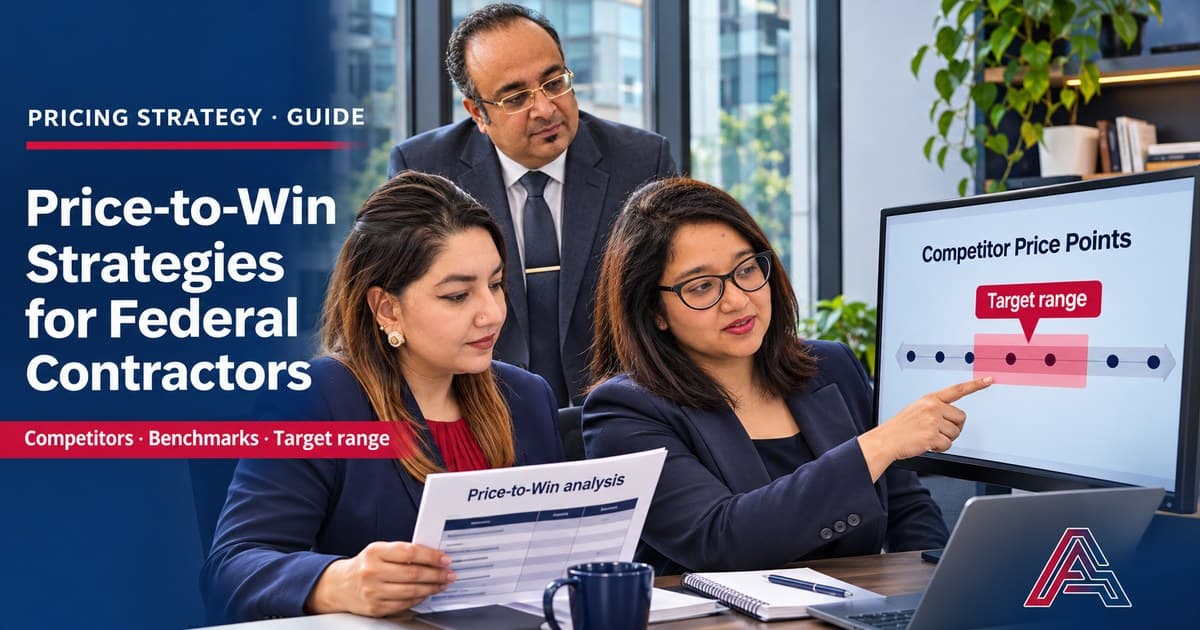
Photo: Sana Rehman and Sumera Khan of Aliff Solutions review a competitor price chart with a highlighted target range while Haroon Haider looks on, next to the title Price-to-Win Strategies for Federal Contractors.
Pricing StrategyJanuary 20, 20266 min read

Price-to-Win Strategies for Federal Contractors

Master the art and science of competitive pricing in government contracting. Learn how to analyze GSA rates, calculate wrap rates, and develop pricing strategies that maximize both your win probability and profitability.

pricingprice-to-winGSA rates
Read Article

Get More GovCon Insights

Subscribe to our weekly newsletter for actionable intelligence on winning government contracts.

GovCon Intelligence Weekly

Actionable insights on winning federal contracts, delivered by email.

Want help putting this to work?

Talk to our team about your next bid.