CPARS Past Performance: How Your Rating Is Written
CPARS evaluations are the report cards the government writes about your work, and they follow you into every bid. Who writes them, the five areas you are rated on, and your 14 days to respond.
On this page
CPARS past performance evaluations are the report cards the government writes about your work, and they follow you into every bid you make afterwards. Someone at the agency rates you on five areas, on a five-point scale. You get up to 14 calendar days to respond, and most contractors let that window pass without noticing it opened.
In short
- CPARS is the governmentwide system for past performance reports on contracts and orders (FAR 42.1502).
- Ratings happen at least annually, and again when the work is finished (FAR 42.1502).
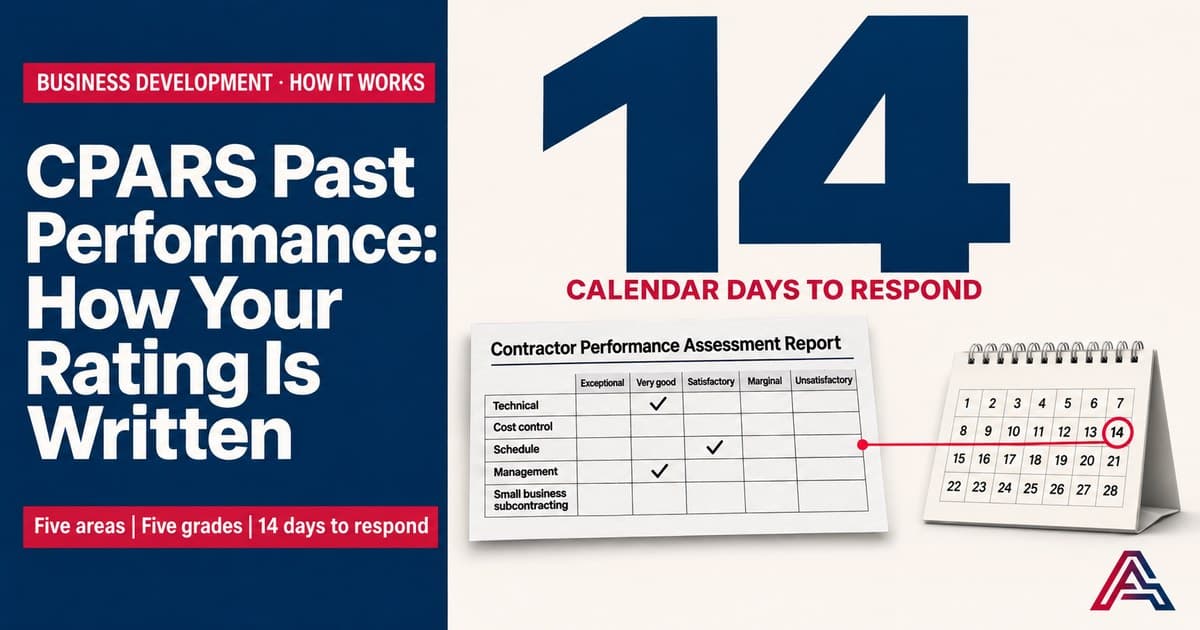
- Five areas, five grades. Technical quality, cost control, schedule, management and business relations, and small business subcontracting (cost control and small business subcontracting only where they apply) — each rated exceptional, very good, satisfactory, marginal or unsatisfactory (FAR 42.1503).
- You get up to 14 calendar days from notification to comment, rebut or add information (FAR 42.1503).
- Our advice: put that 14-day window in your contract calendar on day one. It is the only chance you get before the rating goes on your record.
What CPARS past performance is
It is a record of how you actually performed, written by the customer, kept for the next source selection to read.
FAR 42.1501(a) defines past performance information as "relevant information, for future source selection purposes, regarding a contractor's actions under previously awarded contracts or orders." The definition is broader than most people expect. It covers your record on:
- "Conforming to requirements and to standards of good workmanship"
- "Forecasting and controlling costs"
- "Adherence to schedules, including the administrative aspects of performance"
- "Reasonable and cooperative behavior and commitment to customer satisfaction"
- compliance with small business subcontracting plan requirements
- "Reporting into databases"
- "Integrity and business ethics"
- "Business-like concern for the interest of the customer"
Read that list again. Two of those eight are about behavior rather than delivery. Being difficult to work with is a rateable failing, and so is being late with your own reporting.
The reports live in CPARS, the Contractor Performance Assessment Reporting System, at cpars.gov. FAR 42.1502 calls it "the Governmentwide evaluation reporting tool for all past performance reports on contracts and orders."
Why it matters is covered elsewhere in the rules. Past performance is normally a required evaluation factor in competitive negotiated acquisitions above the simplified acquisition threshold of $350,000 (FAR 15.304(c)(3)(i)), and FAR 15.305(a)(2) governs how it gets assessed in a new competition. So the rating written about last year's contract becomes evidence in next year's bid.
How a CPARS past performance rating is written, step by step

How a CPARS evaluation is written: five areas, five grades, 14 days to respond
-
The agency prepares an evaluation on a schedule. FAR 42.1502: "Past performance evaluations shall be prepared at least annually and at the time the work under a contract or order is completed." A multi-year contract produces several.
-
Someone specific writes it. Agencies assign the responsibility; where their procedures do not designate anyone, "the contracting officer is responsible for this function" (FAR 42.1503). Input is drawn from technical offices, the contracting office, program management, quality assurance and end users. The people you deal with day to day feed this.
-
You are rated in five areas. FAR 42.1503 requires at least these: technical, meaning the quality of the product or service; cost control; schedule and timeliness; management and business relations; and small business subcontracting. Cost control does not apply to firm-fixed-price contracts, and small business subcontracting applies where the contract requires a subcontracting plan. Each area is scored on a five-point scale — exceptional, very good, satisfactory, marginal or unsatisfactory.
-
You get up to 14 calendar days. This is the step to know. Under FAR 42.1503, "contractors shall be afforded up to 14 calendar days from the date of notification of availability" to submit comments, rebutting statements or additional information. The clock starts at notification, not at the moment you happen to log in.
-
A disagreement goes above the contracting officer. FAR 42.1503 requires agencies to "provide for review at a level above the contracting officer to consider disagreements between the parties regarding the evaluation." It also sets out the limit of that: "The ultimate conclusion on the performance evaluation is a decision of the contracting agency." You can contest it. You cannot overrule it.
What this means for your business
The five rated areas are not equally easy to influence once work has started. Here is where each one is actually decided.
| Rated area | What it covers | Where it is really won |
|---|---|---|
| Technical | Quality of the product or service delivered | In delivery, but also in how you document that you delivered |
| Cost control | Forecasting and controlling costs | In your estimates and your change-order discipline |
| Schedule | Adherence to schedules, including administrative aspects | On time, and that includes your paperwork, not just the work |
| Management and business relations | Reasonable, cooperative behavior and customer satisfaction | In every routine interaction, long before the evaluation |
| Small business subcontracting | Where a subcontracting plan is required: meeting its goals and paying small subcontractors on time | In whether you actually used the partners you planned for |
Not every contract gets one. FAR 42.1502 sets the thresholds: contracts and orders above the simplified acquisition threshold generally, construction contracts of $900,000 or more, and architect-engineer services contracts of $45,000 or more. Two exceptions cut the other way — a construction or architect-engineer contract terminated for default gets an evaluation regardless of its value. Agencies also may prepare evaluations below those thresholds, and shall not evaluate performance for contracts awarded under FAR subpart 8.7.
One more thing decides how much a rating is worth to you later. When a new competition assesses past performance under FAR 15.305(a)(2), it weighs how current and how relevant the work was, and looks at trends across your record rather than at single scores.
That has a practical consequence. A strong rating on work that looks nothing like the new requirement carries less weight than a merely satisfactory one on closely similar work. And a run of ratings moving in one direction says more than any single report. It is a record, not a scoreboard.
Three mistakes we see often:
- Missing the 14 days. The notification goes to whoever is registered in CPARS for your firm. If that is someone who has left, or an inbox nobody reads, the window closes and the rating stands unanswered.
- Treating a satisfactory as a failure. It is the middle of a five-point scale, not a complaint. Arguing with a fair rating costs you the relationship that produces the next one.
- Forgetting the subcontracting rules. If your contract carries a subcontracting plan, how you met it is rated. If you won a small business set-aside, failing the limitations on subcontracting can be recorded too (FAR 42.1503). Our teaming guide covers getting that commitment right at the start.
What to do this week
- Check who at your firm is registered in CPARS. If you cannot answer that immediately, that is the problem. Notifications go to that person.
- Put the evaluation dates in your contract calendar. Annual, plus completion. Then add a 14-day reminder from each.
- Read your existing ratings. You should know what has already been written about you before a competitor's bid does.
- Fix the administrative half of schedule. Reports and deliverables filed late count against timeliness, even when the actual work was on time.
- Audit your subcontracting commitments against what you actually did. Our capture management guide and our guide to proposal mistakes both cover how past performance feeds the next bid. New to this? Start with our guide to getting started in government contracting.
Sources (6)
- FAR 42.1501, General (past performance information) — https://www.acquisition.gov/far/42.1501 (FAC 2026-01, effective March 13, 2026; accessed November 12, 2026)
- FAR 42.1502, Policy — https://www.acquisition.gov/far/42.1502 (FAC 2026-01; accessed November 12, 2026)
- FAR 42.1503, Procedures — https://www.acquisition.gov/far/42.1503 (FAC 2026-01; accessed November 12, 2026)
- FAR 15.304, Evaluation factors and significant subfactors — https://www.acquisition.gov/far/15.304 (FAC 2026-01; accessed November 12, 2026)
- FAR 15.305, Proposal evaluation — https://www.acquisition.gov/far/15.305 (FAC 2026-01; accessed November 12, 2026)
- Threshold changes effective October 1, 2025 — https://www.acquisition.gov/threshold-changes (accessed November 12, 2026)
Want help putting this to work for your business? Book a free consultation with Aliff Solutions: https://aliffsolutions.com
This article explains general rules as of November 2026. It is not legal advice, and rules change. Always check the current solicitation and the official sources linked above. We don't guarantee contract awards.
Frequently Asked Questions
- What is CPARS?
- The Contractor Performance Assessment Reporting System, at cpars.gov. FAR 42.1502 describes it as "the Governmentwide evaluation reporting tool for all past performance reports on contracts and orders," and requires past performance information to be entered into it. It is where the government's written assessment of your performance is recorded and kept for future source selections.
- How long do I have to respond to a CPARS evaluation?
- Up to 14 calendar days. FAR 42.1503 provides that "contractors shall be afforded up to 14 calendar days from the date of notification of availability" to submit comments, rebutting statements or additional information. The period runs from notification, so whoever receives those notifications needs to be someone who reads them.
- What am I rated on?
- At least five areas, under FAR 42.1503: technical, meaning the quality of the product or service; cost control; schedule and timeliness; management and business relations; and small business subcontracting where a subcontracting plan is required. Cost control does not apply to firm-fixed-price contracts. Each area is rated on a five-point scale of exceptional, very good, satisfactory, marginal or unsatisfactory.
- Which contracts get a CPARS evaluation?
- FAR 42.1502 requires evaluations for contracts and orders above the simplified acquisition threshold, construction contracts of $900,000 or more, and architect-engineer services contracts of $45,000 or more. A construction or architect-engineer contract terminated for default is evaluated whatever its value. Agencies may also evaluate below those thresholds.
- Can I challenge a rating I think is wrong?
- You can contest it, within limits. FAR 42.1503 requires agencies to "provide for review at a level above the contracting officer to consider disagreements between the parties regarding the evaluation." But the same section is explicit that "the ultimate conclusion on the performance evaluation is a decision of the contracting agency."
- Who can see my CPARS rating?
- Not the public. FAR 42.1503 directs that completed evaluations be marked as source selection information, and that they not be released beyond government personnel and the contractor being evaluated during the relevant period. Evaluations may be used to support future award decisions, which is the point of keeping them.
Get More GovCon Insights
Subscribe to our weekly newsletter for actionable intelligence on winning government contracts.
Written by
Sana Rehman
Co-Founder and VP, Resources, Aliff Solutions
Aliff Solutions provides quantitative intelligence for government contractors. Our team combines decades of federal contracting experience with advanced analytics to help you win more contracts.