Federal Fiscal Year End Spending: What the Data Shows
Is the September rush real? We checked seven fiscal years of USAspending.gov contract data. September was the busiest month every complete year, at roughly double an average month, and here is what that means for you.
On this page
Everyone in government contracting knows about the September rush. Federal fiscal year end spending is supposed to be the moment agencies hurry to award contracts before their money disappears. We checked seven years of official spending data to see whether that is true. For every complete year, it was, clearly. The most recent year is not complete yet, and the reason is worth knowing before you read any spending data.
In short
- The federal fiscal year runs October 1 to September 30. September is the last month agencies have.
- Annual money really does expire. The Government Accountability Office (GAO) puts it plainly: if an agency does not obligate 1-year or multiyear funds by the end of the period of availability, "the budget authority expires, and the funds ultimately are cancelled."
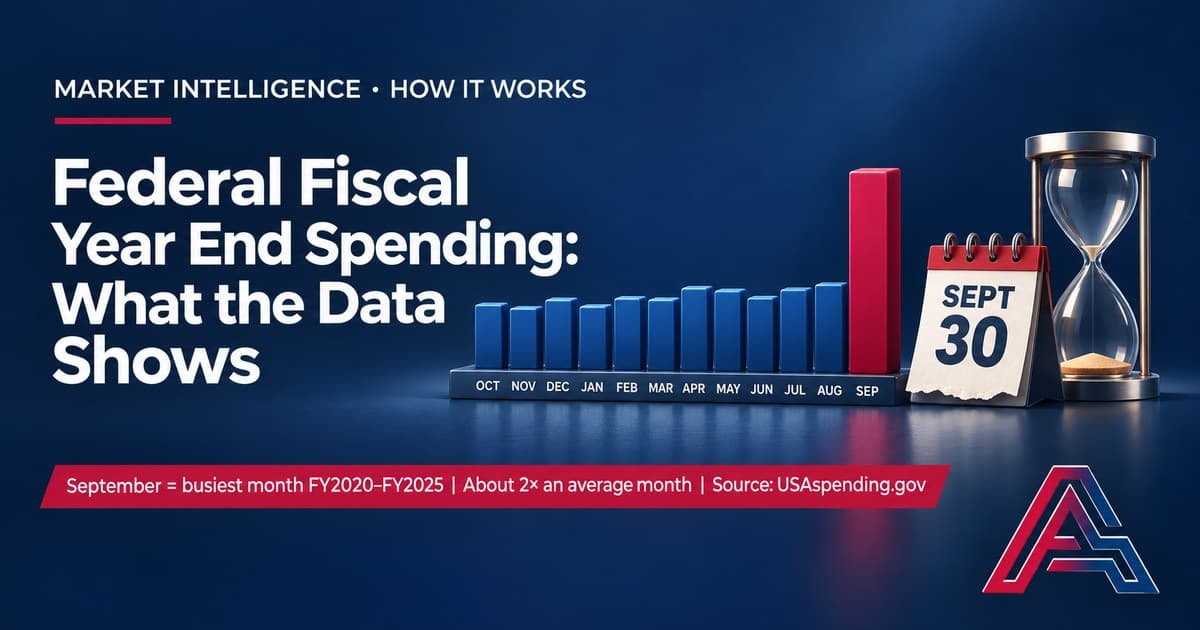
- In FY2020 through FY2025, September was the busiest contracting month every single year — between 15.0% and 19.3% of the year's contract obligations, which is roughly double an average month.
- FY2026 is not complete yet. Defense Department contract data is published on a 90-day delay, so most of its September 2026 awards are not in the public data. Among civilian agencies, September 2026 was still the busiest month, at 16.6% of their year.
- Our advice: plan for the rush, but do not build your year around it.
What the federal fiscal year end is
The federal government does not run on the calendar. USAspending.gov, the official source for federal spending data, defines it: "The fiscal year is an accounting period that spans 12 months. For the federal government, it runs from October 1 to September 30."
The thing that matters to a contractor is not the date. It is what happens to unspent money.
When an agency commits to buy something, that is an obligation. USAspending describes it this way: "When awarding funding, the U.S. government enters a binding agreement called an obligation… An agency incurs an obligation, for example, when it places an order, signs a contract, awards a grant, purchases a service, or takes other actions that require it to make a payment."
Congress gives agencies money with a shelf life attached. GAO calls this the period of availability — "the period during which agencies can obligate funds before they expire." It comes in three forms: "1-year, multiyear, or no-year authority."
And here is the pressure. GAO: "If the agency does not obligate 1-year or multiyear funds by the end of the period of availability, the budget authority expires, and the funds ultimately are cancelled."
One important qualification, because it is often left out. Not every dollar is on a clock. GAO notes that accounts with multiyear or no-year funds "may carry forward amounts that remain legally available for new obligations from one fiscal year to the next." The September deadline bites hardest on 1-year money.
Agencies also cannot simply spend their way past a shortage. FAR 32.702 bars a contracting officer from creating or authorizing an obligation in excess of available funds, or in advance of appropriations. That rule implements the Anti-Deficiency Act at 31 U.S.C. 1341.
How federal fiscal year end spending works, step by step

Use it or lose it: how the fiscal year end works
-
Congress appropriates money with a duration attached. GAO: "One of the limits generally set by appropriations acts is the duration, or period of availability, of the budget authority they provide."
-
Agencies obligate against it during the year. Every award, order and modification draws down the available balance. Agencies "incur new obligations and charge them against available appropriations."
-
Unobligated annual money comes under pressure. As September 30 gets closer, any 1-year funds still sitting unobligated are at risk of expiring and being cancelled.
-
Contracting offices work to get awards out. This is the rush. It is not waste by definition — it is a deadline doing what deadlines do.
-
On October 1 the clock resets. A new fiscal year starts, with new money and, often, a slow first month while appropriations settle.
What this means for your business
We pulled the numbers rather than repeat the folklore. The table below is federal contract obligations by month, from USAspending.gov, for the last seven fiscal years.
| Fiscal year | September obligations | Share of the year | Compared with an average month | Busiest month |
|---|---|---|---|---|
| FY2020 | $100.6B | 15.0% | 1.80× | September |
| FY2021 | $111.1B | 16.9% | 2.02× | September |
| FY2022 | $125.1B | 17.8% | 2.14× | September |
| FY2023 | $128.2B | 16.4% | 1.97× | September |
| FY2024 | $138.2B | 17.8% | 2.14× | September |
| FY2025 | $156.8B | 19.3% | 2.31× | September |
| FY2026 (incomplete, see below) | $60.3B | 7.5% | 0.90× | Not yet known |
| FY2026, civilian agencies only | $60.1B | 16.6% | 1.99× | September |
How we got these numbers. They come from the USAspending.gov API, grouped by month, counting contract award types only — not grants, loans or direct payments — for each fiscal year from FY2020 to FY2026. We ran the query on November 12, 2026. USAspending reported its data was last updated on November 11, 2026.
One detail worth stating, because it is an easy way to get this wrong. The API numbers its months by fiscal month, not calendar month, so month 1 is October and month 12 is September. We confirmed that by querying single months on their own before reading anything into the totals.
A second detail matters even more. USAspending states that procurement data for the Department of Defense and the U.S. Army Corps of Engineers "are published on a 90-day delay in the Federal Procurement Data System (FPDS)." Defense is the largest federal buyer, so its late months land in the public data well after the year closes. In our FY2026 query, Defense showed $1.3B of contract obligations for August 2026 and $0.2B for September 2026, against $46.2B and $100.5B for the same months of FY2025. Those months are not missing because Defense stopped buying. They have not been published yet.
Six years tell one story and it is a strong one. September was the single busiest contracting month every year from FY2020 to FY2025, taking between a sixth and a fifth of the entire year's contract obligations. In FY2025 it was 2.31 times an average month.
So the FY2026 row is not comparable yet. The total line shows September at 7.5% of the year, but that is the publication delay talking, not the agencies. Take Defense out and look at civilian agencies on their own, and September 2026 was still their busiest month, at 16.6% of their year and roughly double an average month. That is a smaller share than civilian agencies posted in any of the six years before (17.8% to 24.4%), so the rush may have softened. We will not call that a trend from one partial year. We will re-run the full table once the Defense data for FY2026 is published, and update this article.
Three mistakes we see often:
- Treating September as a strategy. A busy month is not an opening for a firm the agency has never heard of. Year-end awards still go to vendors who are already registered, already known and already compliant.
- Being unready to deliver fast. Year-end work often comes with short timelines. If a quick award would strain your cash or your capacity, the rush is a risk rather than an opportunity. Our cash flow guide covers what to check.
- Reading incomplete data as a trend. Recent months in public spending data can be missing whole agencies. Before you conclude anything from the latest year, check whether the data for it is complete.
What to do this week
- Be registered and current now, not in August. Everything at year end moves fast, and nothing moves at all if your SAM.gov registration has lapsed.
- Ask your buyers about their timelines. If you already work with an agency, the people you deal with know their own year-end pattern better than any national average does.
- Check what you could actually absorb. Decide in advance the largest order you could take on at short notice without hurting delivery.
- Look at the quieter months too. Even in the busiest years, September was under a fifth of the year's contract obligations. Pipelines built only around September miss most of the year. Our capture management guide covers building one that runs year-round.
- Check the data yourself. USAspending.gov is free and public. You can filter by agency and NAICS code to see when the buyers you care about actually award. Their own history beats a national average every time, and our guide to predicting recompetes sets out how to read it. If you are early in this, start with our guide to getting started in government contracting.
Sources (8)
- USAspending.gov, Glossary (Fiscal Year, Obligation, Contract, Award Type) — https://api.usaspending.gov/api/v2/references/glossary/ (accessed November 12, 2026)
- USAspending.gov, spending over time API — https://api.usaspending.gov/api/v2/search/spending_over_time/ (queried November 12, 2026; contract award types only, grouped by month, FY2020–FY2026)
- USAspending.gov, data last updated endpoint — https://api.usaspending.gov/api/v2/awards/last_updated/ (reported 11/11/2026, read November 12, 2026)
- GAO, Federal Budget: Remaining Budget Authority from the Consolidated Appropriations Act, 2023, GAO-26-108476, April 22, 2026 — https://www.gao.gov/assets/gao-26-108476.pdf (accessed November 12, 2026)
- FAR 32.702, Policy (availability of funds) — https://www.acquisition.gov/far/32.702 (FAC 2026-01, effective March 13, 2026; accessed November 12, 2026)
- SAM.gov, Entity registration — https://sam.gov/entity-registration (accessed November 12, 2026)
- USAspending.gov, About the Data Download, section "Delay in Department of Defense (DOD) Procurement Data" — https://www.usaspending.gov/data/about-the-data-download.pdf (accessed November 12, 2026)
- FPDS, DoD Data Availability — https://www.fpds.gov/common/html/dodDataAvailability.html (accessed November 12, 2026)
Want help putting this to work for your business? Book a free consultation with Aliff Solutions: https://aliffsolutions.com
This article explains general rules as of November 2026. It is not legal advice, and rules change. Always check the current solicitation and the official sources linked above. We don't guarantee contract awards.
Frequently Asked Questions
- When does the federal fiscal year end?
- September 30. USAspending.gov defines the federal fiscal year as running "from October 1 to September 30," and names the quarters as Q1 October–December, Q2 January–March, Q3 April–June and Q4 July–September. A fiscal year is labeled by the calendar year in which it ends, so FY2026 ended on September 30, 2026.
- Why do agencies spend more at the end of the fiscal year?
- Because unspent annual money is lost. GAO states that if an agency does not obligate 1-year or multiyear funds by the end of the period of availability, "the budget authority expires, and the funds ultimately are cancelled." A deadline with a penalty attached produces exactly the behavior you would expect.
- Does all federal money expire on September 30?
- No, and this is widely misunderstood. GAO describes three durations: 1-year, multiyear and no-year authority. Accounts with multiyear or no-year funds "may carry forward amounts that remain legally available for new obligations from one fiscal year to the next." The September deadline applies hardest to annual funds.
- How big is the September spike, really?
- In the six fiscal years from FY2020 to FY2025 it was large and consistent: September took between 15.0% and 19.3% of each year's contract obligations, which is 1.80 to 2.31 times an average month, and it was the busiest month in every one of those years. FY2026 is not complete yet, because Defense contract data is published on a 90-day delay.
- Did the September rush happen in FY2026?
- Among civilian agencies, yes: September 2026 was their busiest month, at 16.6% of their contract obligations for the year. The all-agency total cannot answer the question yet. USAspending publishes Department of Defense procurement data on a 90-day delay, so most Defense awards from August and September 2026 are not in the public data yet. We will update this once they are.
- Can a new contractor win work during the year-end rush?
- It is harder than it sounds. Short timelines favor firms that are already registered, already findable in agency market research and already able to deliver quickly. The rush rewards preparation that happened months earlier; it does not substitute for it.
Get More GovCon Insights
Subscribe to our weekly newsletter for actionable intelligence on winning government contracts.
Written by
Sana Rehman
Co-Founder and VP, Resources, Aliff Solutions
Aliff Solutions provides quantitative intelligence for government contractors. Our team combines decades of federal contracting experience with advanced analytics to help you win more contracts.