Small Business Subcontracting Plans: Why Primes Need You
Large primes bidding federal work above $900,000 must file a subcontracting plan with goals for each small business category. Here is how the plan works, why it makes you useful to primes, and how to find the primes that carry one.
On this page
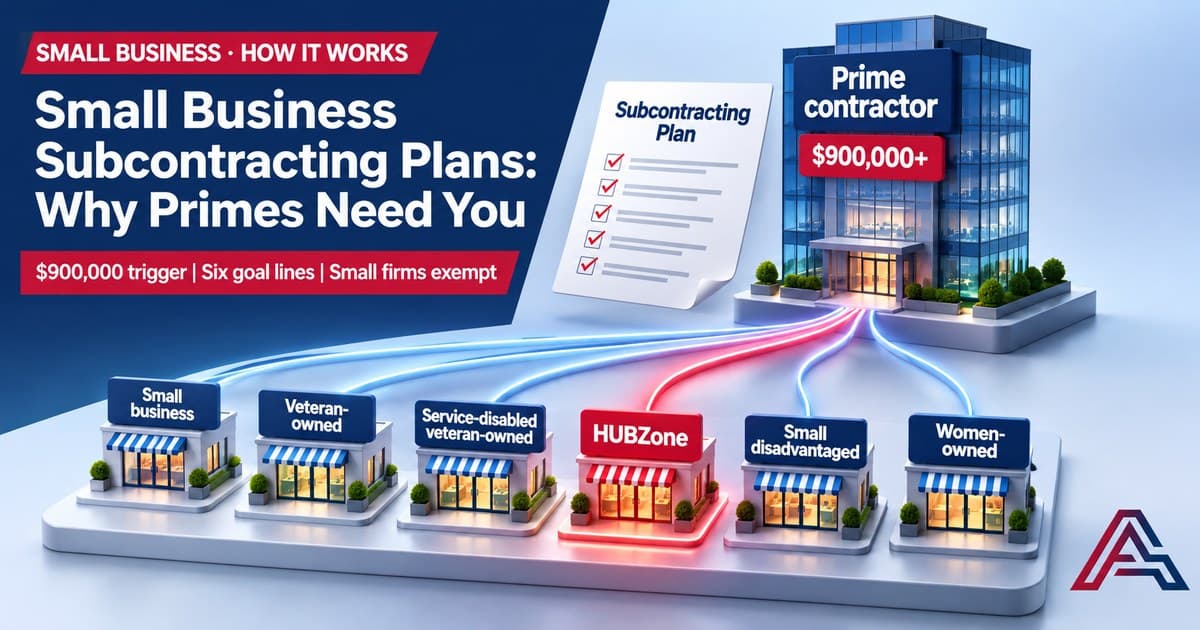
A small business subcontracting plan is a document large contractors have to file when they are in line to win federal work above $900,000. In it they commit to percentage goals for subcontracting to small businesses, broken out by category. That obligation is the reason a prime has a reason to call you, and there is a published list of the primes who carry it.
In short
- The trigger is $900,000 — or $2 million for construction — where subcontracting possibilities exist (FAR 19.702).
- Small businesses are exempt. Plans are not required "from small business concerns" (FAR 19.702).
- The plan sets separate percentage goals by category: small business, veteran-owned, service-disabled veteran-owned, HUBZone, small disadvantaged and women-owned (FAR 19.704).
- Failing to try has a price. Liquidated damages apply where a contractor "failed to make a good faith effort to comply with its subcontracting plan" (FAR 19.705-7).
- Our advice: stop guessing which primes need subs. SBA publishes a directory of the contractors that are required to have a plan.
What a small business subcontracting plan is
It is a written commitment, filed by a large prime, about how much of a contract it will push down to small businesses and to which kinds of small business.
FAR 19.702 sets the trigger. Each solicitation for a contract "expected to exceed $900,000 ($2 million for construction)" requires a subcontracting plan, where subcontracting possibilities exist. The plan comes from the apparently successful offeror in a negotiated acquisition, or from the bidder selected for award in sealed bidding. A modification that pushes a contract past the threshold can trigger one too.
Three exemptions matter. No plan is required "from small business concerns." None is required "for personal services contracts." And none is required "for contracts or contract modifications that will be performed entirely outside of the United States and its outlying areas."
Read the first of those again, because it is the one people misread. Being a small business does not get you a subcontracting plan. It gets you out of having to write one. The plan is an obligation on the large firms above you, and that obligation is what makes you useful to them.
Plans come in three shapes, defined at FAR 19.701. An individual subcontracting plan "covers the entire contract period (including option periods), applies to a specific contract." A master subcontracting plan has all the required elements "except goals," and can be folded into individual plans once approved. A commercial plan "covers the offeror's fiscal year and that applies to the entire production of commercial products and performance of commercial services."
How a small business subcontracting plan works, step by step

How a small business subcontracting plan works: from the $900,000 threshold to liquidated damages
-
The contract crosses the threshold. Above $900,000, or $2 million for construction, with real subcontracting possibilities.
-
The winner files a plan. Not every bidder. The apparently successful offeror in a negotiated buy, or the selected bidder in sealed bidding, submits its plan before award.
-
The plan commits to numbers. FAR 19.704 requires separate percentage goals for small business concerns, veteran-owned, service-disabled veteran-owned, HUBZone, small disadvantaged and women-owned small business concerns. It also requires the total dollars planned to be subcontracted, a description of the supplies and services that will go to small firms, the method used to develop the goals and find sources, and a named individual who administers the program.
-
The prime has to report. FAR 19.704 requires the plan to commit to submitting Individual Subcontract Reports and Summary Subcontract Reports through the Electronic Subcontracting Reporting System. The numbers are tracked, not merely promised. The plan must also describe the records kept and assure timely payment of small business subcontractors.
-
Not trying has a cost. FAR 19.705-7 provides liquidated damages where a contractor "failed to make a good faith effort to comply with its subcontracting plan," computed as "the actual dollar amount by which the contractor failed to achieve each subcontracting goal."
What this means for your business
Start with the goal categories, because this is where a certification turns into a sales argument.
| Goal category in the plan | What it means for you |
|---|---|
| Small business concerns | The baseline. Every plan has this line. |
| Veteran-owned small business | A separate goal, so a separate reason to call you |
| Service-disabled veteran-owned | A separate goal again, often the hardest for primes to fill |
| HUBZone small business | Tied to your address, and frequently under-filled |
| Small disadvantaged business | A distinct line in the plan |
| Women-owned small business | A distinct line in the plan |
A prime chasing a HUBZone goal does not need a good small business. It needs a HUBZone small business. If you hold a certification, you are not one of a thousand small firms — you are one of a much smaller number that counts against a specific line. Our guide to small business certifications covers which you might qualify for.
Now the part most people miss. There is a published list of primes that carry this obligation.
SBA maintains a Directory of Federal Government Prime Contractors with Subcontracting Plans. It describes it as "a listing of Federal Government contractors that have a requirement to subcontract to small businesses." The directory gives vendor name and location, contracting agency, product and service codes, NAICS codes, performance state, contract number, performance dates and total contract value.
One honest caveat: that directory was last updated March 4, 2025 and the most recent edition covers FY 2024, with earlier years going back to FY 2018. So treat it as a map of who holds this kind of work rather than a live feed. Entries stay in it for five years.
SBA also runs SUBNet, which it describes as helping "large federal prime contractors find small subcontractors." Primes post opportunities there and small firms can filter by state or keyword.
Three mistakes we see often:
- Approaching primes cold with no category. "We are a small business" competes with everyone. "We are a HUBZone firm in your performance state, in your NAICS code" speaks to a specific line in their plan.
- Assuming a missed goal is a breach. It is not. FAR 19.705-7 is explicit that "the fact that the contractor failed to meet its subcontracting goals does not, in and of itself, constitute a failure." The test is effort, and FAR 19.701 defines failure as "willful or intentional" conduct. Do not threaten a prime with a rule that does not say what you think it says.
- Letting a teaming promise stay informal. Plans include assurances about small businesses used in preparing the bid. Get your role written down. Our teaming guide covers how.
What to do this week
- Download SBA's directory of prime contractors with subcontracting plans. Filter it to your NAICS codes and your performance state. That is your target list, and it is free.
- Check SUBNet for posted opportunities in your state and keywords.
- Write one line that names your category, your NAICS code and your location. That is what a prime's plan administrator is looking for.
- Find the plan administrator. FAR 19.704 requires the plan to name someone responsible for administering the subcontracting program. That is the person who needs you.
- Decide which certifications are worth pursuing. If your address or ownership puts a separate goal line within reach, that changes who calls you back. Start with our guide to federal set-asides, or our guide to getting started in government contracting if you are earlier than that.
Sources (6)
- FAR 19.701, Definitions — https://www.acquisition.gov/far/19.701 (FAC 2026-01, effective March 13, 2026; accessed November 12, 2026)
- FAR 19.702, Statutory requirements — https://www.acquisition.gov/far/19.702 (FAC 2026-01; accessed November 12, 2026)
- FAR 19.704, Subcontracting plan requirements — https://www.acquisition.gov/far/19.704 (FAC 2026-01; accessed November 12, 2026)
- FAR 19.705-7, Liquidated damages — https://www.acquisition.gov/far/19.705-7 (FAC 2026-01; accessed November 12, 2026)
- SBA, Directory of federal government prime contractors with subcontracting plans — https://www.sba.gov/document/support-directory-federal-government-prime-contractors-subcontracting-plans (last updated March 4, 2025; accessed November 12, 2026)
- SBA, SUBNet subcontracting opportunities — https://www.sba.gov/federal-contracting/contracting-guide/prime-subcontracting/subcontracting-opportunities (accessed November 12, 2026)
Want help putting this to work for your business? Book a free consultation with Aliff Solutions: https://aliffsolutions.com
This article explains general rules as of November 2026. It is not legal advice, and rules change. Always check the current solicitation and the official sources linked above. We don't guarantee contract awards.
Frequently Asked Questions
- What is a small business subcontracting plan?
- A document a large prime contractor files committing to subcontract a stated percentage of a contract to small businesses, broken out by category. FAR 19.704 sets out what it must contain, including separate percentage goals, total dollars to be subcontracted, the method used to develop those goals, and a named administrator.
- When is a subcontracting plan required?
- When a contract is "expected to exceed $900,000 ($2 million for construction)" and subcontracting possibilities exist, under FAR 19.702. The plan is submitted by the apparently successful offeror in a negotiated acquisition, or the selected bidder in sealed bidding. A modification that pushes a contract over the threshold can also trigger one.
- Does my small business need a subcontracting plan?
- No. FAR 19.702 states plans are not required "from small business concerns." Plans are also not required for personal services contracts, or for contracts performed entirely outside the United States and its outlying areas. The obligation sits with the large firms above you, which is precisely why it works in your favor.
- What goals does the plan have to include?
- FAR 19.704 requires separate percentage goals for small business concerns, veteran-owned, service-disabled veteran-owned, HUBZone, small disadvantaged and women-owned small business concerns. Each is its own line, which is why holding a specific certification matters more to a prime than being small in general.
- What happens if a prime misses its subcontracting goals?
- Missing the numbers alone is not a breach. FAR 19.705-7 states that "the fact that the contractor failed to meet its subcontracting goals does not, in and of itself, constitute a failure." Liquidated damages apply where the contractor failed to make a good faith effort, which FAR 19.701 defines as "willful or intentional" failure or action to frustrate the plan.
- How do I find primes that have a subcontracting plan?
- SBA publishes a Directory of Federal Government Prime Contractors with Subcontracting Plans — "a listing of Federal Government contractors that have a requirement to subcontract to small businesses" — with agency, NAICS codes, performance state, contract number and value. It was last updated in March 2025 and its latest edition covers FY 2024, so use it as a map rather than a live feed.
Get More GovCon Insights
Subscribe to our weekly newsletter for actionable intelligence on winning government contracts.
Written by
Haroon Haider
CEO, Aliff Solutions
Aliff Solutions provides quantitative intelligence for government contractors. Our team combines decades of federal contracting experience with advanced analytics to help you win more contracts.