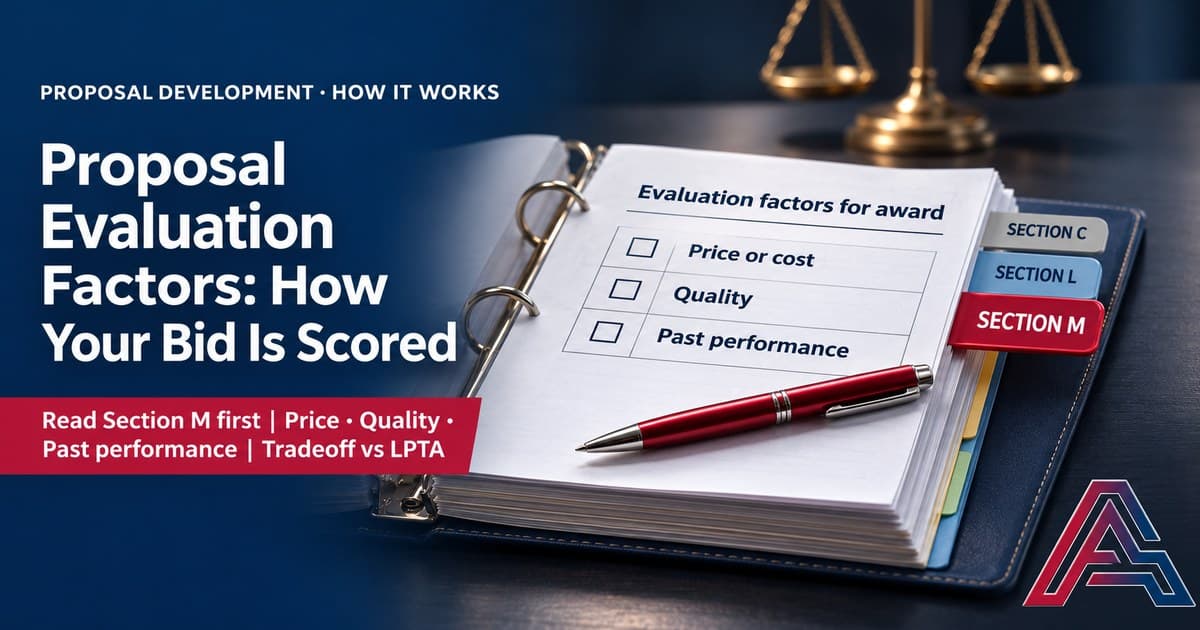
Proposal Evaluation Factors: How Your Bid Is Scored
Every federal source selection scores bids against published evaluation factors: price or cost, quality and past performance. Here is what the FAR requires, where Section M tells you the weights, and how tradeoff and LPTA differ.
On this page
Proposal evaluation factors are the things an agency scores your bid against, and the solicitation has to tell you what they are before you write a word. Three of them show up in nearly every federal competition: price or cost, quality, and past performance. Knowing which one carries the most weight on a given buy changes what your proposal should say.
In short
- The factors are published, not secret. They live in Section M of the solicitation, titled "Evaluation factors for award" (FAR 15.204-1).
- Price or cost is evaluated in every source selection (FAR 15.304(c)(1)), with one narrow exception for certain multiple-award contracts.
- Quality is judged through non-cost factors — technical excellence, management capability, personnel qualifications and more (FAR 15.304(c)(2)).
- Past performance is normally required in competitive negotiated acquisitions above $350,000, unless the contracting officer documents why it would not be appropriate (FAR 15.304(c)(3)(i)).
- Our advice: read Section M before Section C. It tells you what the agency is actually buying.
What proposal evaluation factors are
They are the criteria the government uses to compare bids. The FAR sets a high bar for them. Under FAR 15.304, evaluation factors and significant subfactors must "represent the key areas of importance and emphasis to be considered in the source selection decision." They must also "support meaningful comparison and discrimination between and among competing proposals."
In plain terms: the factors have to matter, and they have to separate good bids from weak ones.
The solicitation must tell you all of it in advance. FAR 15.304 requires that it state all factors and significant subfactors that will affect award, and their relative importance. It must also say whether the non-cost factors combined are significantly more important than, approximately equal to, or significantly less important than cost or price.
That last sentence is the single most useful thing in a solicitation, and most new bidders skim past it.
You will find this in Section M. The uniform contract format at FAR 15.204-1 names Section M "Evaluation factors for award." Its companion, Section L, is "Instructions, conditions, and notices to offerors or respondents" — the rules for how to submit. Section M is how you will be judged; Section L is how to hand it in.
Evaluation itself is defined broadly. FAR 15.305(a) calls proposal evaluation "an assessment of the proposal and the offeror's ability to perform the prospective contract successfully." Note what that includes: not just the document, but whether the agency believes you can actually do the job.
A rewrite is under way, and Section M survives it
The FAR is being rewritten under the Revolutionary FAR Overhaul. On acquisition.gov, the overhauled Part 15, "Contracting by Negotiation," carries an issuance date of September 30, 2025.
The structure holds. The overhaul text keeps Section M, at 15.109-4(c): "Section M, Evaluation factors for award. Identify all significant factors and any significant subfactors that will be considered in awarding the contract, their relative importance." It keeps all three required factors. It keeps both the tradeoff and the lowest price technically acceptable approaches, at 15.103-1 and 15.103-2.
One difference is worth knowing. On past performance, the overhaul text at 15.104(b)(3)(i) says it "must be evaluated in every competitive source selection, unless the contracting officer documents the reason past performance is not an appropriate evaluation factor." The current FAR attaches a dollar threshold to that requirement. The overhaul wording does not.
Our advice: do not assume which version applies. Read the solicitation in front of you, which names the rules and any deviations the agency is using for that buy.
How proposal evaluation factors are scored, step by step

Section M to award: how your bid is scored
-
The agency chooses the factors and publishes them. They go in Section M, with their relative importance stated. Nothing that is not in Section M should decide the award.
-
Price or cost is evaluated. FAR 15.304(c)(1) requires it in every source selection. The exception is narrow: DoD, NASA and the Coast Guard may leave it out for certain multiple-award contracts above the simplified acquisition threshold when award goes to all qualifying offerors.
-
Quality is judged through non-cost factors. FAR 15.304(c)(2) says quality shall be addressed through factors such as "past performance, compliance with solicitation requirements, technical excellence, management capability, personnel qualifications, and prior experience." This is the part most proposals win or lose on.
-
Past performance is normally evaluated too. FAR 15.304(c)(3)(i) requires it in competitive negotiated acquisitions expected to exceed the simplified acquisition threshold of $350,000, unless the contracting officer documents why it would not be appropriate. FAR 15.305(a)(2) is where the assessment rules sit, including how current and relevant your past work is.
-
One person decides, and writes down why. The source selection authority (SSA) makes the call. FAR 15.308: the SSA's decision "shall be based on a comparative assessment of proposals against all source selection criteria in the solicitation." It is their independent judgment, though they may rely on others' reports. The decision must be documented, with "the rationale for any business judgments and tradeoffs made or relied on by the SSA."
What this means for your business
Here is the table worth keeping.
| Factor | What the FAR requires | What it means when you write |
|---|---|---|
| Price or cost | Evaluated in every source selection (FAR 15.304(c)(1)) | Your number is always in play, even when the solicitation stresses technical merit |
| Quality | Addressed through non-cost factors: technical excellence, management capability, personnel qualifications, prior experience and others (FAR 15.304(c)(2)) | This is where most proposals are actually won or lost |
| Past performance | Normally required above $350,000 in competitive negotiated buys, unless the contracting officer documents otherwise (FAR 15.304(c)(3)(i)) | Relevance and currency matter, not just the fact that you have references |
Then there is the question of how those factors get combined, and there are two very different answers.
In a tradeoff source selection, the agency can pay more for a better proposal. FAR 15.101-1 says the process "is appropriate when it may be in the best interest of the Government to consider award to other than the lowest priced offeror." There is a condition. "The perceived benefits of the higher priced proposal shall merit the additional cost," and that reasoning gets documented.
In a lowest price technically acceptable selection, it cannot. FAR 15.101-2 applies "when best value is expected to result from selection of the technically acceptable proposal with the lowest evaluated price," and is blunt about the consequence: "Tradeoffs are not permitted." Proposals are checked for acceptability, not ranked against each other. Writing a beautifully differentiated technical volume for an LPTA buy is wasted effort.
Both sit on what FAR 15.101 calls the best value continuum. Which end a buy sits at tells you where to spend your time.
Three mistakes we see often:
- Writing to Section C instead of Section M. The statement of work tells you what the job is. Section M tells you what gets scored. They are not the same document and they are not weighted the same.
- Ignoring the relative importance sentence. The solicitation must state whether non-cost factors combined outweigh price. If price is approximately equal to everything else, a technically superb and expensive bid is a losing bid.
- Treating past performance as a reference list. Evaluation looks at how relevant and current the work is. Three recent, closely similar contracts beat ten old, loosely related ones. Our guide to proposal writing mistakes covers how that misalignment shows up.
What to do this week
- Open a live solicitation and read Section M first. Before the scope, before anything. Find the sentence about relative importance and write it at the top of your bid plan.
- Work out whether it is tradeoff or LPTA. If tradeoffs are not permitted, stop polishing and start checking you meet every stated requirement. Section M should make the process clear. If it does not, that is a fair question to raise during the solicitation's question period.
- Map your proposal to the factors, one by one. Every factor in Section M should have an obvious home in your response.
- Audit your past performance for relevance, not volume. Pick the closest matches in size, scope and recency. Our win probability guide covers scoring yourself honestly before you commit.
- Price it against the right end of the continuum. Our price-to-win guide and our capture management guide cover the work that should happen before the solicitation drops.
Sources (10)
- FAR 15.304, Evaluation factors and significant subfactors — https://www.acquisition.gov/far/15.304 (FAC 2026-01, effective March 13, 2026; accessed November 12, 2026)
- FAR 15.305, Proposal evaluation — https://www.acquisition.gov/far/15.305 (FAC 2026-01; accessed November 12, 2026)
- FAR 15.308, Source selection decision — https://www.acquisition.gov/far/15.308 (FAC 2026-01; accessed November 12, 2026)
- FAR 15.101, Best value continuum — https://www.acquisition.gov/far/15.101 (FAC 2026-01; accessed November 12, 2026)
- FAR 15.101-1, Tradeoff process — https://www.acquisition.gov/far/15.101-1 (FAC 2026-01; accessed November 12, 2026)
- FAR 15.101-2, Lowest price technically acceptable source selection process — https://www.acquisition.gov/far/15.101-2 (FAC 2026-01; accessed November 12, 2026)
- FAR 15.204-1, Uniform contract format — https://www.acquisition.gov/far/15.204-1 (FAC 2026-01; accessed November 12, 2026)
- Threshold changes effective October 1, 2025 — https://www.acquisition.gov/threshold-changes (accessed November 12, 2026)
- Revolutionary FAR Overhaul, FAR part deviation guide — https://www.acquisition.gov/far-overhaul/far-part-deviation-guide (Part 15 issuance date September 30, 2025; accessed November 12, 2026)
- Revolutionary FAR Overhaul, overhauled Part 15 text — https://www.acquisition.gov/far-overhaul/far-part-deviation-guide/far-overhaul-part-15 (accessed November 12, 2026)
Want help putting this to work for your business? Book a free consultation with Aliff Solutions: https://aliffsolutions.com
This article explains general rules as of November 2026. It is not legal advice, and rules change. Always check the current solicitation and the official sources linked above. We don't guarantee contract awards.
Frequently Asked Questions
- What are proposal evaluation factors?
- They are the criteria an agency uses to compare bids. FAR 15.304 requires that they "represent the key areas of importance and emphasis to be considered in the source selection decision" and "support meaningful comparison and discrimination between and among competing proposals." The solicitation must state all of them and their relative importance.
- Where do I find the evaluation factors in a solicitation?
- Section M. The uniform contract format at FAR 15.204-1 titles Section M "Evaluation factors for award." Section L, "Instructions, conditions, and notices to offerors or respondents," tells you how to submit. Read Section M first, because it tells you what the agency will actually score.
- Is price always evaluated?
- Essentially always. FAR 15.304(c)(1) requires price or cost to be evaluated in every source selection. The exception is narrow: DoD, NASA and the Coast Guard may omit it for certain multiple-award contracts above the simplified acquisition threshold when award is made to all qualifying offerors.
- Is past performance always part of the score?
- Usually, above the threshold. FAR 15.304(c)(3)(i) requires past performance to be evaluated in competitive negotiated acquisitions expected to exceed the simplified acquisition threshold of $350,000. The exception is documented, not assumed: the contracting officer must record why it would not be appropriate for that acquisition. Below the threshold, treatment varies, so read Section M rather than relying on a general rule.
- What is the difference between a tradeoff and LPTA?
- In a tradeoff (FAR 15.101-1) the agency may pay more for a better proposal, provided the benefits "merit the additional cost." Under lowest price technically acceptable (FAR 15.101-2) it may not — "Tradeoffs are not permitted," and the award goes to the lowest evaluated price among technically acceptable proposals.
- What happens if a small business's past performance is found unacceptable under LPTA?
- It does not automatically end there, and this is worth knowing. FAR 15.101-2 provides that if the contracting officer determines that a small business's past performance is not acceptable, the matter is referred to the Small Business Administration for a Certificate of Competency determination under FAR subpart 19.6. SBA then looks at whether the firm is capable of performing. It is a second look that many small bidders do not realize exists.
Get More GovCon Insights
Subscribe to our weekly newsletter for actionable intelligence on winning government contracts.
Written by
Haroon Haider
CEO, Aliff Solutions
Aliff Solutions provides quantitative intelligence for government contractors. Our team combines decades of federal contracting experience with advanced analytics to help you win more contracts.