Government Contract Oral Presentations: How They Work
Oral presentations let you present part of your bid live to the evaluators. Here is what the solicitation tells you in advance, what gets recorded, and why anything you promise must still be written down.
On this page
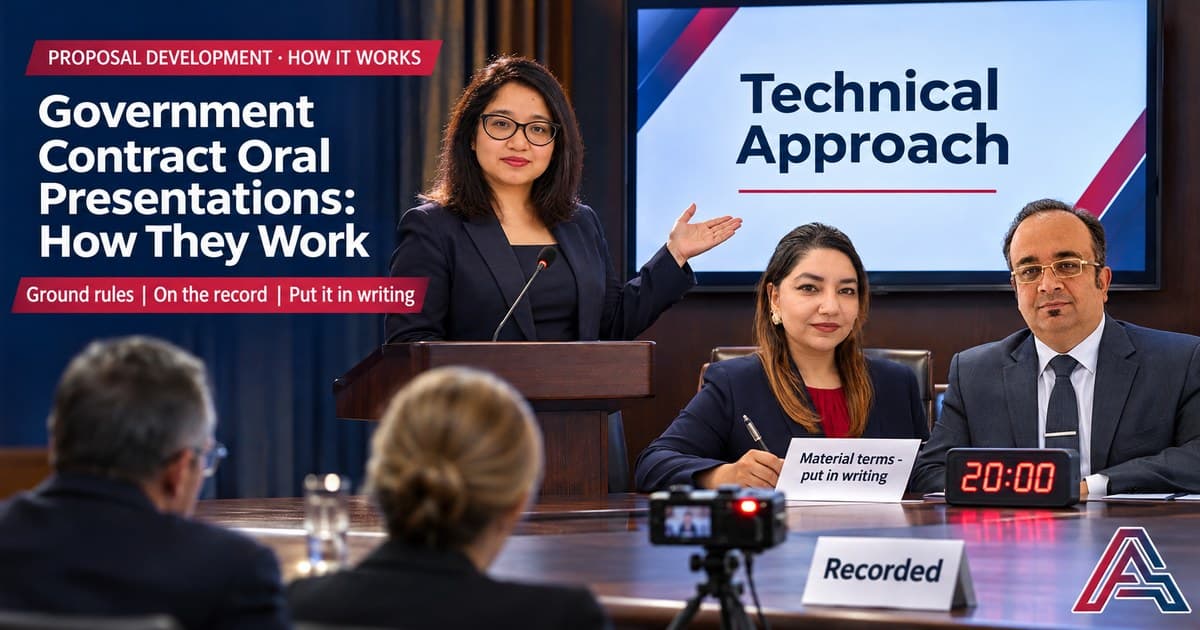
Government contract oral presentations are a live session where you present part of your bid to the evaluators instead of writing it. They can replace sections of a written proposal, they are recorded, and the solicitation has to tell you the rules in advance. What you say in that room is evaluated. What you promise in it is not binding unless somebody writes it down.
In short
- An oral presentation "may substitute for, or augment, written information" (FAR 15.102), and is "subject to the same restrictions as written information," regarding timing and content.
- The solicitation must give you enough information to prepare, and may set out what you present, who may present, time limits, media limits, and the scope of exchanges allowed (FAR 15.102(d)).
- It is on the record. The contracting officer "shall maintain a record of oral presentations" (FAR 15.102).
- Saying it does not make it a contract term. Anything meant to become a material term "shall be put in writing" (FAR 15.102).
- Our advice: read the ground rules before you build a single slide. They decide the format, and the format decides the content.
What an oral presentation is
It is a live, interactive session in which offerors present information that would otherwise be written, to the people evaluating the bid.
FAR 15.102 gives agencies the option. Oral presentations "may substitute for, or augment, written information," and the FAR frames them as a way to streamline source selection. But they are not a looser medium. The same section is clear that they are "subject to the same restrictions as written information," regarding timing and content.
Some things still have to be on paper regardless. Representations and certifications are submitted as required, and a signed offer sheet is submitted in writing. The presentation replaces part of the proposal, not the paperwork that makes an offer an offer.
One definitional point that catches people out. A video you record in advance is not an oral presentation. FAR 15.102(a): "Pre-recorded videotaped presentations that lack real-time interactive dialogue are not considered oral presentations for the purposes of this section, although they may be included in offeror submissions, when appropriate." The live, two-way part is the point.
A rewrite is under way, and orals survive it
The FAR is being rewritten under the Revolutionary FAR Overhaul, and the overhauled Part 15 keeps oral presentations. At 15.105-1 it provides that they "may be used as a substitute for requesting portions of a written proposal information from offerors."
The record-keeping duty survives too. At 15.202(a)(3), contracting officers "must maintain a record of oral presentations to document what the Government relied upon in making the source selection decision."
The overhaul text also keeps a rule that the current FAR 15.102(f) already contains: "Incorporation by reference of oral statements is not permitted." It adds that material terms "must be put in writing and incorporated in the proposal and any resultant contract."
In other words, you cannot write "as described in our oral presentation" in your proposal and expect it to count. Our advice: do not assume which version governs your buy. Read the solicitation, which names the rules and any deviations the agency is using.
How government contract oral presentations work, step by step

How an oral presentation works: ground rules, the room, the record, and what must be written down
-
The solicitation tells you the rules first. FAR 15.102(d) requires it to give you enough information to prepare, and lists six things it may describe:
- the types of information to be presented orally, and the associated evaluation factors;
- the qualifications required of the personnel who present;
- any limits on written material and media;
- the location, date and time;
- the time restrictions for each presentation;
- the scope of exchanges permitted between the government and offerors.
-
It replaces part of your written proposal. Whatever the solicitation assigns to the oral session comes out of the document and goes into the room. The rest of the proposal still gets written and submitted.
-
You present, and it is recorded. The contracting officer "shall maintain a record of oral presentations." The method is at the source selection authority's discretion, and can include videotaping, audio recording or written notes.
-
Material terms go in writing. FAR 15.102: "When an oral presentation includes information that the parties intend to include in the contract as material terms or conditions, the information shall be put in writing." A commitment made out loud and never written down is not a term of the contract.
-
If they negotiate, the rules change. FAR 15.102(g): "If, during an oral presentation, the Government conducts discussions (see 15.306(d)), the Government must comply with 15.306 and 15.307."
A presentation is not automatically discussions, and the difference is worth understanding. FAR 15.306(d) defines discussions as exchanges between the government and offerors "undertaken with the intent of allowing the offeror to revise its proposal." They happen after the competitive range is set. The contracting officer must then raise deficiencies, significant weaknesses and adverse past performance information with each offeror still in contention.
Two lighter forms of exchange sit below that. Clarifications are limited exchanges where award will be made without discussions. Communications happen before the competitive range is established and do not allow you to revise your proposal.
What this means for your business
Everything useful here comes from the fact that the ground rules are published before you prepare. Read them as a specification.
| What the solicitation may state (FAR 15.102(d)) | What you do with it |
|---|---|
| What is presented orally, and the evaluation factors | Build the session against the factors, not against your usual pitch |
| Qualifications required of presenters | Check whether named key personnel must present in person |
| Limits on written material and media | Find out whether slides are allowed at all, and how many |
| Location, date and time | Plan travel and setup; a missed slot is a missed bid |
| Time restrictions for each presentation | Rehearse to the clock, because they will hold you to it |
| Scope of exchanges permitted | Know whether questions are allowed, and how far they can go |
Three things we would focus on:
- Send the people who will do the work. Where the solicitation sets qualifications for presenters, it usually wants the actual team, not the business development lead. Evaluators are assessing whether these people can perform.
- Rehearse against the clock, out loud. The time limit is published and enforced. A presentation that runs long gets cut off at the point it was about to make its best argument.
- Write down anything you commit to. If you offer something in the room that you want in the contract, get it into writing. The FAR requires it, and FAR 15.102(f) bars incorporation by reference of oral statements.
Three mistakes we see often:
- Treating it as a sales pitch. It is an evaluated part of the proposal, graded against published factors. Our guide to proposal mistakes applies in the room as much as on the page.
- Ignoring the media limits. Some solicitations cap slide counts, ban handouts, or require presentation files in advance. Breaking that rule is an easy way to be found non-compliant.
- Assuming the room is off the record. It is recorded, and the record documents what the government relied on in making its decision.
What to do this week
- Search your tracked solicitations for an oral presentation requirement. If one has it, that changes your bid plan immediately.
- Pull the FAR 15.102(d) list out of the solicitation into a one-page brief: who presents, how long, what media, what is evaluated.
- Decide who presents, and check they qualify. If key personnel must present, that constrains your teaming. Our teaming guide covers getting that agreed early.
- Rehearse to the published time limit, with the actual presenters, not a rehearsal cast.
- Keep a written note of every commitment you intend to make, and make sure it lands in the written proposal. If you are earlier than all this, start with our guide to getting started in government contracting and our capture management guide.
Sources (4)
- FAR 15.102, Oral presentations — https://www.acquisition.gov/far/15.102 (FAC 2026-01, effective March 13, 2026; accessed November 12, 2026)
- FAR 15.306, Exchanges with offerors after receipt of proposals — https://www.acquisition.gov/far/15.306 (FAC 2026-01; accessed November 13, 2026)
- Revolutionary FAR Overhaul, FAR part deviation guide — https://www.acquisition.gov/far-overhaul/far-part-deviation-guide (Part 15 issuance date September 30, 2025; accessed November 12, 2026)
- Revolutionary FAR Overhaul, overhauled Part 15 text — https://www.acquisition.gov/far-overhaul/far-part-deviation-guide/far-overhaul-part-15 (accessed November 12, 2026)
Want help putting this to work for your business? Book a free consultation with Aliff Solutions: https://aliffsolutions.com
This article explains general rules as of November 2026. It is not legal advice, and rules change. Always check the current solicitation and the official sources linked above. We don't guarantee contract awards.
Frequently Asked Questions
- What is an oral presentation in a federal procurement?
- A live session where offerors present information to the evaluation team instead of submitting it in writing. FAR 15.102 provides that oral presentations "may substitute for, or augment, written information," while remaining "subject to the same restrictions as written information," regarding timing and content.
- Can an oral presentation replace my whole written proposal?
- No. It replaces the portions the solicitation assigns to it. Representations and certifications are still submitted as required, and a signed offer sheet is still submitted in writing. The overhauled FAR Part 15 describes orals at 15.105-1 as a substitute for "portions of a written proposal information from offerors."
- Does what I say in the room become part of the contract?
- Only if it is written down. FAR 15.102 states that when an oral presentation includes information the parties intend to include in the contract as material terms or conditions, "the information shall be put in writing." The same paragraph adds that "incorporation by reference of oral statements is not permitted."
- Is the presentation recorded?
- Yes. The contracting officer "shall maintain a record of oral presentations." The method is at the source selection authority's discretion and may include videotaping, audio recording or written notes. The overhaul text explains the purpose: to document what the government relied upon in making the source selection decision.
- Is an oral presentation the same as discussions?
- Not automatically, and the distinction matters. FAR 15.102(g) provides that "if, during an oral presentation, the Government conducts discussions (see 15.306(d)), the Government must comply with 15.306 and 15.307." So a presentation can turn into discussions, which brings its own rules.
- Can I submit a pre-recorded video instead?
- Not as an oral presentation. FAR 15.102(a) is explicit that "pre-recorded videotaped presentations that lack real-time interactive dialogue are not considered oral presentations for the purposes of this section, although they may be included in offeror submissions, when appropriate." The live exchange is the point.
Get More GovCon Insights
Subscribe to our weekly newsletter for actionable intelligence on winning government contracts.
Written by
Sumera Khan
Co-Founder and VP, Client Relationships, Aliff Solutions
Aliff Solutions provides quantitative intelligence for government contractors. Our team combines decades of federal contracting experience with advanced analytics to help you win more contracts.