Security Clearances for Contractors: How They Work
A contractor needs two clearances: one for the company and one for each person who touches classified work. Here is how sponsorship works, why you cannot apply for your own facility clearance, and what the company has to have in place.
On this page
Security clearances for contractors come in two kinds, and you need both. The company holds one. Each person who touches classified information holds another. The part that stops most small businesses before they start is that you cannot apply for your company's clearance yourself. Someone has to sponsor you.
In short
- Two clearances, not one. An entity eligibility determination for the company, often called a facility clearance, and an individual determination for each employee.
- You cannot self-apply. "A contractor or prospective contractor cannot apply for its own entity eligibility determination" (32 CFR 117.9(a)(10)).
- A sponsor can be a government customer or a cleared contractor, and sponsorship can happen as early as the solicitation phase.
- An employee needs three things: a need-to-know, a favorable determination at the right level, and a signed non-disclosure agreement (32 CFR 117.10).
- Our advice: stop trying to get cleared first. Get into a position where a sponsor needs you cleared.
What a security clearance for contractors is
It is permission, granted by the government, for access to classified information. The rules sit in the National Industrial Security Program.
FAR 4.402 explains the framework: Executive Order 12829 of January 6, 1993 established the program to protect classified government information released to contractors, and the National Industrial Security Program Operating Manual carries the detail. That manual is now a regulation, at 32 CFR part 117.
The company-level clearance is formally an entity eligibility determination, and the regulation notes it is "also referred to in some instances as an FCL" — a facility clearance. Until it exists, nothing happens: "Neither the contractor nor its employees will be permitted access to classified information until the CSA has made an entity eligibility determination" (32 CFR 117.9(a)(4)).
The person-level clearance is a separate determination for each employee. Both are needed. A cleared company with uncleared staff cannot do classified work, and a cleared individual at an uncleared company cannot either.
One more distinction that catches people out. Being allowed to access classified information is not the same as being allowed to store it. The regulation separates the two: "The determination of entity eligibility for access is separate from the determination of a classified information safeguarding capability."
Both kinds can be granted on a temporary basis
Waiting for a full investigation is not always the only option. At company level, 32 CFR 117.9(h) allows the Cognizant Security Agency to make an interim entity eligibility determination "in the sole discretion of the CSA," on a temporary basis "pending completion of the full investigative requirements."
At person level, 32 CFR 117.10(l) allows temporary eligibility for Top Secret, Secret and Confidential access, but "only be granted if there is no evidence of adverse information that calls into question an individual's eligibility." It is capped: "a temporary eligibility determination shall not exceed one year unless approved by the applicable CSA in the system of record." And it is closed to one group: "Non-U.S. citizens are not eligible for access to classified information on a temporary basis."
Neither is something you can demand. Both are decisions the government makes.
How security clearances for contractors work, step by step

How contractor security clearances work: requirement, sponsor, company eligibility, employee access and foreign ownership review
-
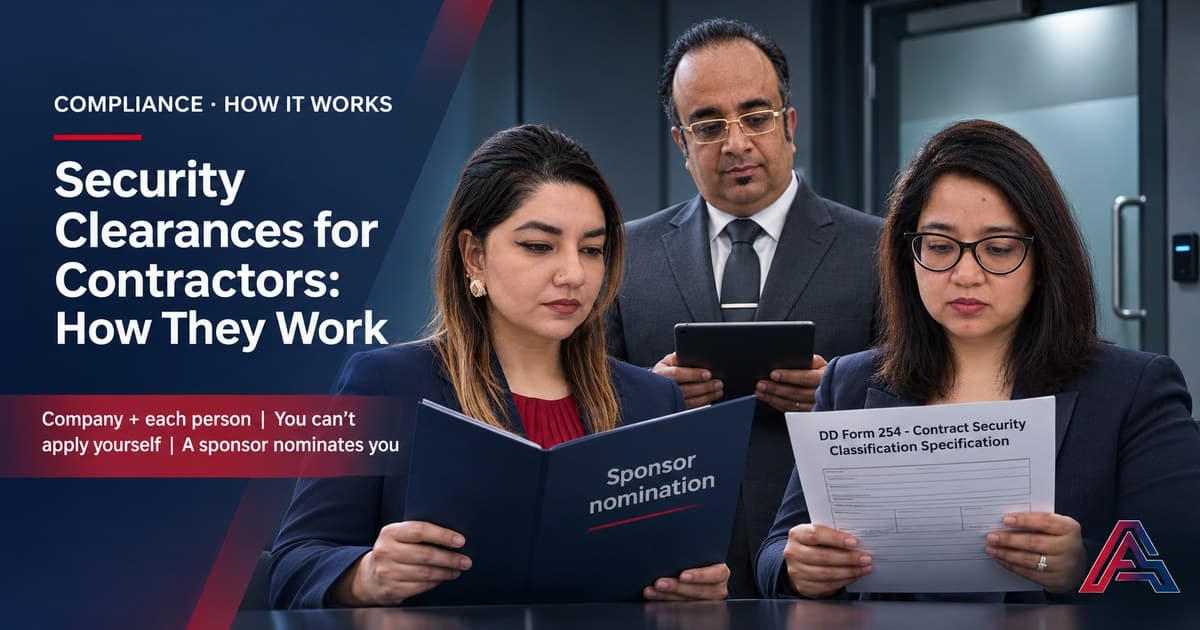
A classified requirement exists, and it is written down. Security classification guidance travels on the Contract Security Classification Specification, the DD Form 254. FAR 4.402 requires DoD components, and non-defense agencies with industrial security services agreements with DoD, to use it. Each contractor and subcontractor location needing classified access is identified on it by CAGE code.
-
Someone sponsors your company. This is the gate. Under 32 CFR 117.9(a)(10), a contractor "cannot apply for its own entity eligibility determination." A government contracting activity or "a currently cleared contractor may sponsor an entity… at any point during the contracting or agreement life cycle at which the entity must have access to classified information to participate (including the solicitation or competition phase)."
-
Your company has to qualify. Under 32 CFR 117.9(c), the entity must need access for a legitimate government requirement. It must be organized and existing under the laws of the United States, a state, the District of Columbia or an organized US territory — or of a formally acknowledged American Indian or Alaska Native tribal entity. It must "be located in the United States or its territorial areas" and have "a record of integrity and lawful conduct in its business dealings." And it needs three named officers — a senior management official, a facility security officer and an insider threat program senior official — who hold and maintain their own eligibility.
-
Each employee is cleared separately. A contractor may give an employee access at the same or lower level than the company's own determination. But that employee must have a valid need-to-know, a favorable government eligibility determination at the appropriate level, and must have "signed a non-disclosure agreement" (32 CFR 117.10(a)(1)(iii)). If the person is already cleared or in process through another agency, you do not start again: 32 CFR 117.10(a)(6) bars submitting a second request in that situation.
-
Foreign ownership gets examined. The regulation treats foreign investment as legitimate — "foreign investment can play an important role in maintaining the vitality of the U.S. industrial base" — while assessing whether a foreign interest could direct or decide issues affecting the company in ways that risk unauthorized access or harm contract performance (32 CFR 117.11).
What this means for your business
The two clearances answer different questions and are obtained in different ways.
| Company (entity eligibility / FCL) | Employee (personnel determination) | |
|---|---|---|
| Who holds it | The legal entity | The individual |
| How you start it | A sponsor nominates you — you cannot self-apply | The cleared company requests it |
| What it requires | US-organized, US-located, record of integrity, cleared SMO, FSO and ITPSO | Need-to-know, favorable determination, signed NDA |
| What it allows | Access at the same or lower classification level | Access at the same or lower level than the company's |
| A key limit | Cannot be used for advertising or promotion | Cannot be requested to build a "cache of cleared employees" |
Three rules in that table deserve spelling out, because they surprise people.
You cannot advertise it. 32 CFR 117.9(a)(9): "A contractor will not use its favorable entity eligibility determination for advertising or promotional purposes." The same provision does allow you to advertise job openings that require a clearance.
You cannot stockpile cleared staff. Contractors must "limit requests for determinations of eligibility… to the minimum number of employees and consultants necessary for operational efficiency," and such requests "will not be used to establish a cache of cleared employees" (32 CFR 117.10(a)(5)). The balance runs both ways, though: 32 CFR 117.9(c)(7) also requires you to "maintain sufficient authorized and cleared employees to manage and implement the requirements of this rule."
A prime needs a clearance even if only its subs touch the material. The requirement for a favorable determination "includes instances where all access to classified information will be limited to subcontractors." The prime must hold one "at the same or higher classification level as its subcontractors" (32 CFR 117.9(a)(5)).
Three mistakes we see often:
- Trying to get cleared speculatively. There is no route to it. Without a sponsor and a legitimate requirement, there is no application to make.
- Assuming a cleared hire clears the company. Hiring someone who holds a clearance does not give your business one. The determinations are separate.
- Forgetting the named officers. The company needs a senior management official, a facility security officer and an insider threat program senior official who are themselves eligible. In a small firm, that is a real staffing commitment.
What to do this week
- Work out whether your target work is actually classified. Much defense-adjacent work is not. Check before building a plan around clearance. On some large vehicles it is a gate — our Army MAPS guide is one example where a facility clearance is mandatory to qualify.
- Identify who could sponsor you. A government customer, or a cleared prime you could subcontract to. Our teaming guide covers building that relationship.
- Look for the DD Form 254 reference in solicitations you track. Its presence tells you classified access is in scope.
- Decide who your three officers would be. Senior management official, facility security officer, insider threat program senior official — and whether they could hold eligibility.
- Separate this from cybersecurity compliance. They are different regimes, and firms conflate them. Our CMMC readiness guide covers that one. If you are earlier than all this, start with our guide to getting started in government contracting, then our capture management guide.
Sources (4)
- 32 CFR 117.9, Entity eligibility determination for access to classified information — https://www.ecfr.gov/current/title-32/subtitle-A/chapter-I/subchapter-D/part-117 (eCFR, current; accessed November 14, 2026)
- 32 CFR 117.10, Determination of eligibility for access to classified information for contractor employees — same source (accessed November 14, 2026)
- 32 CFR 117.11, Foreign Ownership, Control, or Influence — same source (accessed November 14, 2026)
- FAR 4.402, General (safeguarding classified information within industry) — https://www.acquisition.gov/far/4.402 (FAC 2026-01, effective March 13, 2026; accessed November 14, 2026)
Want help putting this to work for your business? Book a free consultation with Aliff Solutions: https://aliffsolutions.com
This article explains general rules as of November 2026. It is not legal advice, and rules change. Always check the current solicitation and the official sources linked above. We don't guarantee contract awards.
Frequently Asked Questions
- What is a facility clearance?
- Formally an entity eligibility determination. It is the government's decision that a company is eligible for access to classified information. 32 CFR 117.9(a)(4) is blunt about its effect: "Neither the contractor nor its employees will be permitted access to classified information until the CSA has made an entity eligibility determination (e.g., issued an FCL)."
- Can my company apply for its own security clearance?
- No. 32 CFR 117.9(a)(10) states that "a contractor or prospective contractor cannot apply for its own entity eligibility determination." A government contracting activity or a currently cleared contractor must sponsor you, and may do so "at any point during the contracting or agreement life cycle," including during the solicitation or competition phase.
- What does an employee need before accessing classified information?
- Three things, under 32 CFR 117.10(a)(1)(iii): a valid need-to-know for the information, a favorable government eligibility determination at the appropriate level, and a signed non-disclosure agreement. Access is limited to the same or lower level than the company's own determination.
- Can we advertise that our company is cleared?
- No. 32 CFR 117.9(a)(9) provides that "a contractor will not use its favorable entity eligibility determination for advertising or promotional purposes." You may still advertise employee positions that require a personnel clearance in connection with the role.
- Can we get staff cleared in advance so we are ready to bid?
- No. The rule requires contractors to limit requests to "the minimum number of employees and consultants necessary for operational efficiency," and says such requests "will not be used to establish a cache of cleared employees" (32 CFR 117.10(a)(5)).
- What is FOCI?
- Foreign Ownership, Control, or Influence. 32 CFR 117.11 treats foreign investment as legitimate in principle, while assessing whether a foreign interest has the power to direct or decide issues affecting a company's management or operations in ways that could result in unauthorized access to classified information or adversely affect classified contract performance.
Get More GovCon Insights
Subscribe to our weekly newsletter for actionable intelligence on winning government contracts.
Written by
Sana Rehman
Co-Founder and VP, Resources, Aliff Solutions
Aliff Solutions provides quantitative intelligence for government contractors. Our team combines decades of federal contracting experience with advanced analytics to help you win more contracts.