Recompetes: The Most Predictable Contracts in GovCon
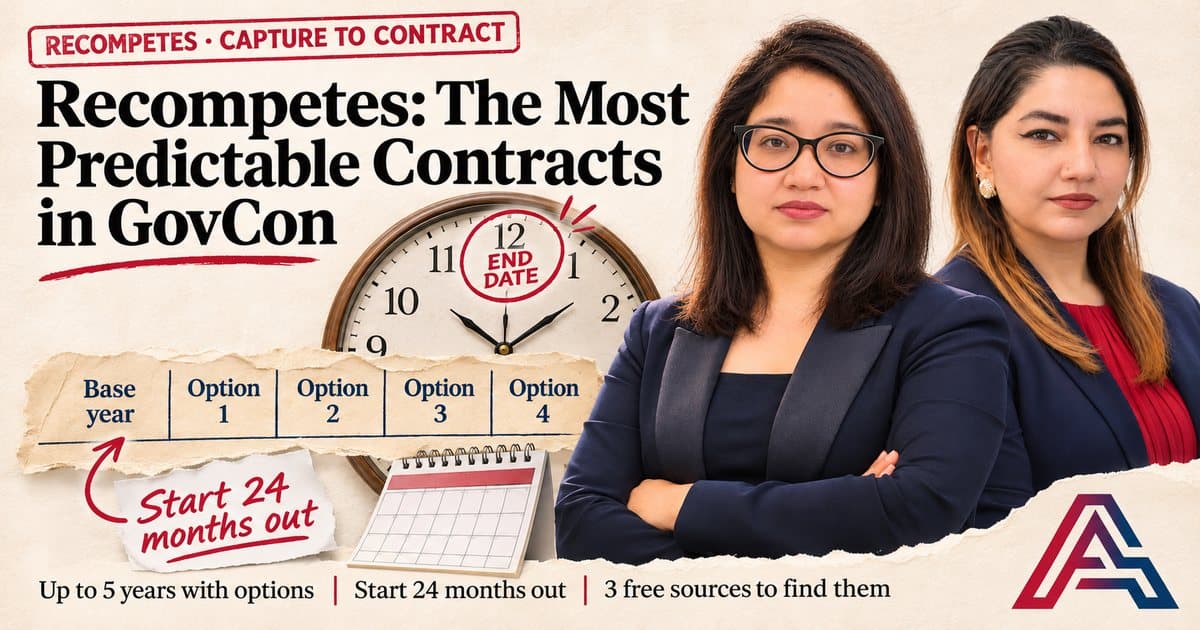
Most federal contracts end on a date anyone can look up. Here is how recompetes work, when to start, where to find them for free, and how to decide whether to challenge, team or subcontract.
On this page
Most federal contracts end on a date anyone can look up.
That makes recompetes the most predictable opportunities in government contracting. The work already exists, the agency already pays for it, and the end date is on the public record. Yet many small businesses first hear about a recompete when the request for proposals (RFP) appears on SAM.gov. By then, the agency has usually spent many months planning the buy, and the incumbent has spent years doing the work.
This lesson shows you how recompetes work, when to start, where to find them for free, and how to decide whether to challenge, team or subcontract.
What a recompete is, and why it happens
A recompete is the new competition an agency runs for work a contractor is already doing. It usually happens when the current contract's base period and option years run out.
You won't find the word "recompete" in the Federal Acquisition Regulation (FAR). The official term is a "follow-on" requirement. The Small Business Administration (SBA) treats a requirement as a follow-on when its scope and end user stay broadly the same and its value hasn't changed by 25% or more for the same period (13 CFR 124.3).
Recompetes come round on a clock because contract length is capped. For services, the base period plus options "shall not exceed 5 years" unless the agency approves a longer term under its own procedures (FAR 17.204(e)). Information technology contracts are exempt from that limit.
A common shape is one base year plus up to four one-year options. The agency decides each year whether to exercise the next option. When the last one ends, the work has to be competed again, unless the agency has a legal reason to award it without competition.
If the new contract isn't ready in time, the agency has two stopgaps:
- A short extension. The FAR's "Option to Extend Services" clause lets the agency keep the work going, but "the total extension of performance... shall not exceed 6 months" (FAR 52.217-8).
- A bridge contract. This is a short, often sole-source contract to the incumbent so the service doesn't stop. The Government Accountability Office (GAO) found that planning delays, an overstretched contracting workforce, bid protests and budget uncertainty were common causes. Some "short" bridges ran past three years (GAO-16-15, October 2015).
The 24-month timeline: what the agency does, and what you should do
The agency starts work on a recompete long before the RFP. The FAR says acquisition planning "should begin as soon as the agency need is identified" (FAR 7.104(a)). For work that already exists, the need is identified the day the current contract is signed.
The timeline below shows a common pattern, counting back from the day the current contract ends. The month bands are our advice based on common practice, not a rule; every agency and contract moves at its own pace.

A recompete runs on a clock you can read
24 to 18 months out. The agency reviews how the contract is going and starts planning the next one. You: find the contract, study the incumbent's award history and check the agency's forecast.
18 to 12 months out. The agency does market research: requests for information (RFIs), sources-sought notices, industry days and one-on-one meetings. You: answer every sources-sought notice, meet the program office and the agency's small business office, and decide whether to bid alone or team.
12 to 6 months out. The agency writes the requirement, chooses the contract type and decides whether to set the work aside for small businesses. You: comment on any draft RFP, line up partners and build your pricing.
6 months to the end date. The RFP is posted on SAM.gov, proposals are evaluated and the award is made. You: write a compliant proposal and plan how you would take over the work.
After the end date. If the agency is late, expect an extension of up to six months or a bridge contract. You: watch for bridge notices and stay in touch; a delayed recompete is still coming.
Early conversations are allowed. The White House Office of Federal Procurement Policy has said officials can generally meet one-on-one with potential bidders before an RFP, as long as no company gets preferential treatment. It has also said the pre-RFP phase is when industry has the most influence on the requirement (OFPP "Myth-Busting" memos, 2011 and 2012).
How often the incumbent keeps the work
The incumbent wins often, but not always. There is no official government figure, and published studies disagree.
| Study | What it found | What it covered |
|---|---|---|
| Grant Thornton contractor survey (via Federal News Network) | Incumbents won 54% of recompetes in government fiscal year 2016, down from 75% in 2015 | Contractors' own reports |
| National Contract Management Association review (via Washington Technology) | 49% at civilian agencies and 65% at defense agencies in 2013 | Contracts over $100 million |
| Federal Times analysis, 2017 (source) | Incumbents won 63%, or 52% when competitions with only one bid were left out | Contracts over $50 million |
So across these studies, incumbents kept the work roughly half to three quarters of the time. That leaves a real opening for a prepared challenger, but rarely for one who starts at the RFP.
Note the second figure in the Federal Times row. Part of the incumbent's advantage came from competitions where no one else bid. Simply showing up with a credible bid takes that advantage away.
Find upcoming recompetes yourself, for free
You don't need a paid database to start. Three free government sources show which contracts are ending and who holds them.
- SAM.gov contract awards. The old FPDS.gov search closed on 24 February 2026, and "all of the data that was previously available in FPDS.gov is now available in SAM.gov" (GSA). You need a free SAM.gov account to search it. Look for the contract's estimated completion date.
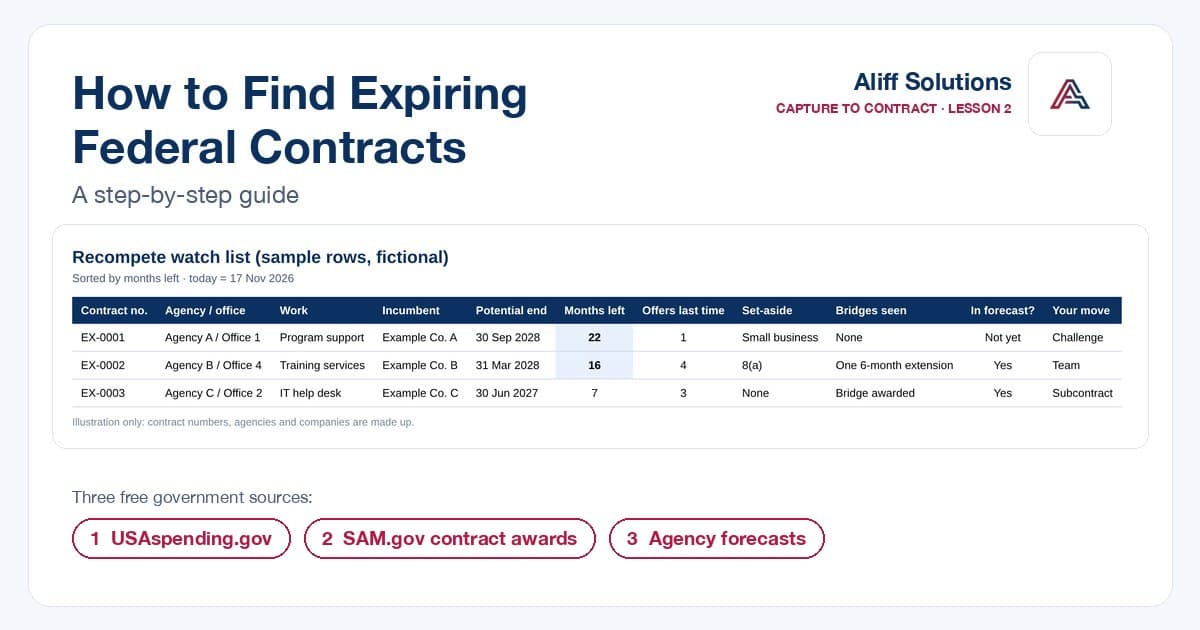
- USAspending.gov. No login is needed. Each contract shows a "current end date" and a "potential end date", which includes options not yet exercised. Search by your industry (NAICS) code, download the results and sort them by end date, keeping those 12 to 24 months away. (The site's date filter is the spending date, not the end date.)
- GSA's Forecast of Contracting Opportunities. Agencies are directed to publish their planned buys in this public tool, with no login required (GSA). Many entries say whether a buy is new or a recompete and name the incumbent. Some agencies, such as the Department of Homeland Security, also keep their own forecast.
Then watch SAM.gov notices for sources-sought notices, RFIs, industry days and notices of bridge or sole-source awards on the contracts you track.
For a step-by-step walkthrough with screenshots, see How to Find Expiring Federal Contracts.
Read the incumbent before you decide
Public award records hold warning signs about an incumbent's position. None of them proves the incumbent is weak, but together they show where to look harder. (This list is our advice.)
- Only one offer last time. The incumbent may have won without a real fight.
- Extensions and bridges. Repeated six-month extensions or a bridge contract can mean the agency is struggling to replace or re-scope the work.
- Many corrective changes. A long list of modifications to fix scope, price or schedule can point to friction.
- A company that has outgrown "small". On contracts longer than five years, the contractor must re-state its size 60 to 120 days before the end of year five and before each later option (FAR 52.219-28). An incumbent that is no longer small can't bid a small business set-aside follow-on as the prime.
Performance ratings (CPARS) are not public, so don't claim to know how the agency rates the incumbent.
Some rules decide who can bid at all:
- 8(a) work tends to stay 8(a). Once SBA accepts a requirement into its 8(a) program, follow-on requirements "shall remain in the 8(a) program" unless SBA agrees to release them (FAR 19.815).
- Union wages carry over. On many service contracts, a new contractor must pay wages and benefits at least equal to those in the incumbent's union agreement (FAR 22.1008-2). You can't win on lower wages there; your price advantage has to come from somewhere else.
- The incumbent's staff are no longer guaranteed a job offer. The executive order that required new service contractors to offer jobs to the outgoing contractor's workers was revoked in January 2025. The Labor Department removed its rules on 22 December 2025 (90 FR 59734). Older contracts may still carry the clause, so read yours.
Your three moves
Once you've found a recompete and read the incumbent, you have three ways in. (Our advice.)
| Move | When it fits | What it takes |
|---|---|---|
| Challenge as the prime | You can do the whole job, you meet the set-aside rules, and you've seen signs the incumbent is exposed | 12 to 24 months of agency contact, a clear reason to switch, and past performance the agency will trust |
| Team with a challenger | A bigger firm is going after the work and needs your certification, location or skill | Reach out early, before teams are formed, with a short note on what you bring |
| Subcontract to the incumbent | The incumbent is likely to win, or the contract is too big for you | Offer a capability the incumbent lacks; this builds past performance for the next round |
All three start the same way: knowing the end date early. A subcontract today can make you the prime at the next recompete five years from now.
How Aliff helps
Aliff Solutions tracks contract end dates, options and bridge extensions for the agencies and industries our clients work in. We start recompete capture up to 24 months before a contract ends, and our team works with yours on the bid/no-bid call, the agency conversations and the proposal. A person on our team makes every recommendation.
One client went from no federal contracts to 30 Defense Department contracts and orders and 5 multi-year contract vehicles within two years. Results vary.
Do this week
- Search USAspending for contracts in your NAICS code that end 12 to 24 months from now. Write down five.
- For each one, note the agency, the incumbent, the number of offers last time and any extensions.
- Check the GSA forecast tool for those agencies, and set SAM.gov alerts for sources-sought notices in your codes.
Next week, Lesson 3: Pick your lane: NAICS codes, size standards and set-asides.
Want help choosing which recompetes are worth chasing? Book a free consultation with our team.
This lesson is general information, not legal advice. Rules change, and the FAR is being rewritten; check the current text before you rely on it. Facts as of 17 November 2026.
Sources (0)
- FAR 17.204, contracts with options
- FAR 52.217-8, Option to Extend Services
- FAR 7.104, acquisition planning
- FAR 19.815, 8(a) follow-on requirements
- FAR 22.1008-2, successor contractors and union agreements
- FAR 52.219-28, size rerepresentation
- 13 CFR 124.3, follow-on definition
- GAO-16-15, bridge contracts (October 2015)
- OFPP Myth-Busting 2 (May 2012)
- SAM.gov, FPDS transition
- GSA Forecast of Contracting Opportunities
- Department of Labor, nondisplacement rescission, 90 FR 59734 (22 Dec 2025)
- Incumbent studies: Federal News Network, Washington Technology, Federal Times
Frequently Asked Questions
- What is a federal recompete?
- A recompete is the new competition an agency runs for work a contractor is already doing. It usually happens when the current contract's base period and option years run out. The Federal Acquisition Regulation calls it a "follow-on" requirement.
- How long can a federal service contract run with options?
- Under FAR 17.204(e), the base period plus options for services "shall not exceed 5 years" unless the agency approves a longer term under its own procedures. Information technology contracts are exempt from that limit. A common shape is one base year plus up to four one-year options.
- What is a bridge contract?
- A short, often sole-source contract to the incumbent so the service doesn't stop when the new contract isn't ready in time. GAO found that some "short" bridges ran past three years (GAO-16-15, October 2015).
- How often do incumbents win recompetes?
- There is no official government figure, and published studies disagree. Across the studies in this lesson, incumbents kept the work roughly half to three quarters of the time.
- Where can I find contracts that are ending?
- Three free government sources: SAM.gov contract awards (free account needed), USAspending.gov (no login) and GSA's Forecast of Contracting Opportunities.
Get More GovCon Insights
Subscribe to our weekly newsletter for actionable intelligence on winning government contracts.
Written by
Haroon Haider
CEO, Aliff Solutions
Aliff Solutions provides quantitative intelligence for government contractors. Our team combines decades of federal contracting experience with advanced analytics to help you win more contracts.