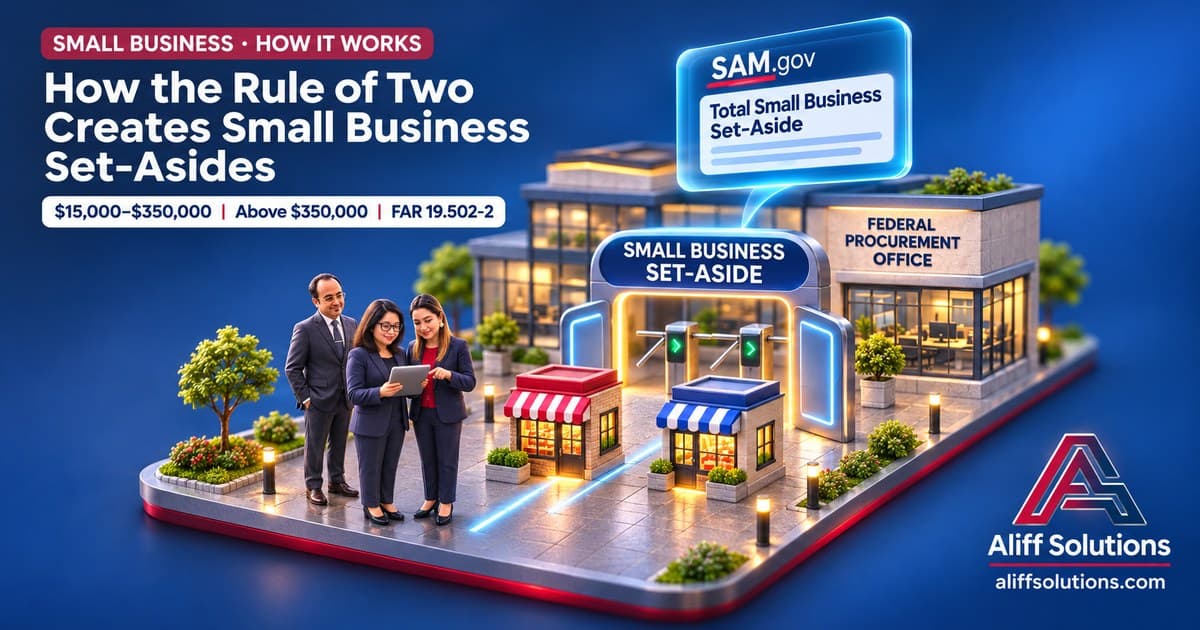
How the Rule of Two Creates Small Business Set-Asides
The rule of two is the federal test that turns an ordinary contract into a small business set-aside. Here is how it works below and above $350,000, and how to get counted as one of the two.
On this page
The rule of two is the federal rule that turns an ordinary contract into a small business set-aside. If a contracting officer expects offers from two or more capable small businesses at fair prices, the work is reserved for them. That one test is why so many SAM.gov notices say "Total Small Business Set-Aside", and you can help trigger it.
In short
- Above $15,000 and up to $350,000: the buy is set aside for small business by default. The contracting officer has to find that two competitive small business offers are not expected (FAR 19.502-2(a)).
- Above $350,000: the contracting officer must set the work aside when at least two responsible small business offers are expected at fair market prices (FAR 19.502-2(b)).
- Above $350,000, the programs come first: the 8(a), HUBZone, SDVOSB and WOSB programs are considered before a general small business set-aside (FAR 19.203(c)).
- Market research decides it. The Small Business Administration (SBA) tells contracting officers they must use its Small Business Search during market research.
- Our advice: answer sources sought notices. Keep your SAM.gov registration and SBA profile current, so a buyer can count you as one of the two.
What the rule of two is
The rule lives in the Federal Acquisition Regulation (FAR), the rulebook for federal buying. You will find it at FAR 19.502-2. You will not find the words "rule of two" there. Buyers and contractors use the nickname; the regulation just describes the test.
The test has two halves. The dividing line is the simplified acquisition threshold (SAT). On October 1, 2025 the micro-purchase threshold rose to $15,000 and the SAT rose to $350,000.
Below the SAT, a set-aside is the default. FAR 19.502-2(a) says each acquisition above the micro-purchase threshold but not over the SAT "shall be set aside for small business unless the contracting officer determines there is not a reasonable expectation" of two or more responsible small business offers. Those offers must be "competitive in terms of fair market prices, quality, and delivery."
Above the SAT, the direction flips. Under FAR 19.502-2(b) the contracting officer "shall set aside" the acquisition when two things are reasonably expected. Offers will come from at least two responsible small business concerns. And award will be made at fair market prices.
"Responsible" is not an opinion. FAR 9.104-1 lists what a contractor must have:
- adequate financial resources, or the ability to get them;
- the ability to meet the delivery or performance schedule;
- a satisfactory performance record;
- a satisfactory record of integrity and business ethics;
- the necessary organization, experience, controls and technical skills;
- the necessary production, construction and technical equipment and facilities;
- eligibility to receive an award under applicable law.
In plain words: two small firms that could actually do the job, on time, at a sensible price. If that sounds like a low bar, it often is. Our complete guide to federal set-asides covers what happens once you are inside one.
A rewrite is under way, so read the solicitation
The FAR is being rewritten under the Revolutionary FAR Overhaul. On acquisition.gov, the overhauled Part 19 text shows an issuance date of September 26, 2025 and an update dated February 20, 2026. In that version the rule sits at 19.104-1(a), in a single form:
"For contracts above the micro-purchase threshold, the contracting officer must set the contract aside for small business if there is a reasonable expectation of obtaining offers—(1) From two or more responsible small business concerns; and (2) That are competitive in terms of fair market prices, quality, and delivery."
That wording drops the separate above-the-SAT paragraph. One test covers everything above the micro-purchase threshold. The official FAR text quoted earlier was current on acquisition.gov as FAC 2026-01 when this article was written. For the wider picture, see our guide to the 2026 FAR overhaul.
Our advice: do not assume. Read the solicitation in front of you. It names the rules and any deviations the agency is using for that buy.
How the rule of two small business set-aside test works, step by step

Be one of the two: how the rule of two works
-
The agency puts a number on the need. Someone inside the agency needs janitorial services, laptops or engineering support. The contracting shop estimates what it will cost. That estimate decides which half of the rule applies.
-
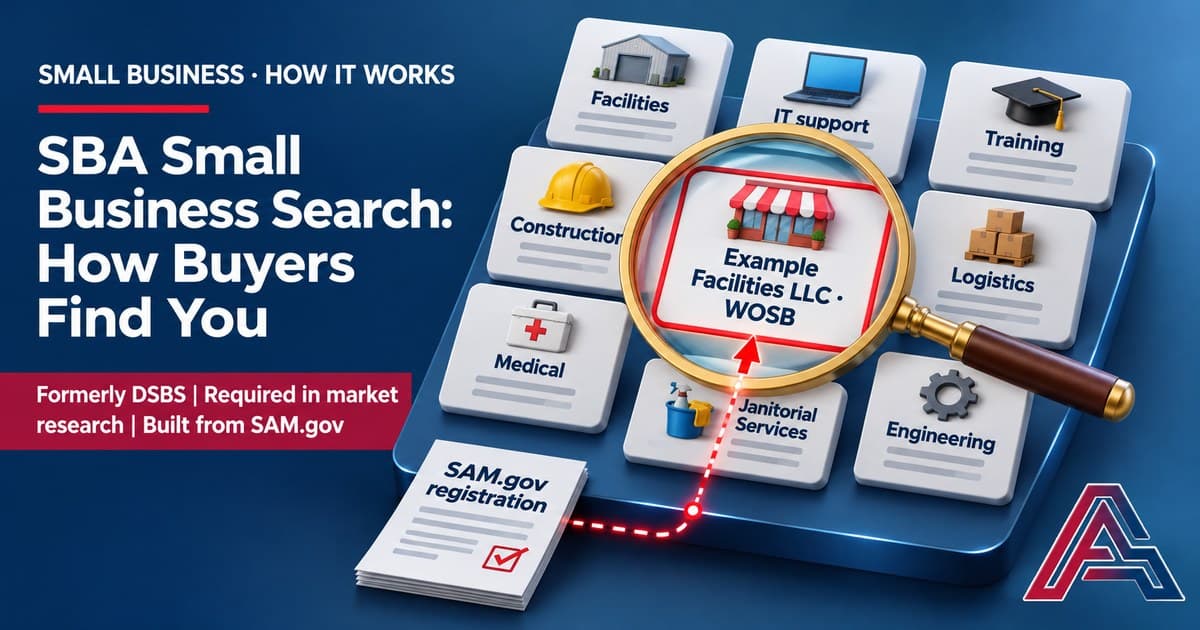
The agency does market research. FAR 10.002(b)(2) lists the techniques. One of them is "Reviewing systems such as the System for Award Management, the Federal Procurement Data System, and the Small Business Administration's Dynamic Small Business Search." SBA now calls that database the Small Business Search. It tells contracting officers plainly: "You're required to use the Small Business Search (SBS, formerly the Dynamic Small Business Search) as a part of your market research." Agencies also publish sources sought notices to see who answers. Market research is stage 2 of the five stages of the federal procurement process, and it is the stage where you can still shape the buy.
-
The contracting officer applies the test. Up to $350,000, they must set it aside unless two competitive small business offers are not expected. Above $350,000, they must set it aside when two are expected at fair market prices. There is also an order of precedence above $350,000. FAR 19.203(c) says the socioeconomic programs are considered first. Our guide to 8(a), HUBZone, SDVOSB and WOSB explains how each one qualifies you.
-
The notice goes up on SAM.gov. Proposed contract actions expected to exceed $25,000 are synopsized in the governmentwide point of entry, which is SAM.gov (FAR 5.101(a)(1)). When there is a set-aside, "the contracting officer shall identify the type of set-aside in the synopsis and in the solicitation" (FAR 5.207(d)). The notice must be published at least 15 days before the solicitation, with a shorter period allowed for commercial buys (FAR 5.203(a)). For non-commercial buys above the SAT, agencies allow at least 30 days to respond (FAR 5.203(c)).
-
If the small businesses do not show up, the set-aside can go away. FAR 19.502-2(a) is blunt. Only one acceptable offer from a responsible small business? The contracting officer should award to that firm. None at all? Then "the set-aside shall be withdrawn and the requirement, if still valid, shall be resolicited on an unrestricted basis."
What this means for your business
Say an agency needs a $200,000 janitorial contract at a regional office. That number is hypothetical, used here to show the mechanics. It sits above $15,000 and below $350,000, so a set-aside is the default. To open the work to everyone, the contracting officer has to find that two competitive small business offers are not expected. If two capable janitorial firms in that area are registered and visible, that finding gets hard to make.
Now say the same agency needs $2 million of IT support. That is above $350,000, so two things happen. First, the socioeconomic programs are considered before a general small business set-aside (FAR 19.203(c)). Second, the set-aside is required when at least two responsible small business offers are expected at fair market prices. The whole question turns on what market research found. Which is to say: on who was visible, and who replied.
| The buy | What the rule says | Where it is |
|---|---|---|
| Above $15,000, up to $350,000 | Set aside for small business unless the contracting officer determines two or more responsible, competitive small business offers are not expected | FAR 19.502-2(a) |
| Above $350,000 | Must be set aside when offers from at least two responsible small businesses are expected and award will be at fair market prices | FAR 19.502-2(b) |
| A total set-aside does not fit | A portion can be set aside if two or more responsible small businesses are expected to offer on that portion, and the other conditions are met | FAR 19.502-3(a) |
Three mistakes we see often:
- Treating sources sought notices as junk mail. They are market research. By the time the solicitation is published, the set-aside decision is usually made.
- Letting your profiles go thin. A lapsed SAM.gov registration hides you. So does an SBA profile with no keywords and no capability text. A contracting officer who cannot find you cannot count you.
- Assuming last time tells you this time. Past acquisition history matters. But FAR 19.502-2(b) says it is not the only factor. Our advice: treat every recompete as a new decision; an unrestricted contract can come back as a set-aside, and the reverse.
What to do this week
- Check that your SAM.gov registration is active. Everything else depends on it. Registration is free at SAM.gov.
- Fill in your SBA profile properly. Add real keywords and capability text at SBA's Small Business Search. It is the database contracting officers are required to use in market research.
- Save a search on SAM.gov Contract Opportunities for your NAICS codes. A free SAM.gov user account "lets you save searches, follow changes to opportunities, and join interested vendor lists."
- Answer one sources sought notice this week. One reply, on time, with a short capability summary. That is how an agency learns you exist before the decision is made. New to this? Start with our guide to getting started in government contracting.
- Read the set-aside field on every notice you track. The synopsis and solicitation must name the set-aside type (FAR 5.207(d)). It tells you who you are really competing against.
Sources (17)
- FAR 19.502-2, Total small business set-asides — https://www.acquisition.gov/far/19.502-2 (FAC 2026-01, effective March 13, 2026; accessed November 12, 2026)
- FAR 19.203, Relationship among small business programs — https://www.acquisition.gov/far/19.203 (FAC 2026-01; accessed November 12, 2026)
- FAR 19.502-3, Partial set-asides — https://www.acquisition.gov/far/19.502-3 (FAC 2026-01; accessed November 12, 2026)
- FAR 19.504, Orders under multiple-award contracts — https://www.acquisition.gov/far/subpart-19.5 (FAC 2026-01; accessed November 12, 2026)
- FAR 19.1305, HUBZone set-aside procedures — https://www.acquisition.gov/far/19.1305 (FAC 2026-01; accessed November 12, 2026)
- FAR 10.002, Market research procedures — https://www.acquisition.gov/far/10.002 (FAC 2026-01; accessed November 12, 2026)
- FAR 9.104-1, General standards of responsibility — https://www.acquisition.gov/far/9.104-1 (FAC 2026-01; accessed November 12, 2026)
- FAR 8.404, Use of Federal Supply Schedules — https://www.acquisition.gov/far/8.404 (FAC 2026-01; accessed November 12, 2026)
- FAR 5.101, Methods of disseminating information — https://www.acquisition.gov/far/5.101 (FAC 2026-01; accessed November 12, 2026)
- FAR 5.203, Publicizing and response time — https://www.acquisition.gov/far/5.203 (FAC 2026-01; accessed November 12, 2026)
- FAR 5.207, Preparation and transmittal of synopses — https://www.acquisition.gov/far/5.207 (FAC 2026-01; accessed November 12, 2026)
- Threshold changes effective October 1, 2025 — https://www.acquisition.gov/threshold-changes (accessed November 12, 2026)
- Revolutionary FAR Overhaul, FAR part deviation guide — https://www.acquisition.gov/far-overhaul/far-part-deviation-guide (Part 19 issuance date September 26, 2025, update February 20, 2026; accessed November 12, 2026)
- Revolutionary FAR Overhaul, overhauled Part 19 text — https://www.acquisition.gov/far-overhaul/far-part-deviation-guide/far-overhaul-part-19 (accessed November 12, 2026)
- SBA, Guidance for federal contracting officials: small business procurement — https://www.sba.gov/partners/contracting-officials/small-business-procurement (accessed November 12, 2026)
- SBA Small Business Search (formerly the Dynamic Small Business Search) — https://search.certifications.sba.gov (accessed November 12, 2026)
- SAM.gov Contract Opportunities — https://sam.gov/content/opportunities (accessed November 12, 2026)
Want help putting this to work for your business? Book a free consultation with Aliff Solutions: https://aliffsolutions.com
This article explains general rules as of November 2026. It is not legal advice, and rules change. Always check the current solicitation and the official sources linked above. We don't guarantee contract awards.
Frequently Asked Questions
- What does "responsible" mean in the rule of two?
- It is a defined standard, not a view about reputation. FAR 9.104-1 requires adequate financial resources and the ability to meet the schedule. It also requires a satisfactory performance record, and a satisfactory record of integrity and business ethics. The firm needs the right organization, experience, controls, skills, equipment and facilities. Finally, it must be eligible for award under applicable law.
- What happens if only one small business bids?
- FAR 19.502-2(a) covers this for buys in that range. If only one acceptable offer arrives from a responsible small business, the contracting officer should award to that firm. If no acceptable offers arrive from responsible small businesses, the set-aside is withdrawn. The requirement, if still valid, is then resolicited on an unrestricted basis.
- Does the rule of two apply to GSA Schedule orders?
- Generally no. FAR 8.404(a) states that parts 13, 14, 15 and 19 "do not apply to BPAs or orders placed against Federal Supply Schedules contracts." It carves out two narrow requirements, at 19.102(b)(3) and 19.202-1(e)(1)(iii). Schedule buying runs on its own ordering procedures. Do not expect a FAR 19.502-2 analysis on a Schedule order.
- Is the rule of two the same for 8(a), HUBZone, SDVOSB and WOSB?
- The two-offer idea repeats, but each program has its own rule. FAR 19.1305(b), for example, requires a reasonable expectation of offers from two or more HUBZone small businesses, with award at a fair market price. Above $350,000, FAR 19.203(c) puts those programs ahead of a general small business set-aside.
- Does the rule of two apply to orders under a multiple-award contract?
- Not as a requirement. FAR 19.504 provides that contracting officers "may, at their discretion, set aside orders placed under multiple-award contracts" for the small business concerns the rule identifies. A set-aside at order level is therefore possible. But it is a choice the contracting officer makes, not a test they must apply.
- What if the agency cannot set aside the whole contract?
- It may still set aside part of it. FAR 19.502-3(a) allows a partial set-aside in certain conditions. Market research must show a total set-aside is not appropriate. The requirement must divide into distinct portions. Two or more responsible small businesses must be expected to offer on the set-aside portion. Other conditions in that section also apply, and construction is excluded.
Get More GovCon Insights
Subscribe to our weekly newsletter for actionable intelligence on winning government contracts.
Written by
Haroon Haider
CEO, Aliff Solutions
Aliff Solutions provides quantitative intelligence for government contractors. Our team combines decades of federal contracting experience with advanced analytics to help you win more contracts.