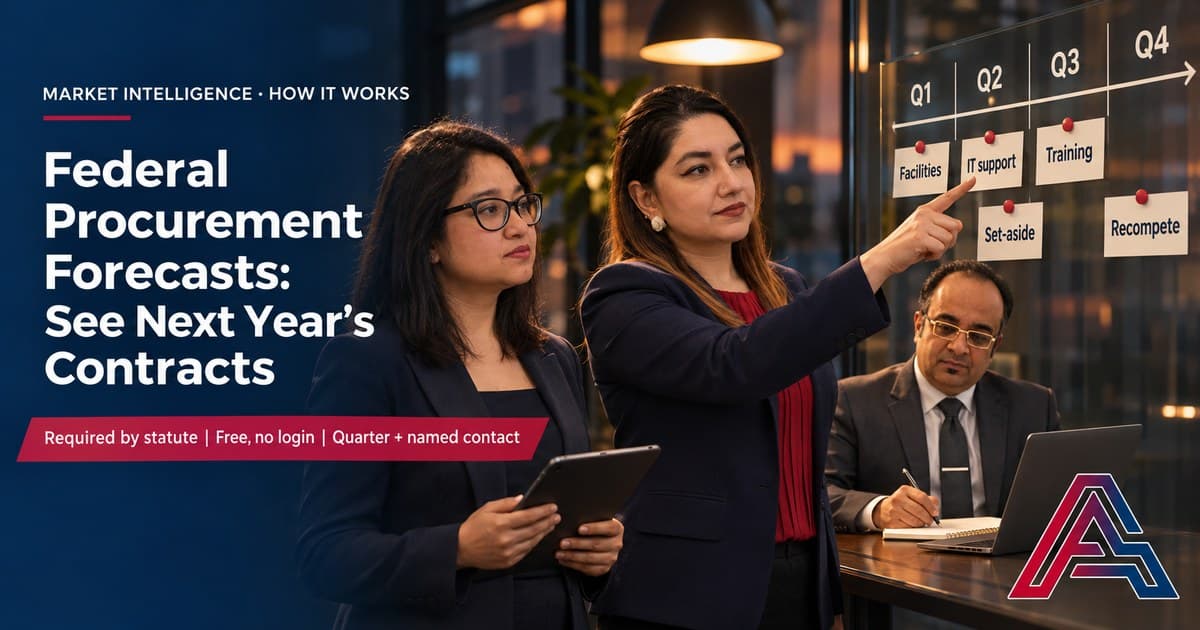
Federal Procurement Forecasts: See Next Year's Contracts
A federal procurement forecast is an agency's own list of the contracts it expects to award. It is required by statute, free to search and needs no login. Here is how forecasts work and how to use the lead time.
On this page
A federal procurement forecast is a list of the contract opportunities an agency expects to award. Agencies are required by law to publish one. It is free to read, and no account is needed. If you want to know what the government plans to buy next year, this is where it is written down.
In short
- Forecasts are required by statute. Section 8(a)(12)(C) of the Small Business Act, 15 U.S.C. § 637(a)(12)(C), requires covered agencies to prepare and periodically update a forecast of expected contract opportunities small businesses can perform.
- One place to search them all. GSA's Forecast of Contracting Opportunities (FCO) tool sits at acquisitiongateway.gov/forecast.
- No registration. GSA says plainly: "Registration is not required to use the FCO tool."
- Each entry carries a projected fiscal quarter and a named contact — including the agency's small business specialist.
- Our advice: a forecast is lead time, not a lead. Use the quarter to decide who to go and talk to now.
What a federal procurement forecast is
It is the agency's own list of what it expects to buy, published ahead of time. Not a solicitation. Not an advertisement. A plan.
The requirement is old. Public Law 100-656, the Business Opportunity Development Reform Act of 1988, amended the Small Business Act. It made federal departments and agencies compile and publish forecasts of contract opportunities each fiscal year.
The codified rule is narrower than "every agency." It sits at Section 8(a)(12)(C) of the Small Business Act, 15 U.S.C. § 637(a)(12)(C). It covers agencies reporting actions to the Federal Procurement Data System "with an aggregate value in excess of $50M in FY 88 dollars." Those agencies must annually prepare and periodically update a forecast. The forecast covers opportunities "that small business concerns are capable of performing."
So the forecast was built for small businesses from the start. That is not a side effect. It is the point of the statute.
In November 2024 the Office of Federal Procurement Policy (OFPP) issued guidance called Strengthening Federal Agency Procurement Forecasts. It did three things. It standardized what goes in a forecast. It required more frequent updates. And it pushed every agency's data into one searchable place.
How federal procurement forecasts work, step by step

From the agency's plan to your search: how a forecast reaches you
-
The agency decides what it expects to buy. The OFPP guidance asks agencies to forecast proposed contract actions above the simplified acquisition threshold of $350,000. These are the actions they expect to publicize in the governmentwide point of entry.
-
It fills in a standard set of fields. The 2024 guidance set out the data elements every forecast should carry. They include the title and description of the requirement. The contracting agency and office. Place of performance. The predominant NAICS code. A total estimated value range. Extent competed. Anticipated socioeconomic set-aside type. Anticipated contract and award type. The projected fiscal year and fiscal quarter for release of the solicitation. The projected period of performance start date. A point of contact. A small business specialist contact. And the date the entry was last updated.
-
It updates on a schedule. Agencies "should therefore update their internal policies and processes to report new forecasts on no less than a quarterly basis." Unknown fields are not meant to be left blank. The guidance says to label them "to be determined" and fill them in at the next quarterly update.
-
The data lands in one searchable tool. GSA's FCO tool is "a governmentwide planning tool that shows upcoming federal contract opportunities." Agencies take one of two routes. Some keep their own forecasting tool and upload the data to FCO. Others use FCO as their forecasting tool directly. Under the 2024 guidance, forecasts were to be fully available in FCO by the end of the third quarter of fiscal year 2026 — a date that has now passed.
-
You search it, for free. GSA states that "Registration is not required to use the FCO tool so you can get started searching for potential opportunities right away." Search by keyword or NAICS code. Then filter by agency, place of performance, NAICS code, estimated award date, acquisition strategy, contract type and award status.
Because some agencies still run their own tools, it is worth checking an agency's own forecast page too. That is especially true for an agency you already sell to.
One more thing worth knowing. The 2024 guidance told every agency to name a Forecasting Lead. That person is "the accountable official to OFPP for agency compliance with the requirements of this memorandum, and resolution of agency forecast data issues." So if an agency's forecast entry looks wrong, out of date or half empty, someone there owns the problem.
What this means for your business
The forecast is the only official document that tells you what is coming before anyone can bid. That is its whole value.
Say your firm does facilities maintenance. You find an entry: a recompete, projected for release in the third quarter of next fiscal year. The NAICS code is one you hold. The anticipated strategy is a small business set-aside. There is a named small business specialist. That example is hypothetical, but it is the shape of a real entry.
You now have months. Not the six weeks you get once a solicitation is public.
Months is enough for the things that actually decide the outcome. Being known before the notice goes up. Being findable when the agency does its market research. Lining up a teaming partner. Our guide to capture management covers how contractors organize that work.
| What the forecast gives you | Why it matters |
|---|---|
| Projected fiscal year and quarter | Lead time. You can work backwards from it. |
| Anticipated set-aside type | Tells you whether you would be competing against large firms. See our guide to federal set-asides. |
| Estimated value range | A size check, before you spend anything on the pursuit. |
| Existing contract or order number | Often the sign of a recompete, with an incumbent to study. |
| Small business specialist contact | A named person whose job is to talk to firms like yours. |
Three mistakes we see often:
- Treating the forecast as a promise. GSA is explicit. The tool "is for information and planning purposes only" and "does not commit the government to purchase." Entries are "subject to revision or cancellation."
- Reading it once a year. Agencies report new forecasts at least quarterly. A list you checked in January is stale by spring.
- Ignoring the date last updated. It is one of the standard fields. It tells you how much to trust the rest of the entry.
What to do this week
- Open the Forecast of Contracting Opportunities tool and search your NAICS code. No account, no sign-up. Do this before anything else on the list.
- Filter by agency and by acquisition strategy. The set-aside filter shows you which entries are realistically winnable at your size.
- Pick entries with a projected quarter at least two quarters out. Those are the ones where you still have time to matter. New to this? Start with our guide to getting started in government contracting.
- Write down the small business specialist contact for the one or two agencies that come up most often in your results.
- Check the "date last updated" on every entry you save. Then re-run the whole search next quarter.
Sources (7)
- OFPP, Strengthening Federal Agency Procurement Forecasts, memorandum of November 29, 2024 — https://bidenwhitehouse.archives.gov/wp-content/uploads/2024/11/OFPP-Memorandum-Strenghtening-Federal-Agency-Procurement-Forecasts.pdf (accessed November 12, 2026)
- GSA, Forecast of contracting opportunities — https://www.gsa.gov/small-business/forecast-of-contracting-opportunities (accessed November 12, 2026)
- GSA, Find opportunities — https://www.gsa.gov/small-business/find-opportunities (accessed November 12, 2026)
- GSA Forecast of Contracting Opportunities tool — https://acquisitiongateway.gov/forecast (accessed November 12, 2026)
- U.S. Nuclear Regulatory Commission, Forecast of contract opportunities — https://www.nrc.gov/about-nrc/contracting/small-business/forecast (accessed November 12, 2026)
- Threshold changes effective October 1, 2025 — https://www.acquisition.gov/threshold-changes (accessed November 12, 2026)
- FAR 5.101, Methods of disseminating information — https://www.acquisition.gov/far/5.101 (FAC 2026-01, effective March 13, 2026; accessed November 12, 2026)
Want help putting this to work for your business? Book a free consultation with Aliff Solutions: https://aliffsolutions.com
This article explains general rules as of November 2026. It is not legal advice, and rules change. Always check the current solicitation and the official sources linked above. We don't guarantee contract awards.
Frequently Asked Questions
- Are agencies legally required to publish a procurement forecast?
- Covered agencies are. Section 8(a)(12)(C) of the Small Business Act, 15 U.S.C. § 637(a)(12)(C), requires agencies reporting actions to the Federal Procurement Data System with an aggregate value above $50M in FY 88 dollars to annually prepare and periodically update a forecast of expected contract opportunities that small business concerns are capable of performing. The requirement came from Public Law 100-656 in 1988.
- Do I need an account to read federal procurement forecasts?
- No. GSA states that "Registration is not required to use the FCO tool so you can get started searching for potential opportunities right away." You will still need an active SAM.gov registration before you can bid on anything you find. Reading the forecast costs nothing and requires no login.
- Is a forecast a guarantee the contract will be awarded?
- No. GSA states the tool "is for information and planning purposes only" and "does not commit the government to purchase." Opportunities in it are "subject to revision or cancellation." Agency forecasts carry similar wording. The NRC, for example, says its descriptions are "based on the best available information from the agency's program offices at the time of publication."
- How often are forecasts updated?
- The 2024 OFPP guidance tells agencies to report new forecasts "on no less than a quarterly basis." It also asks them to update published entries when better information arrives. Every entry carries a "date last updated" field. Check it, rather than assuming a line is current.
- What information is in a forecast entry?
- The standard data elements include the requirement's title and description, agency and contracting office, place of performance, predominant NAICS code, estimated value range, extent competed, anticipated set-aside type, anticipated contract and award type, the projected fiscal year and quarter for the solicitation, the projected start of performance, a point of contact, a small business specialist contact, and the date last updated.
- Is the forecast the same thing as SAM.gov?
- No, and the two do different jobs. SAM.gov is the governmentwide point of entry for active procurement opportunities — work you can bid on now. The forecast shows what an agency expects to solicit later. Use the forecast to plan, and SAM.gov to bid.
Get More GovCon Insights
Subscribe to our weekly newsletter for actionable intelligence on winning government contracts.
Written by
Sana Rehman
Co-Founder and VP, Resources, Aliff Solutions
Aliff Solutions provides quantitative intelligence for government contractors. Our team combines decades of federal contracting experience with advanced analytics to help you win more contracts.