How to Win Federal Contracts in 2027: A Guide for Small Businesses
Many small businesses that lose a federal contract lose it before the solicitation is posted. Here is what changed in the rules for 2027, and a nine-step plan to win before the RFP.
On this page
Many small businesses that lose a federal contract lose it before the solicitation is even posted. They just don't find out until the proposal comes back.
The pattern is familiar. A notice appears on SAM.gov. The team spends two to four weeks on a proposal. The award goes to a firm that knew the buyer, shaped the requirement and planned its bid months earlier. The loser blames the writing, fixes the formatting, and repeats the cycle on the next notice.
The Department of Defense's own small business office puts it plainly: it typically takes at least 18 months of planning before a contractor wins its first contract. Winning starts long before the RFP.
In 2027 there's a second problem. Many small businesses are still working from a 2026 playbook, while the rules underneath federal buying have moved. The federal acquisition rules are being rewritten, purchase thresholds have gone up, a cybersecurity mandate has been paused, and a major small business program has been reshaped.
This guide covers both: what has changed for 2027, and a nine-step plan to win federal contracts before your competitors open the solicitation.
What's different for federal contractors in 2027
Standing still is expensive. Every bid you couldn't win costs proposal hours, and a recompete that goes to someone else can be locked up for years. In 2027, five rule changes and three market shifts raise those stakes.
Five rule changes
- The FAR is being rewritten. Under the Revolutionary FAR Overhaul, agencies already buy using rewritten FAR parts adopted through class deviations. Formal rulemaking began in June 2026, and 8 of 12 proposed rules were out by September. The small business rules (Part 19) are in the last batch, still to come. Proposed changes include letting contracting officers accept a late proposal when it's in the government's interest. What it means for you: read each solicitation's clauses, not last year's template.
- SAM.gov registration is lighter, but solicitations ask for more. SAM.gov released modernized representations and certifications in March 2026. Under the overhaul, SAM keeps company-level representations, while those specific to a purchase move into each solicitation. An active registration no longer covers everything: check every solicitation for reps you must sign.
- Purchase thresholds went up. Since 1 October 2025 the micro-purchase threshold is $15,000 and the simplified acquisition threshold is $350,000. Buys between the two are set aside for small businesses unless the contracting officer doesn't expect offers from two or more of them. Our Rule of Two guide explains the test.
- The CMMC third-party audit is paused, not cancelled. The Department of Defense suspended CMMC Phase 2 on 13 July 2026 and made the pause binding on contracting officers in September. New contracts can require only Level 1 or Level 2 self-assessments for now. The underlying cybersecurity rules (DFARS 252.204-7012 and NIST SP 800-171) still apply, existing flow-downs from primes stay in force, and a reform task force has given the department options that include restarting Phase 2 for a narrower group.
- The 8(a) program has been reshaped. Since 10 September 2026, individually owned firms applying to 8(a) must show evidence of social disadvantage instead of relying on a presumption. Current participants aren't re-tested. SBA's audit of the program continues, with suspensions, terminations and a GSA review of contracts held by suspended firms. If your plan depends on 8(a), have a plan B.
Three market shifts
- Fewer firms are winning. Small businesses won about $179 billion in federal prime contracts in FY2025, about 28% of eligible dollars, above the 23% goal, according to SBA's FY2025 scorecard. But the number of small businesses winning prime contracts fell 6.9% in a year, to 56,725, according to SBA data reported by Washington Technology. The money is there; it's going to fewer, better-prepared firms.
- Buying is moving onto big contract vehicles. The rewritten rules push agencies to buy commercial products and services through existing government-wide vehicles first, such as GSA schedules and government-wide acquisition contracts. Firms without a seat on those vehicles may see fewer stand-alone opportunities.
- The size rules may change. In August 2026 SBA proposed replacing about 1,000 size standards with 338, raising many sharply. SBA estimates about 114,500 more businesses would count as small. It's only a proposal, but if it's finalized, set-asides could draw larger competitors.
Add uncertain funding: FY2027 began on a continuing resolution that runs to 11 December 2026. Solicitations may slip, then arrive in bunches. The firms that prepared early will be ready for them.
From no federal contracts to 30: a client story
When we started working with one small business, it had never won a federal contract. It had the capability, and it was eligible to compete. What it didn't have was a system: a way to find the right bids, price them to win and get compliant responses in on time. With no past performance to point to, every bid started from zero.
That's where many small businesses get stuck. Being eligible gets you to the starting line. It doesn't win the contract.
So we didn't write one proposal and leave. We ran the firm's federal contracting work end to end. We found and qualified opportunities that fit it, and judged honestly which ones it could win. We found suppliers, collected quotes and built competitive prices for its product bids. We kept every response compliant and on time. After each award, we kept delivery and compliance on track, because performing well on one contract is what helps win the next.
Within two years, the firm won 30 Defense Department contracts and orders, mostly for supplies and equipment, and 5 multi-year contract vehicles. Every award is on the public federal record (figures as of October 2026). The work is ongoing, and Defense award data is published about 90 days late, so the newest awards may not show yet.
There was no shortcut. It was the steps below, repeated: choose the right opportunities, price carefully, submit compliant bids, deliver, and let each win become past performance for the next one. Results depend on each firm's capability, eligibility and the opportunities available, and no one can guarantee awards.
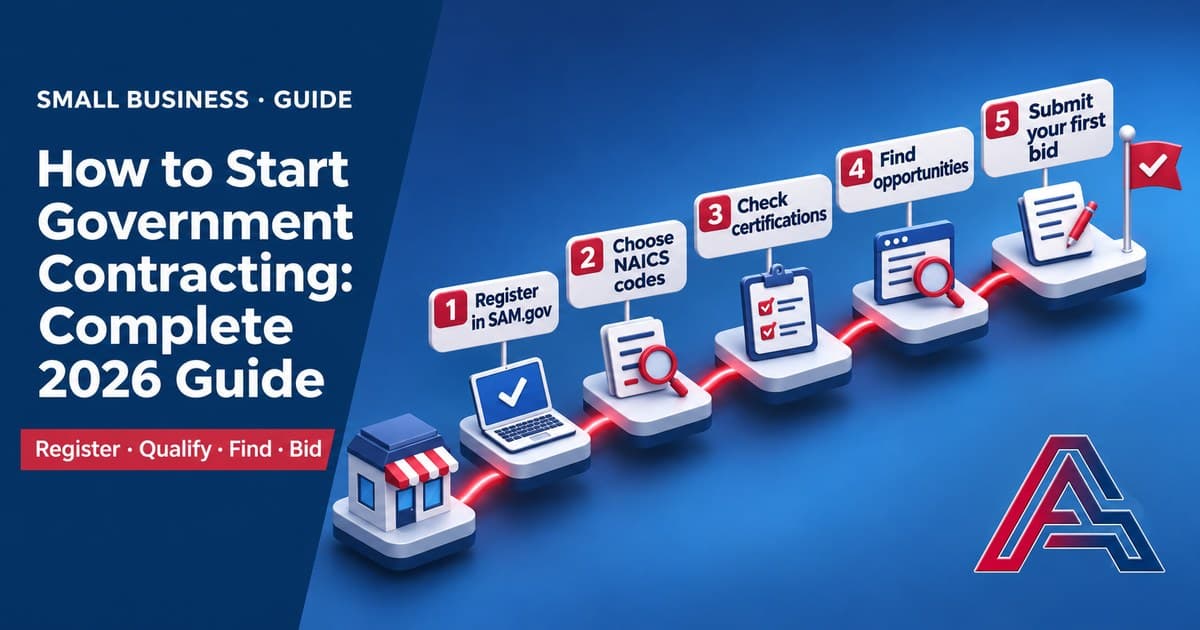
How to win federal contracts in 2027, step by step
The goal: a pipeline built from forecasts and recompetes instead of last-minute notices, fewer but better bids, and proposals that meet the 2027 rules. Here's how to get there.

How to win federal contracts in 2027: five rule changes, a tighter market and a four-phase plan
1. Pick your lane
Choose the one or two industries (NAICS codes) and the few agencies where you're strongest. Check your size standard for each code, and be clear about which certifications you actually hold. Set-aside solicitations state the NAICS code and size standard, so this decides which contracts you can bid on. Keep an eye on SBA's size standards proposal, but current standards apply until a final rule is published.
What changes: you stop chasing everything and start building a reputation in one place.
2. Register in SAM.gov, and keep it current
Registration in SAM.gov is free and must be renewed every year. Review the modernized reps and certs when you renew, and remember that many solicitations now carry their own reps to sign. Award research has also moved into SAM.gov, so use your login to study who won similar work.
What changes: you're eligible on day one, and your registration never stops a bid.
3. Read the forecasts and the recompete list
Agencies are required by law to publish forecasts of upcoming contracts, and many post them on GSA's Acquisition Gateway forecast tool, with the planned quarter and a small business contact. Pair forecasts with contracts in your lane that are due to expire. Our guide to federal procurement forecasts shows how to read them.
What changes: you see opportunities months before they're posted.
4. Get in before the RFP
The Department of Defense advises requesting a meeting with a small business professional at least 18 months before an existing contract expires. Answer sources sought notices and requests for information: the FAR says sources sought notices exist to improve small business access and identify opportunities. Your response is how a contracting officer learns that capable small businesses exist, which can decide whether a contract is set aside. Our guide to the five stages of the federal procurement process shows where each step fits.
What changes: you help shape the contract instead of reacting to it.
5. Aim where small businesses win
Buys between $15,000 and $350,000 are set aside for small businesses in most cases. Above $350,000, the same "Rule of Two" test applies: a set-aside is required when two or more capable small businesses are expected to bid at fair prices. Many smaller buys and year-end orders land in July to September. In FY2025, about 37.5% of federal contract dollars were obligated in that quarter, according to an analysis by GovSpend.
What changes: you compete where the rules are on your side.
6. Make honest bid/no-bid calls
Chase the contracts you can win, not every contract you could perform. Ask: do we know this buyer, do we meet every requirement, can we price it competitively, and do we have relevant past performance? Read the evaluation criteria closely. The rewritten rules allow a method where only the top-rated technical proposal has its price evaluated; when you see it, bid only if you can be rated best technically.
What changes: fewer wasted proposals, and more time for the ones that matter.
7. Team up
If you lack past performance or capacity, subcontract to a prime or partner with another firm. Under SBA's mentor-protégé program, a joint venture can bid as a small business when the protégé is small, and the protégé must do at least 40% of the joint venture's work. On set-aside contracts, the prime must also stay within the limits on how much work it subcontracts, generally 50% for services and supplies. SBA plans to revise those limits, so check the current rules. As more buying moves onto large vehicles, partnering with firms that hold them gets more important.
What changes: you can bid on work you couldn't win alone, and build the past performance to win it next time.
8. Use free help
APEX Accelerators, formerly known as PTACs, are funded by the Department of Defense and offer free help with registration, certifications, finding opportunities and preparing bids. According to the Department of Defense, there are 90+ Accelerators working from about 300 offices nationwide. Our APEX Accelerators guide explains how to use them.
What changes: you get expert guidance without adding cost.
9. Submit a compliant proposal, then ask for a debrief
Follow the instructions exactly, answer every requirement, and submit on time. Under the rewritten rules contracting officers may have more room to accept a late proposal, but don't plan on it. If you lose a negotiated procurement, request a debriefing in writing within 3 days of the award notice; that deadline is set by statute. After a required debriefing on a Department of Defense award, you can also send follow-up questions in writing within 2 business days.
What changes: every loss teaches you something for the next bid.
What to watch in 2027
- The last FAR overhaul rules, including the small business rules in Part 19. The Rule of Two above $350,000 is set by regulation rather than by statute, so watch how it's treated.
- A CMMC decision: whether Phase 2 restarts, and for whom.
- SBA's final size standards rule, and whether your firm's status changes.
- SBA's revised subcontracting limits, with draft changes expected by April 2027.
- FY2027 funding, and whether solicitations arrive late and in bunches.
- July to September, the government's busiest buying months. Prepare in the spring.
How Aliff Solutions helps
The nine steps are simple to list and hard to keep doing alongside running a business. That's the gap we fill.
We work with small businesses at every stage of a federal pursuit: finding and qualifying the right opportunities, honest bid/no-bid analysis, capture planning, sourcing and pricing, and building compliant bids with your team. After the award, we help keep delivery and compliance on track.
Our focus is winning the contract, not just writing the proposal. That means starting before the RFP, and saying so when a bid isn't worth chasing.
It starts with a free consultation. We'll look at your lane, your registration and your next likely opportunities, and tell you honestly where you stand. It's for small businesses that have the capability but not yet the wins, and for those that have bid and lost and want to know why.
We don't promise contracts or quote win rates. Results depend on your capability, eligibility and the opportunities available.
Sources (16)
- Department of Defense, Office of Small Business Programs, Guide to working with DoD — https://business.defense.gov/Work-with-us/Guide-to-working-with-DoD/ (accessed November 15, 2026)
- Federal Register, FAR inflation adjustment of acquisition-related thresholds, 27 August 2025 — https://www.federalregister.gov/documents/2025/08/27/2025-16412/federal-acquisition-regulation-inflation-adjustment-of-acquisition-related-thresholds
- FAR 19.502-2, Total small business set-asides — https://www.acquisition.gov/far/19.502-2
- Federal Register, Revolutionary FAR Overhaul, Parts 8, 12, 13, 15, 38, 44 and 51, 18 September 2026 — https://www.federalregister.gov/documents/2026/09/18/2026-19162/federal-acquisition-regulation-revolutionary-far-overhaul-parts-8-12-13-15-38-44-and-51
- Acquisition.gov, FAR Overhaul: You Said, We Did — https://www.acquisition.gov/far-overhaul/you-said-we-did
- SAM.gov, Modernized reps and certs, 24 March 2026 — https://sam.gov/announcements/modernized-reps-certs-coming-samgov-march-24th-2026
- Federal Register, SBA 8(a) social disadvantage final rule, 11 August 2026 — https://www.federalregister.gov/documents/2026/08/11/2026-16370/reforms-to-13-cfr-124103-to-remove-sbas-8a-programs-rebuttable-presumption-of-social-disadvantage
- SBA, FY25 small business contracting scorecard release, 25 June 2026 — https://www.sba.gov/article/2026/06/25/sba-releases-fy25-scorecard-small-business-contracting
- Washington Technology, Small business prime awards fell in fiscal 2025 — https://www.washingtontechnology.com/contracts/2026/06/small-business-prime-awards-fell-fiscal-2025/414463/
- Congressional Research Service, Continuing appropriations for FY2027 — https://www.congress.gov/crs-product/R49353
- GovSpend, A look at federal Q4 contract awards — https://govspend.com/blog/a-look-at-federal-q4-contract-awards/
- Department of Defense, APEX Accelerators flyer — https://business.defense.gov/Portals/57/APEX%20Accelerators%20(2_25).pdf
- DFARS 215.506-70, Opportunity for follow-up questions — https://www.acquisition.gov/dfars/215.506-70-opportunity-follow-questions.
- Faegre Drinker, SBA proposes sweeping overhaul of small business size standards — https://www.faegredrinker.com/en/insights/publications/2026/8/sba-proposes-sweeping-overhaul-of-small-business-size-standards-for-338-industry-groups
- Clark Hill, SBA limitations on subcontracting changes — https://www.clarkhill.com/news-events/news/sba-small-business-subcontracting-rules-changes/
- WilmerHale, Pentagon suspends CMMC Phase 2 requirements — https://www.wilmerhale.com/en/insights/client-alerts/20260720-pentagon-suspends-cmmc-phase-2-requirements-and-launches-review-of-cybersecurity-certification-program
Ready to start your 2027 plan? The firms that win in 2027 will be the ones already working on it in late 2026. Book a free consultation with Aliff Solutions.
This article explains general rules as of November 2026. It is not legal advice, and rules change. Always check the current solicitation and the official sources linked above. We don't guarantee contract awards.
Frequently Asked Questions
- What is the micro-purchase threshold in 2027?
- It's $15,000, up from $10,000 on 1 October 2025. The simplified acquisition threshold is $350,000.
- Do small businesses need CMMC certification in 2027?
- Not third-party certification for new Department of Defense contracts while Phase 2 is suspended; contracts may require Level 1 or Level 2 self-assessments. The underlying cybersecurity rules still apply, primes' flow-down requirements stay in force, and the department could restart Phase 2 with a narrower scope.
- Is it harder to get into the 8(a) program now?
- For individually owned firms, yes. Since 10 September 2026, applicants must show evidence of social disadvantage rather than rely on a presumption. Current participants aren't re-tested, but expect close scrutiny of financial records.
- How long does it take to win a first federal contract?
- The Department of Defense's small business office says to plan on at least 18 months. Smaller set-aside buys under $350,000 can come sooner.
- Will SBA's new size standards affect my business?
- Not yet. The August 2026 proposal isn't final, so current size standards apply.
- What happens if the government shuts down in December?
- Current funding runs to 11 December 2026. A lapse would pause many new awards; another continuing resolution would keep agencies on current spending levels, which can delay new competitions.
Get More GovCon Insights
Subscribe to our weekly newsletter for actionable intelligence on winning government contracts.
Written by
Sumera Khan
Co-Founder and VP, Client Relationships
Aliff Solutions provides quantitative intelligence for government contractors. Our team combines decades of federal contracting experience with advanced analytics to help you win more contracts.