HUBZone Contracts: The Three Ways Agencies Award Them
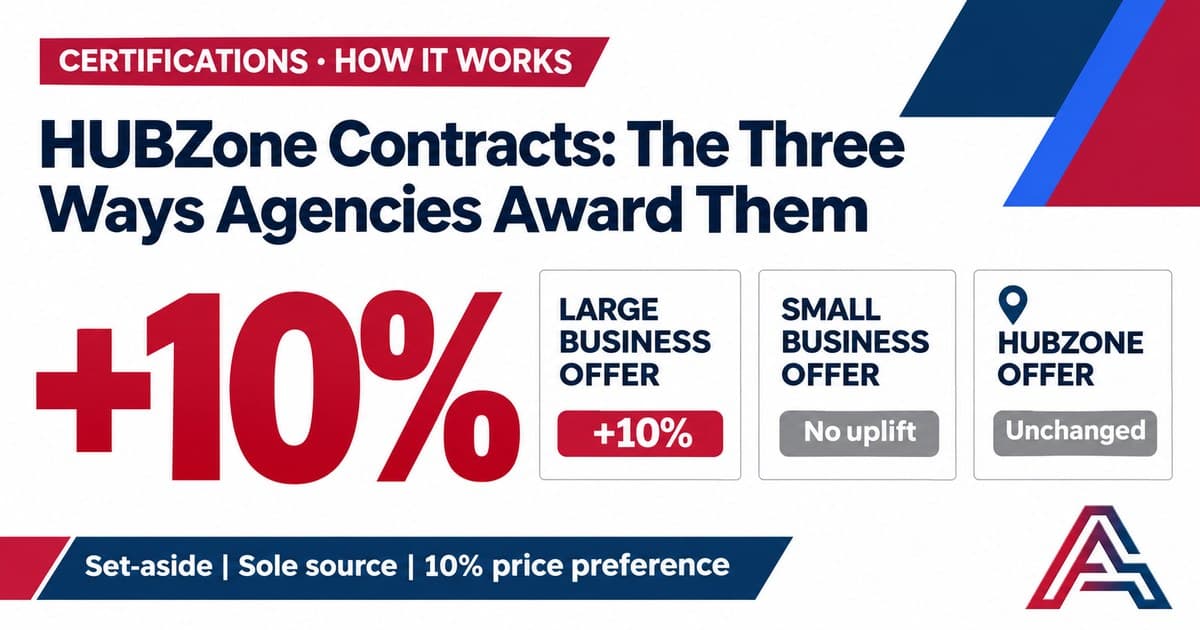
HUBZone contracts reach you by three routes: a set-aside, a sole source award, and a 10% price preference in full and open competition. Here is the order a contracting officer follows, the sole source limits, and why the price preference does nothing against other small businesses.
On this page
HUBZone contracts reach you by three different routes, and they work nothing alike. One is a competition limited to HUBZone firms. One is a contract with no competition at all. The third is a 10% price preference in open competition — and it does not do what most people think it does.
In short
- Three routes, in a set order. Set-aside first, then sole source, and separately a price preference in full and open competition (FAR 19.1305, 19.1306, 19.1307).
- The price preference does not lower your price. The contracting officer adds 10% to everyone else's offer — but not to other small businesses (FAR 19.1307(b)).
- Sole source runs to $8.5 million and $5.5 million. Manufacturing NAICS codes and everything else, where two HUBZone offers are not expected (FAR 19.1306(a)(2)).
- You must be certified when you bid. Eligibility is tested "at the time of its initial offer," not at award (FAR 19.1303(d)).
- Our advice: check the exclusion list before you chase anything. Several whole categories of work are outside this subpart entirely.
What HUBZone contracts are
Contracts awarded with a preference for firms whose principal office sits in a historically underutilized business zone and whose workforce lives in one. The Act is at 15 U.S.C. 631 note; SBA runs eligibility under 13 CFR part 126; the contracting rules sit in FAR subpart 19.13.
This article is about the award side. For the application itself, Aliff Solutions' certifications guide covers the eligibility criteria and the portal.
Two things about status are worth knowing before anything else.
Only the published designation counts. SBA designates certified firms in the Dynamic Small Business Search and in SAM. FAR 19.1303(b) is explicit: "Only firms designated in DSBS and SAM as HUBZone small business concerns are eligible for HUBZone preferences." Our guide to SBA Small Business Search covers keeping that record right.
Where the work happens is irrelevant. The same provision adds that "HUBZone preferences are not contingent on the place of performance." Your office and your employees have to be in a zone. The contract does not.
8(a) outranks HUBZone on the same requirement
FAR 19.1304 lists what this subpart does not reach. Federal Prison Industries and AbilityOne. Orders under indefinite-delivery contracts, and orders against Federal Supply Schedules, although a contracting officer may still set those orders aside at its discretion (FAR 16.505(b)(2)(i)(F) and 8.405-5). Commissary and exchange resale items. And requirements already being performed by an 8(a) participant, or accepted by SBA into the 8(a) program, unless SBA releases them.
That last one matters. If a requirement is sitting in the 8(a) program, HUBZone cannot reach it.
How HUBZone contracts work, step by step

HUBZone Contracts: The Three Ways Agencies Award Them
-
The exclusions get checked first. None of the three routes applies to the categories at FAR 19.1304, apart from discretionary set-asides of orders. A requirement held by an 8(a) firm is the one that catches people most often.
-
The set-aside is considered before anything else. A contracting officer "shall consider HUBZone set-asides before considering HUBZone sole-source awards or small business set-asides" (FAR 19.1305(a)(3)). The test is the familiar one: a reasonable expectation of offers from two or more HUBZone firms, and award at a fair market price. Our rule of two article covers that test in general.
-
One offer is not a failure. If only one acceptable HUBZone offer arrives, the contracting officer "should make an award to that concern" (FAR 19.1305(c)). If none arrives, the set-aside is withdrawn and the requirement is set aside for small business instead.
-
Sole source applies when two are not expected. Under FAR 19.1306(a) a contracting officer must consider a HUBZone sole source award before a small business set-aside. Five conditions apply. Offers from two or more HUBZone firms are not reasonably expected. The requirement is not already in the 8(a) program. The firm is responsible. Award can be made at a fair and reasonable price. And the anticipated price including options will not exceed $8.5 million for manufacturing NAICS codes or $5.5 million for all others. SBA's own rule at 13 CFR 126.612 still shows the earlier figures, $7 million and $4.5 million, but contracting officers work from the FAR.
-
The price preference is a separate thing entirely. It applies in full and open competition — not in set-asides. The mechanic is in the next section, because it is the part that is most often described backwards.
What this means for your business
The three routes answer different questions, and only one of them involves competing against large businesses.
| Set-aside | Sole source | Price preference | |
|---|---|---|---|
| Competition | HUBZone firms only | None | Full and open |
| Trigger | Two or more HUBZone offers expected | Two not expected | Price is a selection factor |
| Ceiling | None | $8.5M manufacturing, $5.5M other | None |
| Who you beat | Other HUBZone firms | Nobody | Large businesses only |
| Rule | FAR 19.1305 | FAR 19.1306 | FAR 19.1307 |
Three points deserve spelling out.
The preference adds to their price. It does not cut yours. FAR 19.1307(b) directs the contracting officer to give HUBZone offers a preference "by adding a factor of 10 percent to all offers." There are two exceptions: offers from HUBZone firms that have not waived the preference, and "otherwise successful offers from small business concerns." So the 10% lands on large businesses. Against another small business, the preference does nothing at all.
The factor is applied per line item or per award group. Other evaluation factors, such as transportation costs, are added before the 10% (19.1307(c)). And if a HUBZone firm and a large business tie after the preference is applied, the contracting officer "shall award the contract to the HUBZone small business concern" (19.1307(d)).
The 35% is a headcount, and it rounds. At least 35% of employees must be HUBZone residents. SBA rounds to the nearest whole number, with two worked examples in the regulation: 25 employees needs 9, because 8.75 rounds up; 95 employees needs 33, because 33.25 rounds down (13 CFR 126.200(d)(1)). A firm with one employee needs that employee in a zone.
There is a 20% floor during performance. Firms certify that they will "attempt to maintain" 35% residency while performing a HUBZone contract. SBA defines that as "substantive and documented efforts" — written job offers, advertisements, job fairs. And it sets a hard line: "a firm that has less than 20% of its total employees residing in a HUBZone during the performance of a HUBZone contract has failed to attempt to maintain the HUBZone residency requirement" (13 CFR 126.103).
Three mistakes we see often:
- Thinking the preference beats other small businesses. It does not. In a full and open competition with small business competitors, HUBZone status gives you nothing on price.
- Getting certified after the bid goes in. You must be a HUBZone small business concern "at the time of its initial offer" (FAR 19.1303(d)). Certification landing a week later does not fix it.
- Treating 35% as a one-time test. It is checked at application, at each recertification, and at every offer — and the 20% floor applies throughout performance.
What to do this week
- Confirm your designation appears in both DSBS and SAM. If it is not published in both, the preferences are not available to you.
- Run the headcount with the rounding rule. Multiply your employee count by 0.35 and round to the nearest whole number. That is your actual target, not an approximation.
- Check whether your target requirements are already in 8(a). If SBA has accepted them, HUBZone cannot reach them without a release.
- Decide which route each pursuit is. Set-aside, sole source, or open competition with a price preference. They need different capture work. Our capture management guide covers the groundwork.
- Start documenting your hiring efforts now. "Attempt to maintain" is proved with records. Written offers, advertisements and job fair attendance are the examples the regulation gives.
Sources (2)
- FAR subpart 19.13, Historically Underutilized Business Zone (HUBZone) Program — https://www.acquisition.gov/far/subpart-19.13 (FAC 2026-01, effective March 13, 2026; accessed November 15, 2026)
- 13 CFR part 126, HUBZone Program — https://www.ecfr.gov/current/title-13/chapter-I/part-126 (eCFR, current; accessed November 15, 2026)
Want help putting this to work for your business? Book a free consultation with Aliff Solutions: https://aliffsolutions.com
This article explains general rules as of November 2026. It is not legal advice, and rules change. Always check the current solicitation and the official sources linked above. We don't guarantee contract awards.
Frequently Asked Questions
- Does the HUBZone price preference make my bid 10% cheaper?
- No, and this is the most common misunderstanding. FAR 19.1307(b) adds 10 percent to competitors' offers rather than reducing yours. The difference matters, because the uplift is not applied to "otherwise successful offers from small business concerns" — so the preference only helps you against large businesses.
- When does the price evaluation preference not apply?
- In acquisitions that are not full and open competition, where price is not a selection factor such as architect-engineer work, where all fair and reasonable offers are accepted such as multiple award schedule contracts, and for the reserved portion of a multiple-award solicitation (FAR 19.1307(a)).
- What are the HUBZone sole source limits?
- The anticipated price including options may not exceed $8.5 million for requirements in manufacturing NAICS codes, or $5.5 million for all other NAICS codes (FAR 19.1306(a)(2)). SBA's 13 CFR 126.612 has not yet been updated and still shows $7 million and $4.5 million. The contracting officer must also not reasonably expect offers from two or more HUBZone firms.
- How many employees must live in a HUBZone?
- At least 35%, rounded to the nearest whole number. SBA's own examples: a 25-employee firm needs 9 HUBZone residents, and a 95-employee firm needs 33 (13 CFR 126.200(d)(1)). A one-employee firm needs that person to live in a zone.
- What happens if employees move out of the zone?
- Up to four may count as Legacy HUBZone Employees, if they kept living in a HUBZone for at least 180 calendar days immediately after your certification or anniversary date and remain continuously employed. You need at least one other HUBZone employee for any legacy employee to count (13 CFR 126.200(d)(3)).
- Does the work have to be performed in a HUBZone?
- No. FAR 19.1303(b) states plainly that "HUBZone preferences are not contingent on the place of performance." The requirements attach to your principal office and to where your employees live, not to where the contract is carried out. A HUBZone firm can perform anywhere, including at a government site in another state, without affecting its status.
Get More GovCon Insights
Subscribe to our weekly newsletter for actionable intelligence on winning government contracts.
Written by
Sumera Khan
Co-Founder and VP, Client Relationships
Aliff Solutions provides quantitative intelligence for government contractors. Our team combines decades of federal contracting experience with advanced analytics to help you win more contracts.