Buy American and the Trade Agreements Act, Explained
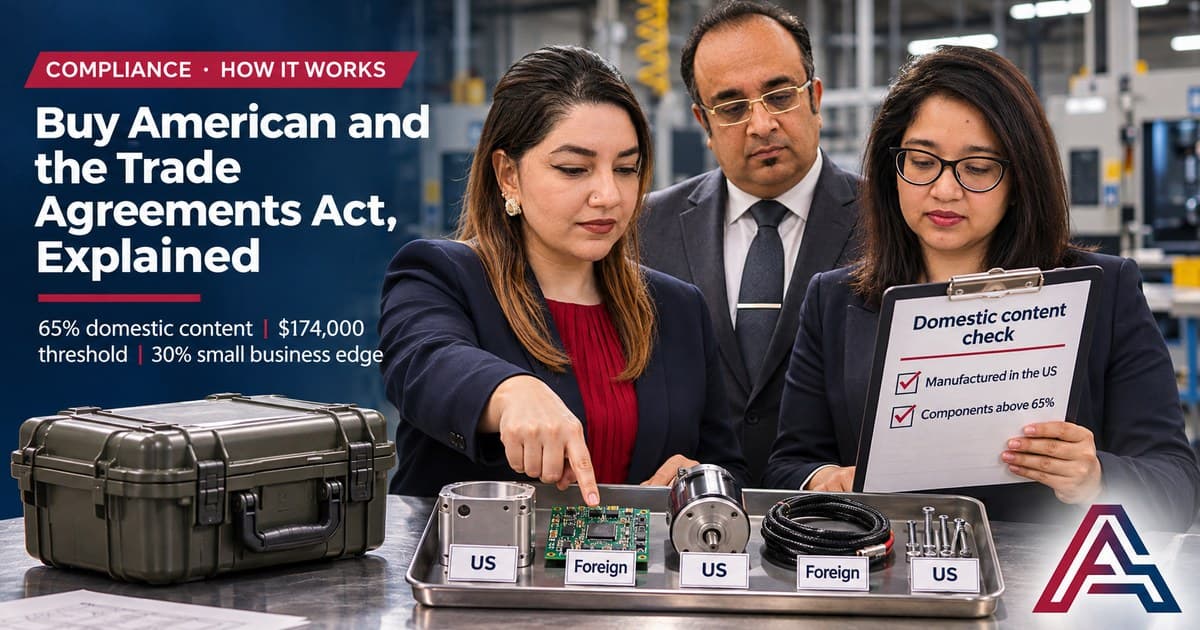
Buy American prefers domestic products; the Trade Agreements Act waives that preference above set thresholds. The 65 percent content test, the $174,000 threshold, and the price edge for small domestic offerors.
On this page
Buy American and the Trade Agreements Act are the two rules that decide whether your product is allowed to win a federal contract. They pull in opposite directions. One prefers American-made goods; the other waives that preference for products from countries the United States has trade agreements with. Which one applies comes down mostly to the size of the buy.
In short
- Two tests make a product domestic: it must be manufactured in the United States, and enough of its components must be domestic too (FAR 25.003).
- The content threshold is rising. It is 65 percent for items delivered in calendar years 2024 through 2028, and 75 percent for items delivered from 2029 (FAR 25.003).
- Above a trade agreement threshold, Buy American is waived for eligible products from designated countries (FAR 25.402). For the WTO Government Procurement Agreement that threshold is $174,000 for supplies and services.
- Small businesses get the bigger preference. Where Buy American applies, a foreign offer has 30 percent added to its price if the lowest domestic offer is from a small business, against 20 percent for a large one (FAR 25.106).
- Our advice: check the delivery year, not just the award year. The content percentage is tied to when the item is delivered.
What Buy American and the Trade Agreements Act are
They are two layers of the same question: where did this product come from, and does that matter here?
Buy American prefers domestic end products. FAR 25.003 defines a domestic end product as one "manufactured in the United States" where "the cost of its components mined, produced, or manufactured in the United States exceeds" a set percentage "of the cost of all its components." So it is two tests, not one. Final manufacture in the US is necessary but not sufficient.
That percentage is on a published escalator. It is 60 percent at the base, then "65 percent for items delivered in calendar years 2024 through 2028 and 75 percent for items delivered starting in calendar year 2029."
Read the trigger carefully: delivered, not awarded. A contract signed today with deliveries running into 2029 can cross into the higher threshold partway through.
Iron and steel are stricter. For those products, the cost of foreign iron and steel "must constitute less than 5 percent" of component cost (FAR 25.101).
Commercially available off-the-shelf items get relief. The domestic content test "has been waived for acquisitions of COTS items" (FAR 25.101) — though not for COTS items consisting predominantly of iron or steel, with an exception for COTS fasteners.
The Trade Agreements Act goes the other way. It gives the President authority to "waive the Buy American statute and other discriminatory provisions for eligible products" from countries the US has agreements with, and that power sits with the US Trade Representative. An eligible product is "a foreign end product, construction material, or service that, due to applicability of a trade agreement to a particular acquisition, is not subject to discriminatory treatment."
Designated countries fall into four groups: WTO Government Procurement Agreement countries, free trade agreement countries, least developed countries, and Caribbean Basin countries.
How Buy American and the Trade Agreements Act work, step by step

How Buy American and the Trade Agreements Act decide whether a product can win
-
Check the value of the buy first. This is what decides which rule governs. FAR 25.402(b) sets thresholds by agreement and contract type.
-
Above the threshold, the Trade Agreements Act takes over. Buy American is waived for eligible products from designated countries, and those products compete on equal terms with domestic ones.
-
Below the threshold, Buy American applies. Now the two-part test matters: manufactured in the United States, and domestic components above the applicable percentage of total component cost.
-
Check whether an exception applies. FAR 25.103 lists five. The head of the agency may determine that domestic preference "would be inconsistent with the public interest." Articles may be unavailable domestically "in sufficient and reasonably available commercial quantities and of a satisfactory quality." The contracting officer may determine the cost of a domestic product "would be unreasonable." Products may be bought for commissary resale. And the restrictions do not apply to information technology that is a commercial product.
-
If a foreign offer is in the mix, the price preference bites. FAR 25.106 tells the contracting officer to add to the foreign offer's price, inclusive of duty, 20 percent where the lowest domestic offer is from a large business and 30 percent where it is from a small business. Critical items and products containing critical components carry an additional preference factor on top. These percentages have no end date. What stops on January 1, 2030 is a narrower fallback: when no domestic offer is reasonably priced, a US-made product with more than 55 percent domestic content can be treated as a domestic offer.
What this means for your business
Two numbers decide most of it: the value of the buy, and the percentage of your product that is domestic.
Here are selected thresholds from FAR 25.402(b). The full table covers more agreements.
| Agreement | Supplies and services | Construction |
|---|---|---|
| WTO Government Procurement Agreement | $174,000 | $6,683,000 |
| Korea FTA | $100,000 | $6,683,000 |
| USMCA (Mexico) | $105,767 | $13,749,689 |
| Australia, Chile, Colombia, Singapore, CAFTA-DR | $105,767 | $6,683,000 |
| Israeli Trade Act | $50,000 (supplies only) | — |
Below those figures you are usually competing under Buy American, where a domestic product is preferred. Above them, a product from a designated country competes with yours on level terms.
Now the part worth sitting with. The price preference is larger when the domestic offeror is small. Where Buy American applies and a foreign offer is cheaper, the evaluators add 30 percent to that foreign price if the lowest domestic offer comes from a small business — half again more than the 20 percent a large domestic business would get. If you are a small firm offering a genuinely domestic product, that is a structural advantage, and it is written into the rule.
One more thing worth knowing if you resell finished goods. The domestic content test is waived for acquisitions of commercially available off-the-shelf items. That exemption does not extend to COTS items consisting predominantly of iron or steel, with COTS fasteners carved back out again. For a lot of small suppliers, whether a product counts as COTS is the question that decides everything else.
Three mistakes we see often:
- Assuming "assembled in the USA" settles it. Final manufacture in the United States is only the first test. The component cost percentage is the second, and it is the one that fails.
- Using last year's percentage. The threshold steps up on delivery year. A product that qualified on a 2023 delivery may not qualify on a 2029 one.
- Not reading the solicitation's clause. Which rule applies to a specific buy is set out in the solicitation. Our guide to proposal mistakes covers what else gets missed in the first read.
What to do this week
- Work out the domestic content percentage of each product you sell. By component cost, not by weight or by feel. You cannot certify what you have not calculated.
- Check your delivery years against the escalator. Anything delivering from 2029 faces 75 percent.
- Look at where your components actually come from, including subassemblies bought from distributors. The test follows the components, not the invoice.
- For iron and steel products, check the 5 percent limit separately. It is a different and tighter test.
- Note the value of the buys you chase. Below roughly $174,000 for supplies under the WTO agreement, a domestic product is preferred; above it, you are in open competition. Our capture management guide covers building that into pipeline decisions, and our guide to federal set-asides covers the other structural advantages small firms hold. New to all this? Start with our guide to getting started in government contracting.
Sources (5)
- FAR 25.003, Definitions — https://www.acquisition.gov/far/25.003 (FAC 2026-01, effective March 13, 2026; accessed November 14, 2026)
- FAR 25.101, General (Buy American statute) — https://www.acquisition.gov/far/25.101 (FAC 2026-01; accessed November 14, 2026)
- FAR 25.103, Exceptions — https://www.acquisition.gov/far/25.103 (FAC 2026-01; accessed November 14, 2026)
- FAR 25.106, Evaluating offers (reasonableness of cost) — https://www.acquisition.gov/far/25.106 (FAC 2026-01; accessed November 14, 2026)
- FAR 25.402, General (trade agreements) — https://www.acquisition.gov/far/25.402 (FAC 2026-01; accessed November 14, 2026)
Want help putting this to work for your business? Book a free consultation with Aliff Solutions: https://aliffsolutions.com
This article explains general rules as of November 2026. It is not legal advice, and rules change. Always check the current solicitation and the official sources linked above. We don't guarantee contract awards.
Frequently Asked Questions
- What is the Buy American statute?
- A domestic preference rule for federal purchases of products. It works through the definition of a domestic end product at FAR 25.003: an end product "manufactured in the United States" where the cost of components "mined, produced, or manufactured in the United States" exceeds a set percentage of the cost of all components. Both parts have to be satisfied.
- What percentage of a product has to be American?
- It depends on when the item is delivered. FAR 25.003 sets 60 percent at the base, then "65 percent for items delivered in calendar years 2024 through 2028 and 75 percent for items delivered starting in calendar year 2029." Products predominantly of iron or steel face a different test: foreign iron and steel must be less than 5 percent of component cost.
- What is the Trade Agreements Act?
- The authority to set Buy American aside for products from countries the United States has trade agreements with. FAR 25.402 explains that the US Trade Representative "has waived the Buy American statute and other discriminatory provisions for eligible products" under covered agreements, so those products are not treated less favorably than domestic ones.
- When does the Trade Agreements Act apply instead of Buy American?
- When the value of the acquisition reaches the relevant threshold in FAR 25.402(b). For the WTO Government Procurement Agreement, that is $174,000 for supplies and services and $6,683,000 for construction. Other agreements have their own figures, from $50,000 under the Israeli Trade Act upward.
- Do small businesses get an advantage under Buy American?
- Yes, and it is a real one. Under FAR 25.106, where a foreign offer competes, the contracting officer adds 20 percent to that foreign price if the lowest domestic offer is from a large business, and **30 percent** if it is from a small business. Critical items carry an additional factor. The 20 and 30 percent factors have no end date; only a narrower fallback for US-made products above 55 percent domestic content stops on January 1, 2030.
- Are there exceptions to Buy American?
- Five, at FAR 25.103: a public interest determination by the head of the agency; nonavailability of the article domestically in sufficient commercial quantities and satisfactory quality; unreasonable cost of the domestic product; purchase for commissary resale; and information technology that is a commercial product.
Get More GovCon Insights
Subscribe to our weekly newsletter for actionable intelligence on winning government contracts.
Written by
Haroon Haider
CEO, Aliff Solutions
Aliff Solutions provides quantitative intelligence for government contractors. Our team combines decades of federal contracting experience with advanced analytics to help you win more contracts.