8(a) Sole Source Contracts: How Agencies Award Them
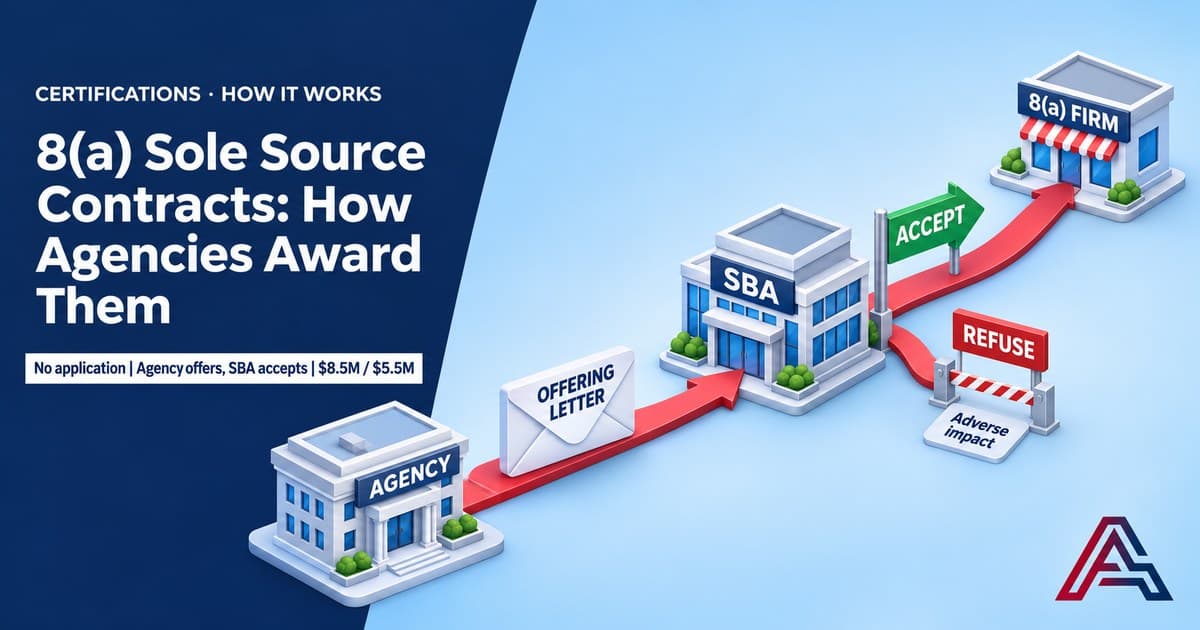
An 8(a) sole source contract is awarded without competition, but you cannot apply for one. An agency has to offer the requirement to SBA, and SBA can refuse it. Here is how the offer, the acceptance, the thresholds and the adverse impact rule work.
On this page
8(a) sole source contracts are the program's headline benefit: a federal contract awarded to you without a competition. What surprises most firms is that you do not apply for one. Two different parts of the government have to say yes first, and the second one can say no.
In short
- Two decisions, not one. The contracting officer offers the requirement to SBA. Then SBA decides whether to accept it. "SBA is not required to accept any particular procurement offered to the 8(a) BD program" (13 CFR 124.503(a)).
- The competitive thresholds are $8.5 million and $5.5 million. Above those, the work must normally be competed among 8(a) firms rather than awarded sole source (FAR 19.805-1).
- SBA can refuse on adverse impact. If an incumbent small business has held the work 24 months and it is 25% or more of its sales, SBA presumes harm and will not take the requirement (13 CFR 124.504(c)).
- Once in, it tends to stay in. Follow-on requirements remain in the 8(a) program unless SBA agrees to release them (FAR 19.815).
- Our advice: self-marketing is the real lever here. The offering letter has a field for the firm that caused the requirement to be reserved.
What 8(a) sole source contracts are
This article is about how the award happens, not how to get certified. If you are still at the application stage, start with our step-by-step 8(a) certification guide and come back to this one.
The legal structure is stranger than most people expect. Section 8(a) of the Small Business Act (15 U.S.C. 637(a)) authorizes SBA "to enter into all types of contracts with other agencies and award subcontracts for performing those contracts to firms eligible for program participation" (FAR 19.800(a)).
Read that again. SBA is the prime contractor. The 8(a) firm is SBA's subcontractor. In practice SBA now delegates contract execution to most agencies under partnership agreements, so you sign with the agency. But that underlying architecture is why a third party gets a vote on your contract.
FAR 19.800(b) is the operative sentence: contracts "may be awarded to the SBA for performance by eligible 8(a) participants on either a sole source or competitive basis." Sole source is one of two routes, not the whole program.
8(a) is considered before other set-asides
There is an ordering rule worth knowing. Above the simplified acquisition threshold of $350,000, the contracting officer "shall consider 8(a) set-asides or sole source awards before considering small business set-asides" (FAR 19.800(d)).
So 8(a) is evaluated ahead of the general small business set-aside decision our rule of two article describes. Different programs, different order of play.
How 8(a) sole source contracts work, step by step

How an 8(a) sole source contract is awarded: match, offering letter, SBA acceptance, price and follow-on
-
A requirement gets matched to a firm. FAR 19.803 lists three ways this starts. SBA sends the agency a search letter describing a participant's capabilities. SBA sends a requirements letter asking the agency to offer a specific acquisition. Or the agency identifies the requirement itself, "independently, or through the self marketing efforts of an 8(a) participant." That third route is the one you control.
-
The agency sends an offering letter. This is the formal step. FAR 19.804-2 specifies what goes in it: the NAICS code, the anticipated dollar value including options, and the type of contract. It also requires the acquisition history, "including the names and addresses of any small business contractors that have performed this requirement during the previous 24 months." And it names any "particular 8(a) participant designated for consideration." The justification can be that the participant "marketed the requirement and caused it to be reserved for the 8(a) program."
-
SBA accepts, or does not. SBA replies in writing within 10 business days for contracts above the simplified acquisition threshold, and 2 business days at or below it (13 CFR 124.503(a)). SBA checks that the NAICS code is reasonable and determines whether the nominated firm is eligible. If no appropriate match exists, SBA may nominate a different participant instead (FAR 19.804-3(c)).
-
The price gets negotiated, and capped. SBA either participates in negotiations or authorizes the contracting officer to negotiate directly with you, but SBA approves the contract before award (FAR 19.808-1(c)). The ceiling is firm: an 8(a) contract "may not be awarded if the price of the contract results in a cost to the contracting agency which exceeds a fair market price" (FAR 19.806(b)). Our cost realism article covers how agencies test a price.
-
The follow-on stays in the program. Once a requirement is accepted into 8(a), its follow-on requirements "shall remain in the 8(a) program" (FAR 19.815(a)). The exceptions are a mandatory source, or SBA agreeing to release it. Release needs written concurrence from SBA's Associate Administrator for Business Development.
What this means for your business
The sole source route and the competitive route are different games, and the dividing line is a number.
| Sole source 8(a) | Competitive 8(a) | |
|---|---|---|
| When it applies | At or below $8.5M manufacturing, $5.5M all other | Above those values, where two or more capable firms are expected |
| Who you convince | One contracting officer, then SBA | The evaluation panel, against other 8(a) firms |
| How you get there | Self-marketing, incumbency, an SBA nomination | Responding to a synopsized solicitation |
| SBA's role | Determines your eligibility as part of accepting | Determines the apparent successful offeror's eligibility |
| Price limit | Cannot exceed fair market price | Cannot exceed fair market price |
Three rules in that table deserve spelling out.
The threshold has exceptions in both directions. Above it, SBA may still accept a sole source award in two cases (FAR 19.805-1(b)). One is where there is no reasonable expectation of two offers at a fair market price. The other is where the firm is owned by an Indian tribe or an Alaska Native Corporation. Below the threshold, SBA may approve competition "on a limited basis" where technical competitions make sense (19.805-1(d)).
You cannot slice a requirement to fit. FAR 19.805-1(c) is explicit. A requirement above the threshold "shall not be divided into several requirements for lesser amounts in order to use 8(a) sole source procedures for award to a single firm."
Adverse impact can stop the whole thing. SBA will not accept a requirement where it has determined the award "would have an adverse impact on an individual small business, a group of small businesses located in a specific geographical location, or other small business programs." For an individual firm, SBA presumes adverse impact where three things are all true (13 CFR 124.504(c)(1)(i)):
- the small business has performed the specific requirement for at least 24 months;
- it is performing the requirement when it is offered to 8(a), or stopped within the previous 30 days; and
- the requirement is 25% or more of its most recent annual gross sales, including affiliates.
Two carve-outs matter. Adverse impact does not apply to follow-on or renewal 8(a) acquisitions, and it is not considered at all below the simplified acquisition threshold.
Three mistakes we see often:
- Treating certification as the finish line. It is the entry ticket. The award still requires an agency to offer the work and SBA to accept it.
- Competing before acceptance. If an agency competes a requirement among 8(a) firms before offering it to SBA, that is a reason for SBA to refuse the requirement outright (13 CFR 124.504(b), FAR 19.808-2).
- Ignoring the incumbent. If a small business has held the work for two years and it is a quarter of their revenue, the adverse impact presumption is working against you before you start.
What to do this week
- Confirm your 8(a) status shows where buyers look. SBA designates participants in the Dynamic Small Business Search and in SAM (FAR 19.802). Our guide to SBA Small Business Search covers getting that profile right.
- Pick three requirements and find out who holds them now. How long have they held the work, and roughly how big are they? That tells you whether adverse impact is in play.
- Build a self-marketing approach for one specific requirement. Not a capability statement blast. One named requirement, one contracting office.
- Check the value against $8.5M and $5.5M. It tells you whether you are asking for a sole source award or preparing to compete.
- Look for upcoming requirements early. Our procurement forecast article explains where agencies publish them before anything is solicited.
Sources (3)
- FAR subpart 19.8, Contracting with the Small Business Administration (The 8(a) Program) — https://www.acquisition.gov/far/subpart-19.8 (FAC 2026-01, effective March 13, 2026; accessed November 15, 2026)
- FAR 2.101, Definitions (simplified acquisition threshold) — https://www.acquisition.gov/far/2.101 (same edition; accessed November 15, 2026)
- 13 CFR 124.502, 124.503 and 124.504 — https://www.ecfr.gov/current/title-13/chapter-I/part-124 (eCFR, current; accessed November 15, 2026)
Want help putting this to work for your business? Book a free consultation with Aliff Solutions: https://aliffsolutions.com
This article explains general rules as of November 2026. It is not legal advice, and rules change. Always check the current solicitation and the official sources linked above. We don't guarantee contract awards.
Frequently Asked Questions
- Can I apply for an 8(a) sole source contract?
- No. There is no application. A contracting officer offers a requirement to SBA through an offering letter, and SBA decides whether to accept it (13 CFR 124.502, 124.503). What you can do is market a specific requirement to a specific contracting office, which FAR 19.803(c) recognizes as a legitimate route in.
- What are the 8(a) competitive thresholds?
- Under FAR 19.805-1(a)(2), an acquisition offered to SBA must normally be competed among 8(a) participants when the anticipated total value including options exceeds $8.5 million for manufacturing NAICS codes and $5.5 million for everything else, and at least two capable firms are expected to bid.
- Can an 8(a) sole source award exceed the threshold?
- Yes, in two situations under FAR 19.805-1(b): where there is no reasonable expectation that two eligible firms will submit offers at a fair market price, or where SBA accepts on behalf of a firm owned by an Indian tribe or an Alaska Native Corporation. Sole source awards above $30 million also require a justification under FAR 6.303.
- What is adverse impact in the 8(a) program?
- SBA's refusal to take work away from a small business already performing it outside the 8(a) program. SBA presumes adverse impact where an incumbent small business has performed the requirement for 24 months, is still performing it, and the work is 25% or more of its annual gross sales (13 CFR 124.504(c)).
- How long does SBA take to accept a requirement?
- Within 10 business days of the offering letter above the simplified acquisition threshold, and 2 business days at or below it (13 CFR 124.503(a)). If SBA does not reply, the agency can escalate, and if there is still no reply within 5 calendar days may assume acceptance (FAR 19.804-3(a)(1)).
- Can an agency move an 8(a) contract out of the program later?
- Only with SBA's agreement. Follow-on requirements must stay in the 8(a) program unless the Associate Administrator for Business Development concurs in writing, and SBA generally releases only where the agency will set the work aside under another small business program (FAR 19.815, 13 CFR 124.504(d)).
Get More GovCon Insights
Subscribe to our weekly newsletter for actionable intelligence on winning government contracts.
Written by
Haroon Haider
CEO, Aliff Solutions
Aliff Solutions provides quantitative intelligence for government contractors. Our team combines decades of federal contracting experience with advanced analytics to help you win more contracts.