Other Transaction Agreements (OTAs): How They Work
Other transaction agreements let the Department of Defense buy prototypes outside the FAR, and the statute is written to pull in companies new to defense work. Here is how the four conditions, the approval tiers and the follow-on production route work.
On this page
Other transaction agreements are how the Department of Defense buys prototypes without using a normal contract. They sit outside the Federal Acquisition Regulation, which is what makes them fast. And the law that authorizes them is written to pull in companies that do not already do defense work, which is an unusual position for a small business to find itself in: wanted because you are new.
In short
- An OTA is not a contract, grant or cooperative agreement. 10 U.S.C. 4021 authorizes transactions "other than contracts, cooperative agreements, and grants."
- Prototype projects are the main route. 10 U.S.C. 4022 covers prototypes "directly relevant to enhancing the mission effectiveness" of DoD personnel or improving its platforms, systems, components or materials.
- One of four conditions must be met, and two of them are about who you are rather than what you cost (10 U.S.C. 4022(d)(1)).
- A successful prototype can become production without re-competing (10 U.S.C. 4022(f)).
- Our advice: check whether you are a "nontraditional defense contractor" before anything else. Many small firms are, and do not know it.
What an other transaction agreement is
It is a legal instrument that is deliberately none of the usual ones.
10 U.S.C. 4021 gives the Secretary of Defense and the service secretaries authority to "enter into transactions (other than contracts, cooperative agreements, and grants)" for research. Because an OTA is not a procurement contract, the body of rules that attaches to procurement contracts does not attach to it. That is the source of the speed, and also the source of the unfamiliarity.
The prototype authority at 10 U.S.C. 4022 is the one most companies encounter. It lets the Director of the Defense Advanced Research Projects Agency, the Director of the Defense Innovation Unit, a service secretary, or another official designated by the Secretary of Defense carry out "prototype projects that are directly relevant to enhancing the mission effectiveness of personnel of the Department of Defense or improving platforms, systems, components, or materials proposed to be acquired or developed by the Department of Defense."
"Prototype project" is defined broadly at 4022(e)(5). It includes "a proof of concept, model, or process, including a business process," reverse engineering to address obsolescence, "a pilot or novel application of commercial technologies for defense purposes," agile development activity, and "the creation, design, development, or demonstration of operational utility."
Note "including a business process." A prototype does not have to be hardware.
Competition has not disappeared either. 10 U.S.C. 4022(b)(2): "To the maximum extent practicable, competitive procedures shall be used when entering into agreements to carry out the prototype projects."
How other transaction agreements work, step by step

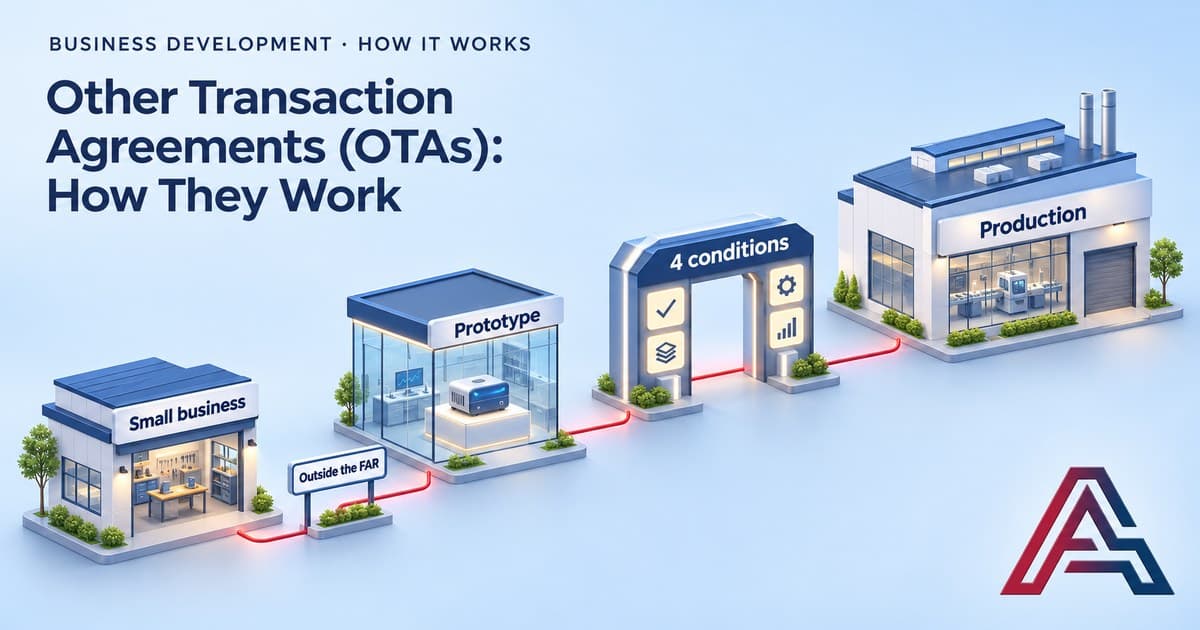
How an other transaction agreement works: prototype, four conditions, competition, approvals and follow-on production
-
The project has to qualify as a prototype. Under the broad definition at 4022(e)(5), including proofs of concept, pilots of commercial technology for defense use, and agile development.
-
One of four conditions must be met. This is the gate, at 10 U.S.C. 4022(d)(1). No official may enter an OTA for a prototype project unless:
- "There is at least one nontraditional defense contractor or nonprofit research institution participating to a significant extent in the prototype project";
- "All significant participants in the transaction other than the Federal Government are small businesses… or nontraditional defense contractors";
- "At least one third of the total cost of the prototype project is to be paid out of funds provided by sources other than the Federal Government"; or
- the senior procurement executive determines in writing that exceptional circumstances justify innovative business arrangements, or an opportunity to expand the defense supply base in a way not practical under a contract.
-
Competitive procedures are used where practicable. Not always a full competition, but not a private arrangement either.
-
Bigger projects need senior sign-off. Two tiers apply.
Above $100 million and up to $500 million, the head of the contracting activity must determine in writing that the conditions will be met, and that the authority "is essential to promoting the success of the prototype project." For DARPA, the Defense Innovation Unit and the Missile Defense Agency, that determination sits with the agency director.
Above $500 million the bar rises again. The senior procurement executive (or, for those three agencies, the agency director) must find the use "essential to meet critical national security objectives," and the congressional defense committees must be notified in writing at least 30 days beforehand. None of that authority can be delegated.
-
Success can convert into production. Under 4022(f)(2), a follow-on production contract or transaction may be awarded to the participants "without the use of competitive procedures" if competitive procedures were used to select the parties in the first place, and the participants "successfully completed the prototype project."
What this means for your business
The condition at step 2 is the whole opportunity, so read it closely.
A nontraditional defense contractor is defined at 10 U.S.C. 3014 as an entity "that is not currently performing and has not performed, for at least the one-year period preceding the solicitation," any DoD contract or subcontract "subject to full coverage under the cost accounting standards."
Read that again. It is a definition of absence. You qualify by not having had a certain kind of DoD work. A software firm that has never sold to defense, a manufacturer serving commercial markets, a company whose only federal work has been civilian-agency — these are the firms the authority is built to reach.
And the second condition is more generous still. If all significant non-federal participants are small businesses or nontraditional defense contractors, the condition is satisfied. A team made up entirely of small firms clears the gate on its own.
| Condition (10 U.S.C. 4022(d)(1)) | What it asks of you |
|---|---|
| A nontraditional contractor or nonprofit research institution participating significantly | Be the nontraditional party, or bring one in |
| All significant non-federal participants are small businesses or nontraditional contractors | A team of small firms qualifies by itself |
| At least one third of total cost from non-federal sources | Cost share, where you can fund it |
| Senior procurement executive finds exceptional circumstances | Rare, and not something you can plan around |
Three mistakes we see often:
- Assuming OTAs are only for large technology firms. The statutory conditions point the other way. Two of the four are satisfied by being small or new to defense.
- Treating "outside the FAR" as "no rules." Competitive procedures apply to the maximum extent practicable, the Comptroller General gets records access on agreements over $5 million, and large projects need written determinations at senior level.
- Ignoring the follow-on route. The production award is the prize, and it depends on competitive procedures having been used at the prototype stage. Our teaming guide covers getting your position in a consortium right before that matters.
What to do this week
- Work out whether you are a nontraditional defense contractor. The test is whether you have performed a DoD contract or subcontract under full cost accounting standards coverage in the past year. Many small firms have not.
- Look at consortia in your field. Much OTA prototype work is awarded through consortium vehicles, and 4022(f) contemplates awards to "a consortium of United States industry and academic institutions."
- Reframe what you sell as a prototype project. The definition covers business processes, pilots of commercial technology, and agile development — not only hardware.
- Decide whether you could fund a cost share. The one-third route is an alternative gate if the others do not fit.
- Plan for the follow-on, not just the prototype. If you are early in federal work generally, start with our guide to getting started in government contracting, then our capture management guide. Our guide to federal set-asides covers the separate advantages small firms hold in ordinary contracting.
Sources (3)
- 10 U.S.C. 4021, Research projects: transactions other than contracts and grants — https://www.govinfo.gov/link/uscode/10/4021?link-type=html (U.S. Code, 2024 Edition, U.S. Government Publishing Office; accessed November 14, 2026)
- 10 U.S.C. 4022, Authority of the Department of Defense to carry out certain prototype projects — https://www.govinfo.gov/link/uscode/10/4022?link-type=html (U.S. Code, 2024 Edition, U.S. Government Publishing Office; accessed November 14, 2026)
- 10 U.S.C. 3014, Nontraditional defense contractor — https://www.govinfo.gov/link/uscode/10/3014?link-type=html (U.S. Code, 2024 Edition, U.S. Government Publishing Office; accessed November 14, 2026)
Want help putting this to work for your business? Book a free consultation with Aliff Solutions: https://aliffsolutions.com
This article explains general rules as of November 2026. It is not legal advice, and rules change. Always check the current solicitation and the official sources linked above. We don't guarantee contract awards.
Frequently Asked Questions
- What is an other transaction agreement?
- A legal instrument that is not a procurement contract, grant or cooperative agreement. 10 U.S.C. 4021 authorizes the Secretary of Defense and the service secretaries to "enter into transactions (other than contracts, cooperative agreements, and grants)" for research. Because it is not a procurement contract, the usual procurement rulebook does not attach to it.
- What is a prototype project under an OTA?
- Broader than it sounds. 10 U.S.C. 4022(e)(5) includes "a proof of concept, model, or process, including a business process," reverse engineering to address obsolescence, "a pilot or novel application of commercial technologies for defense purposes," agile development activity, and the creation, design, development or demonstration of operational utility.
- Who can use OTA prototype authority?
- Under 10 U.S.C. 4022(a)(1), the Director of the Defense Advanced Research Projects Agency, the Director of the Defense Innovation Unit, the Secretary of a military department, or any other official designated by the Secretary of Defense. Projects above $100 million and above $500 million require escalating written determinations that cannot be delegated.
- What is a nontraditional defense contractor?
- Defined at 10 U.S.C. 3014 as an entity "that is not currently performing and has not performed, for at least the one-year period preceding the solicitation," any DoD contract or subcontract "subject to full coverage under the cost accounting standards." It is a status you hold by *not* having done a certain kind of defense work.
- Can a small business qualify for an OTA?
- Yes, and the statute makes it straightforward. 10 U.S.C. 4022(d)(1)(B) is satisfied where "all significant participants in the transaction other than the Federal Government are small businesses… or nontraditional defense contractors." A team made up entirely of small firms meets the condition without needing a large partner.
- Can an OTA prototype turn into a production contract?
- Yes. 10 U.S.C. 4022(f)(2) allows a follow-on production contract or transaction to be awarded to the participants "without the use of competitive procedures," provided competitive procedures were used to select the parties for the original transaction and the participants "successfully completed the prototype project."
Get More GovCon Insights
Subscribe to our weekly newsletter for actionable intelligence on winning government contracts.
Written by
Sumera Khan
Co-Founder and VP, Client Relationships, Aliff Solutions
Aliff Solutions provides quantitative intelligence for government contractors. Our team combines decades of federal contracting experience with advanced analytics to help you win more contracts.