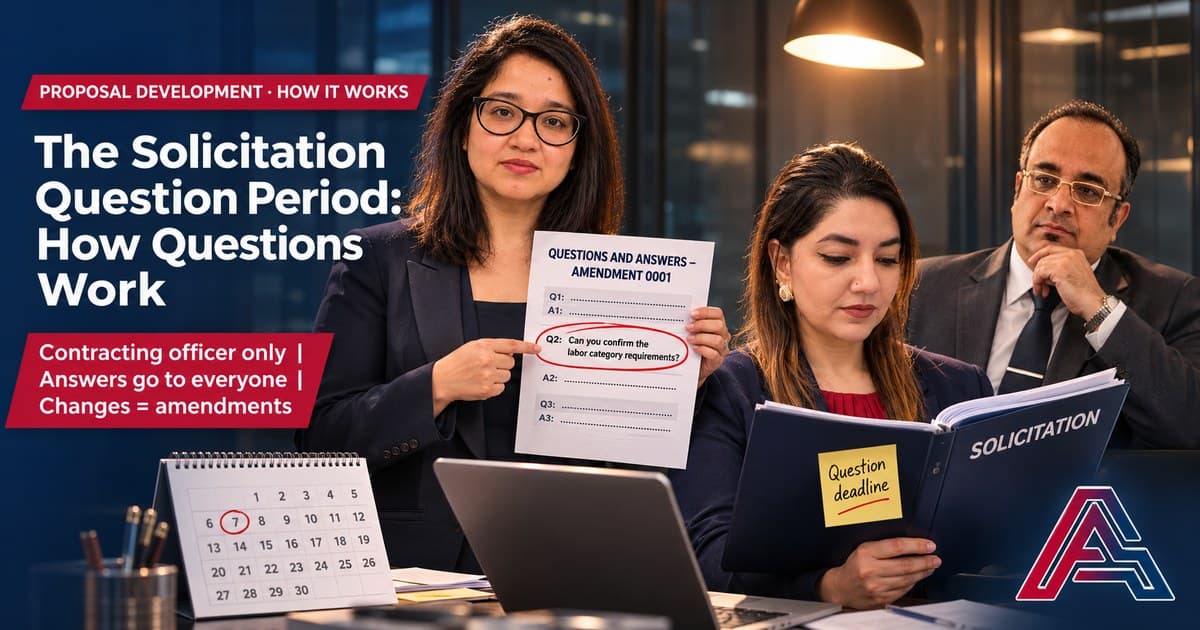
The Solicitation Question Period: How Questions Work
After a solicitation is released, bidders can ask the contracting officer what it means, but every answer goes to every bidder. Here is how the question period works under the FAR, and which questions are worth asking.
On this page
The solicitation question period is the short window after a solicitation is published when bidders can ask the agency what it means. It is the only point at which you can get a requirement clarified, or changed, before you have to bid on it. One thing surprises people: your question becomes everyone's answer, and that is deliberate.
In short
- The contracting officer is the only door. After the solicitation is released, FAR 15.201(f) makes the contracting officer "the focal point" for exchanges with potential offerors.
- Answers get shared. Information given to one potential offeror "must be made available to the public as soon as practicable," so no one gains an unfair advantage.
- A real change arrives as an amendment. If the government changes its requirements or terms, "the contracting officer shall amend the solicitation" (FAR 15.206(a)).
- The deadline comes from the solicitation, not from the FAR. There is no standard question date, so read for it the day the solicitation drops.
- Our advice: ask about things that change what you would bid. Not about things that reveal how you would bid.
What the solicitation question period is
It is a formal exchange between bidders and the agency, inside a defined window, with the answers published to everyone.
The FAR treats exchanges with industry as a good thing. FAR 15.201 says the purpose is to improve "the understanding of Government requirements and industry capabilities," so the government can get better supplies and services at reasonable prices. An agency that answers questions well usually gets better bids.
The question period is the last of a longer sequence. FAR 15.201(c) lists techniques agencies use to exchange information before proposals come in, including industry or small business conferences, public hearings, market research, one-on-one meetings with potential offerors, presolicitation notices, draft requests for proposals, requests for information, presolicitation or preproposal conferences, and site visits.
Note where the question period sits in that list: at the end. By the time a solicitation is published, the requirement is largely written. Everything earlier on that list is where it gets shaped, which is why our capture management guide, our guide to predicting recompetes and our guide to procurement forecasts all push you to act long before this point.
Still, the question period is not nothing. It is the one moment when a written answer from the agency becomes part of the record everyone bids against.
How the solicitation question period works, step by step

From question to amendment: how the question period works
-
The solicitation sets the deadline. There is no universal question date in the FAR. Each solicitation names its own, and it is usually far earlier than bidders expect — often within the first week or two of a response period that runs a month or more.
-
Questions go to the contracting officer. FAR 15.201(f) is clear that after the solicitation is released, "the contracting officer must be the focal point" for exchanges with potential offerors. Not the program office. Not the person you met at an industry day.
-
The answer is published to everyone. This is the part that catches people out. Under FAR 15.201(f), when specific information about the acquisition is disclosed to one potential offeror, it "must be made available to the public as soon as practicable, but no later than the next general release," so that no offeror gains an unfair competitive advantage.
-
A real change arrives as an amendment. Clarifying an ambiguity may just need an answer. Changing the requirement needs more. FAR 15.206(a): "When, either before or after receipt of proposals, the Government changes its requirements or terms and conditions, the contracting officer shall amend the solicitation." Amendments issued before the proposal deadline "shall be issued to all parties receiving the solicitation" (FAR 15.206(b)).
-
Check whether the clock moved. An amendment can change the scope, the evaluation factors or the due date. Read every amendment in full rather than skimming for the part you asked about.
Sealed bidding works the same way on this point. Under FAR 14.208, any information given to a prospective bidder about an invitation for bids "shall be furnished promptly to all other prospective bidders as an amendment" where it is necessary for bidding or would prejudice other bidders. Changes use Standard Form 30 and go to everyone before bid opening.
The same logic covers conferences. FAR 15.201(c) lists presolicitation and preproposal conferences among the ways agencies exchange information, and FAR 14.208 makes the point explicitly for sealed bidding: the duty to share applies even when a pre-bid conference has been held. So a question you ask out loud in a room is still a question everyone gets the answer to.
What this means for your business
The sharing rule is the whole strategic puzzle. You cannot ask a private question, which means every question carries a cost as well as a benefit.
A good question fixes something that would otherwise make the solicitation unbiddable, or unbiddable for you. A page limit that contradicts a submission requirement. A license requirement that no firm of your size could hold. A delivery schedule that does not match the period of performance. Those are worth asking, because the fix helps you more than the disclosure hurts.
A poor question tells your competitors how you are thinking. "Would the government consider accepting a cloud-hosted alternative?" announces your solution to everyone bidding, before you have been credited with it.
| Question type | Why ask it | What it costs you |
|---|---|---|
| A contradiction between sections | A real fix, published to all, and the solicitation gets biddable | Almost nothing |
| An unclear or impossible requirement | May produce an amendment that widens who can bid | Little, if phrased neutrally |
| Missing information you need to price | You cannot price guesswork, and neither can anyone else | Little |
| "Would you accept our approach?" | Rarely answered usefully | Reveals your approach to every competitor |
| Anything that only matters to you | Signals your weakness or your niche | Can mark you out as unqualified |
Three mistakes we see often:
- Missing the deadline. It is typically in the first days of the response period, not near the end. By the time most bidders start writing, the window has closed.
- Asking the program office instead. After release, the contracting officer is the focal point. Side conversations do not bind the agency, and they can create problems.
- Not reading other bidders' questions. The published answer set tells you who else is paying attention and what the agency is willing to change. It is free competitive information and most firms skim it.
What to do this week
- On any solicitation you are tracking, find the question deadline now. Put it in the calendar before you read anything else. Our guide to proposal mistakes covers what else gets missed in the first read.
- Write your questions as if a competitor will read them. They will.
- Separate the two kinds. Clarifications that make the bid possible, and questions that reveal your approach. Ask the first. Keep the second.
- Read the full answer set when it is published. Not just your own question. The others tell you what the field is worried about.
- Log every amendment. Check whether the due date, the scope or the evaluation factors moved. If you are new to all this, start with our guide to getting started in government contracting.
Sources (4)
- FAR 15.201, Exchanges with industry before receipt of proposals — https://www.acquisition.gov/far/15.201 (FAC 2026-01, effective March 13, 2026; accessed November 12, 2026)
- FAR 15.206, Amendments to solicitations — https://www.acquisition.gov/far/15.206 (FAC 2026-01; accessed November 12, 2026)
- FAR 14.208, Amendment of invitation for bids — https://www.acquisition.gov/far/14.208 (FAC 2026-01; accessed November 12, 2026)
- FAR 5.203, Publicizing and response time — https://www.acquisition.gov/far/5.203 (FAC 2026-01; accessed November 12, 2026)
Want help putting this to work for your business? Book a free consultation with Aliff Solutions: https://aliffsolutions.com
This article explains general rules as of November 2026. It is not legal advice, and rules change. Always check the current solicitation and the official sources linked above. We don't guarantee contract awards.
Frequently Asked Questions
- When is the deadline to submit questions on a solicitation?
- Whenever that solicitation says. The FAR does not set a standard question deadline, so it varies by acquisition and is stated in the solicitation itself. In practice it often falls in the first week or two of the response period, well before most bidders have finished reading, which is why it is worth putting in the calendar on day one.
- Will other bidders see my question?
- Normally yes, and that is the point. FAR 15.201(f) provides that specific information about the acquisition disclosed to one potential offeror "must be made available to the public as soon as practicable, but no later than the next general release," so that no offeror gains an unfair competitive advantage. Assume your question will be published.
- Who should I send questions to?
- The contracting officer. FAR 15.201(f) states that after release of the solicitation "the contracting officer must be the focal point" for exchanges with potential offerors. Contacting the program office or technical staff directly after release is a common and avoidable error.
- What happens if my question changes the requirement?
- It becomes an amendment. FAR 15.206(a) requires that when the government changes its requirements or terms and conditions, before or after proposals are received, "the contracting officer shall amend the solicitation." Amendments issued before the proposal deadline go "to all parties receiving the solicitation."
- Does the agency have to answer every question?
- The FAR does not require a response to each one, and agencies routinely group, reword or decline questions. What the rules do require is even-handedness: information released to one potential offeror has to reach everyone. So the protection is about fairness between bidders, not about guaranteeing you an answer.
- Does this work the same way in sealed bidding?
- The sharing principle does. FAR 14.208 provides that information given to a prospective bidder about an invitation for bids "shall be furnished promptly to all other prospective bidders as an amendment" where it is needed for bidding or would prejudice other bidders, using Standard Form 30, before bid opening.
Get More GovCon Insights
Subscribe to our weekly newsletter for actionable intelligence on winning government contracts.
Written by
Sumera Khan
Co-Founder and VP, Client Relationships, Aliff Solutions
Aliff Solutions provides quantitative intelligence for government contractors. Our team combines decades of federal contracting experience with advanced analytics to help you win more contracts.