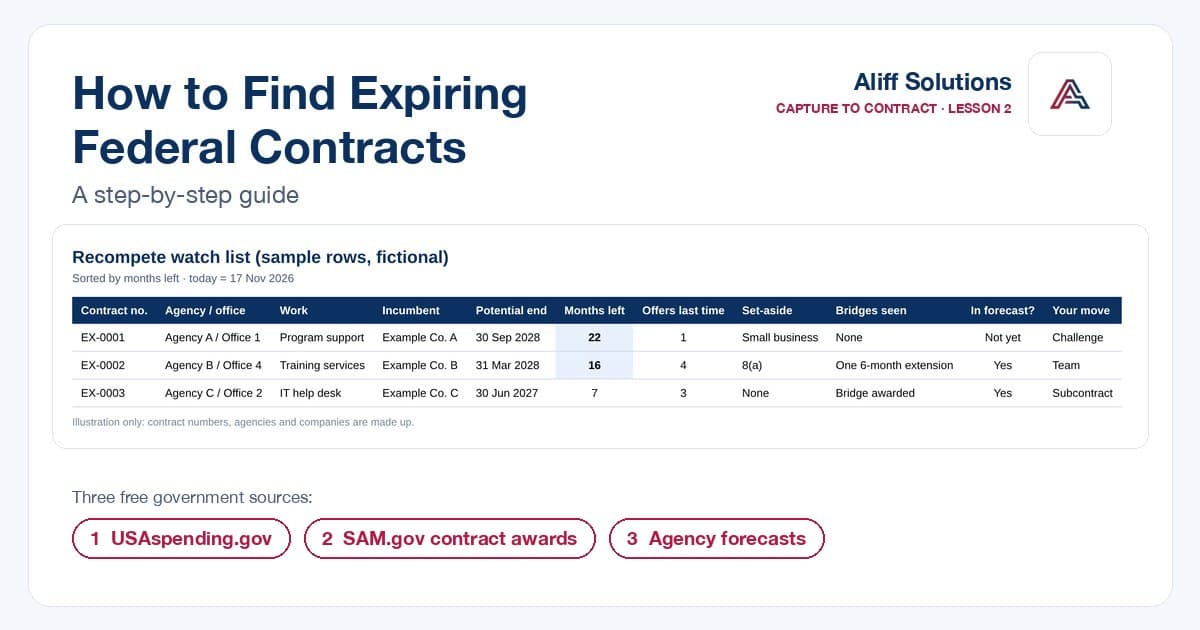
How to Find Expiring Federal Contracts: A Step-by-Step Guide
With three free government websites and about 20 minutes, you can build a list of contracts in your field that end in the next one to two years: the recompetes you could prepare for now.

CEO, Aliff Solutions
17+ years experience
Haroon Haider is the CEO of Aliff Solutions, which helps businesses win U.S. government contracts, federal, state and local. Haroon has directed federal contracts and led capture strategy across defense, civilian, and intelligence community programs since 2009 (17 years), overseeing pursuits and contract execution from opportunity to award.
His background spans the full federal contract lifecycle: opportunity identification, capture strategy, proposal management (Shipley methodology), color team reviews, pricing strategy, post-award execution, and program management. Before joining Aliff Solutions as CEO, he led BD and capture organizations at multiple GovCon firms and built relationships with contracting officers and program managers across DoD, VA, HHS, DHS, GSA, and intelligence community agencies.
As CEO, Haroon leads Aliff Solutions' work helping businesses win government contracts and win more contracts.

With three free government websites and about 20 minutes, you can build a list of contracts in your field that end in the next one to two years: the recompetes you could prepare for now.

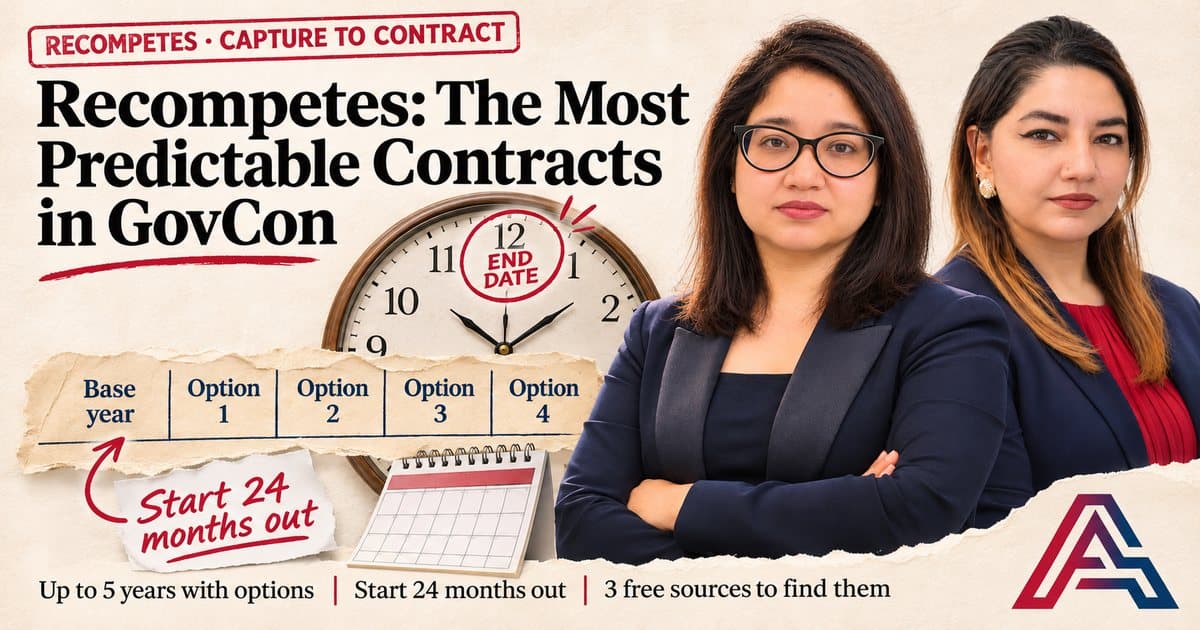
Most federal contracts end on a date anyone can look up. Here is how recompetes work, when to start, where to find them for free, and how to decide whether to challenge, team or subcontract.

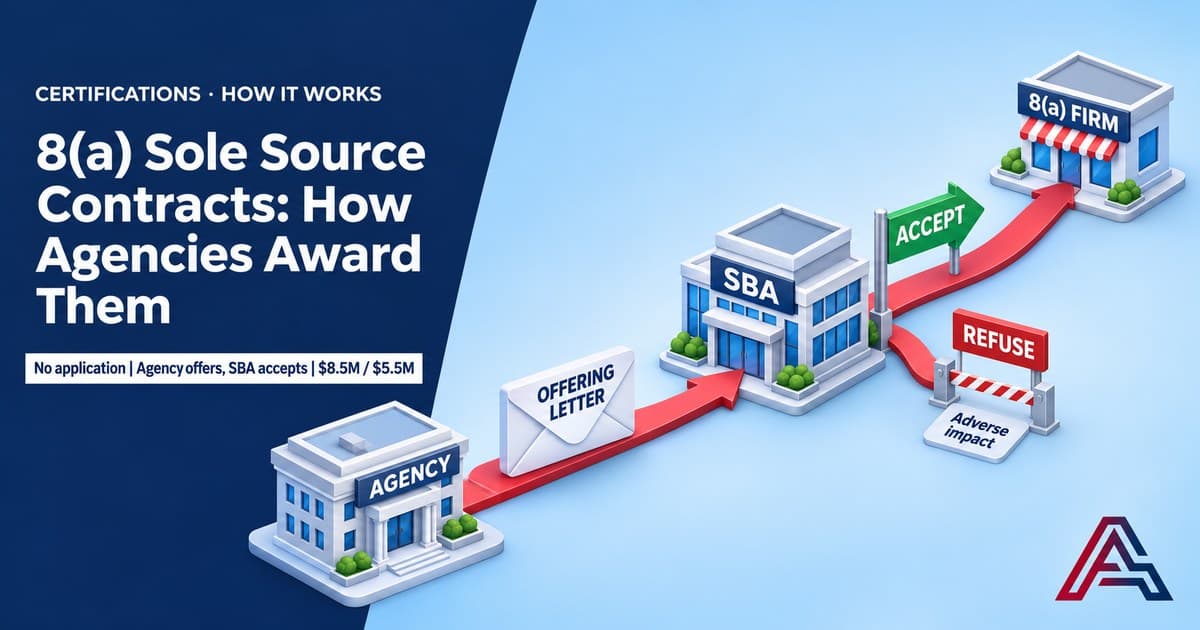
An 8(a) sole source contract is awarded without competition, but you cannot apply for one. An agency has to offer the requirement to SBA, and SBA can refuse it. Here is how the offer, the acceptance, the thresholds and the adverse impact rule work.

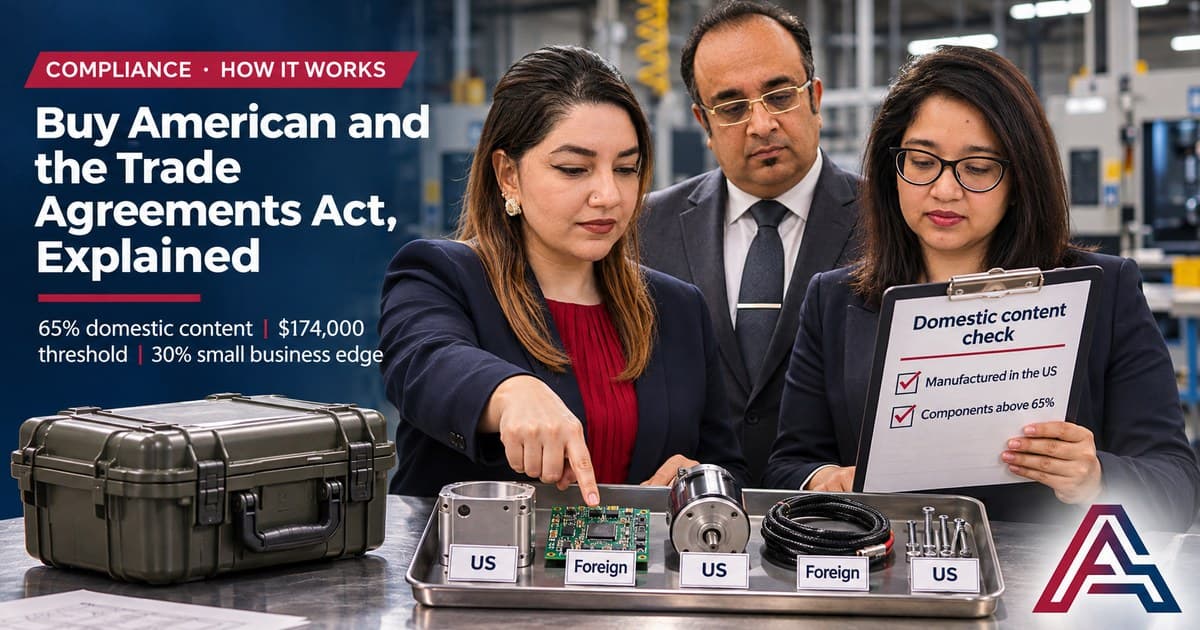
Buy American prefers domestic products; the Trade Agreements Act waives that preference above set thresholds. The 65 percent content test, the $174,000 threshold, and the price edge for small domestic offerors.

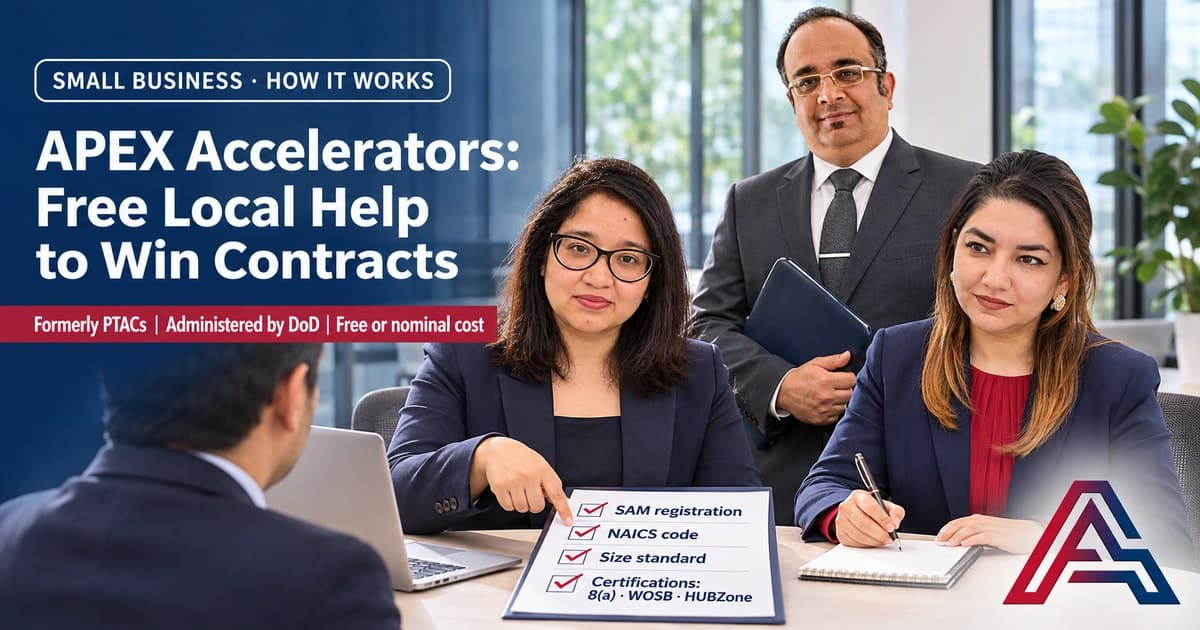
APEX Accelerators, formerly PTACs, are local offices that help small businesses sell to federal, state and local governments, free or at a nominal cost. Here is what they do and how to get the most from one.

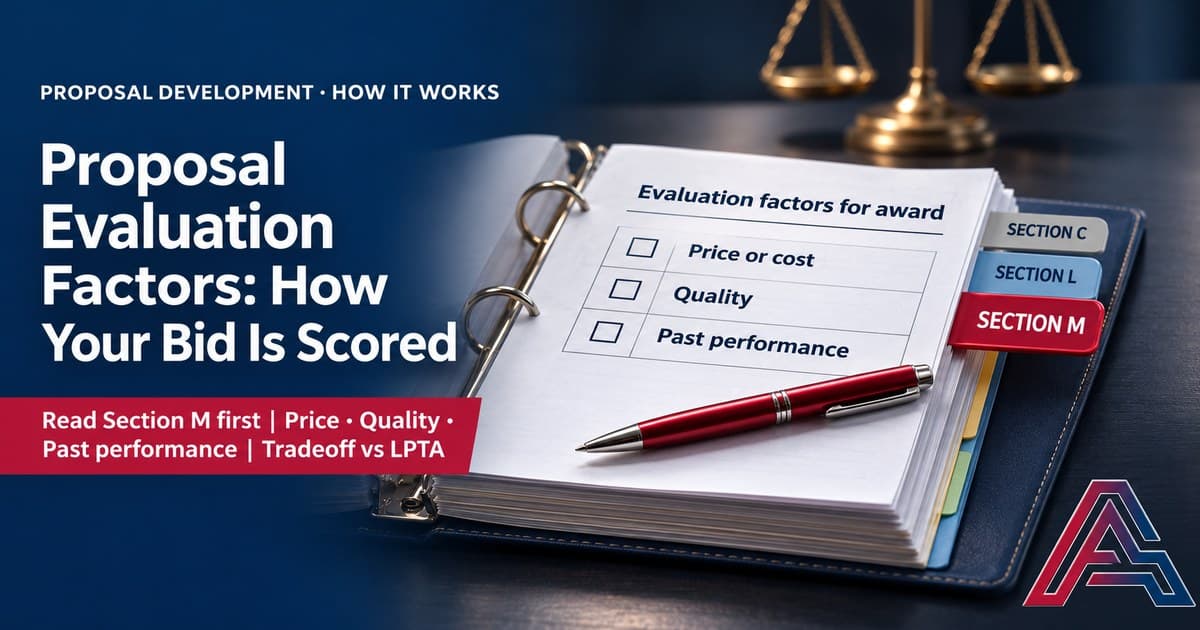
Every federal source selection scores bids against published evaluation factors: price or cost, quality and past performance. Here is what the FAR requires, where Section M tells you the weights, and how tradeoff and LPTA differ.

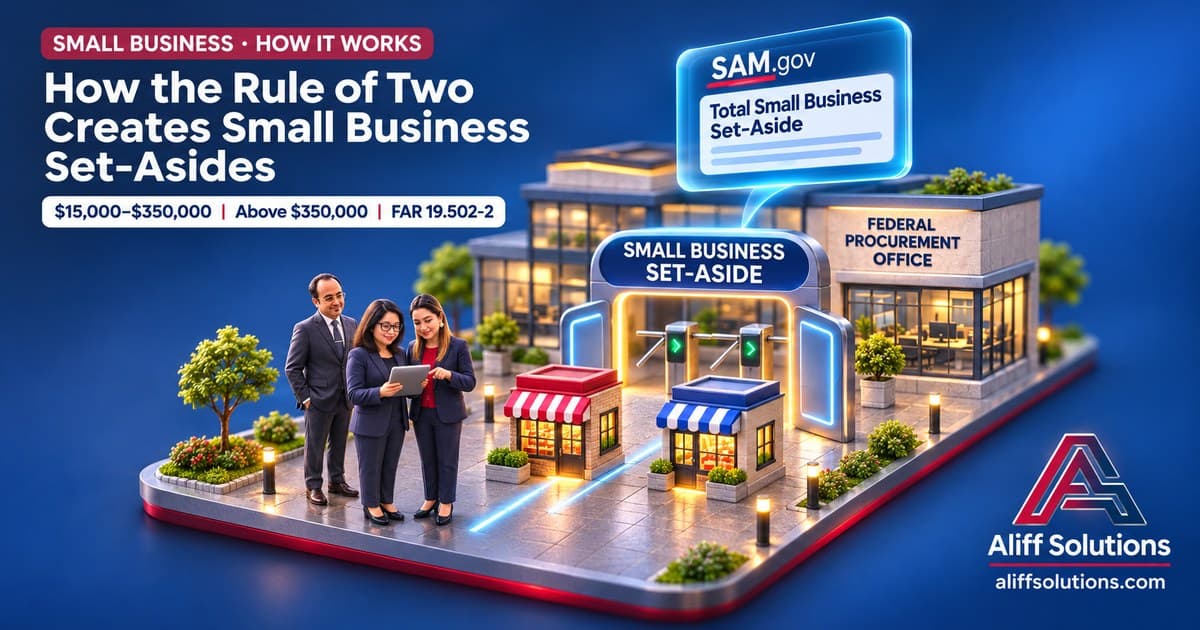
The rule of two is the federal test that turns an ordinary contract into a small business set-aside. Here is how it works below and above $350,000, and how to get counted as one of the two.

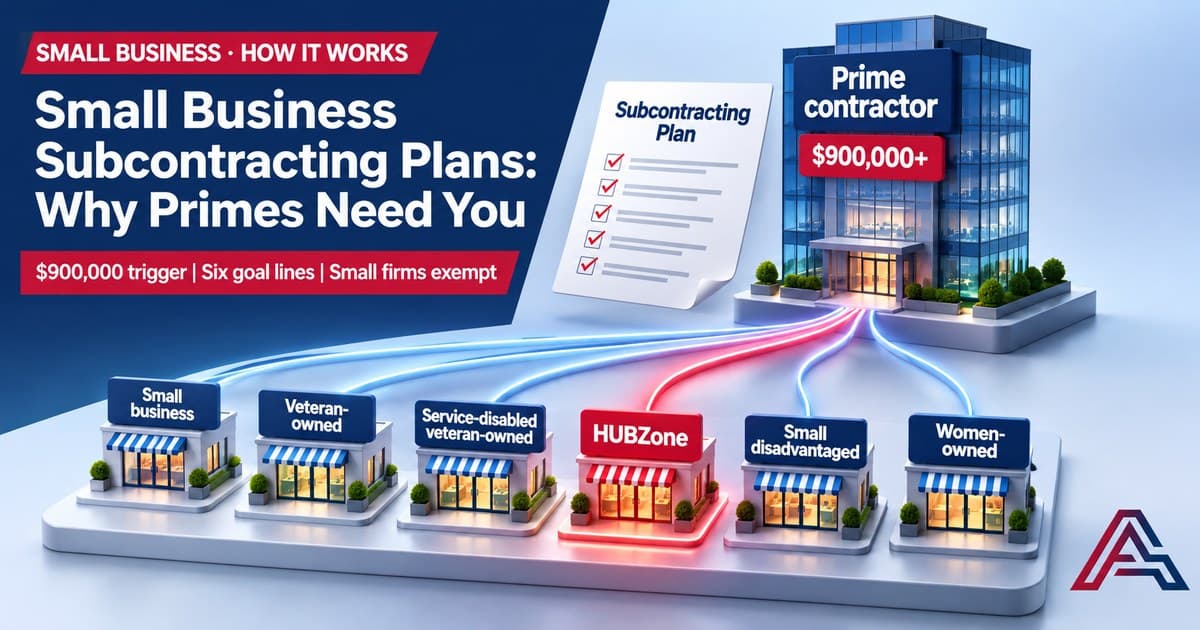
Large primes bidding federal work above $900,000 must file a subcontracting plan with goals for each small business category. Here is how the plan works, why it makes you useful to primes, and how to find the primes that carry one.
The GovCon market is a $2.25T landscape where the industry average federal proposal win rate sits at roughly 4%. Quantitative methodology — recompete prediction, vulnerability scoring, Price-to-Win, and the 8-factor pWin model — is replacing instinct-driven capture with systematic decision support.
GSA Schedule, SEWP VI, CIO-SP4, Alliant 2, OASIS+, Polaris — the choice paralysis is real. Here's the decision tree for picking the right next vehicle based on your firm size, target agencies, and capabilities.
1,840 federal IT services contracts will recompete over the next eight quarters — roughly $52B in capturable revenue. Here's the quarter-by-quarter playbook for capture managers.
Should your firm pursue a GSA Schedule, win seats on stand-alone IDIQs like Alliant 2 and OASIS+, or both? The strategic comparison, decision framework, and capture sequencing playbook.
We are building an AI model trained on 47 years of federal procurement data. Not a chatbot with a government prompt — a purpose-built intelligence engine for BD and capture managers. Launching soon.
Most AI tools optimize for sounding confident. Aliff Copilot is designed to be right — or tell you when it cannot be. Here is why honesty is the most underrated feature in GovCon intelligence.
We spent a year assembling decades of federal and SLED procurement data into a single machine-readable corpus and training a prediction engine on it. Here is what we learned about cross-market GovCon intelligence.
The U.S. Army's Marketplace for the Acquisition of Professional Services (MAPS) consolidates RS3 and ITES-3S into a single $50 billion, 10-year IDIQ. Here is what government contractors need to know about the five domains, 250 anticipated awards, and the capture window before proposals are due.
The Army MAPS $50B IDIQ uses a hybrid self-scoring evaluation model that fundamentally changes how proposals are evaluated. Learn how the phase-gate approach, scorecard mechanics, and domain selection strategy determine who wins -- and how to maximize your points.

Master the end-to-end capture management process from opportunity identification through contract award. Learn how gate reviews, B&P investment decisions, and quantitative analysis transform each phase of the Shipley capture lifecycle.
The CMMC 2.0 phased rollout is accelerating in 2026. This guide covers the three-level structure, Phase 2 third-party assessment deadlines, cost estimates by level, C3PAO scheduling, supply chain flow-down requirements, and the concrete steps contractors must take now.
A practical guide to CMMC 2.0 readiness for government contractors. Understand the three maturity levels, assessment requirements, SSP and POA&M documentation, and the concrete steps to prepare your organization for certification.
The Department of Government Efficiency is reshaping the federal contracting landscape through aggressive contract terminations, spending audits, and the defense-civilian spending bifurcation. This guide analyzes which sectors are most affected and how contractors can adapt.
The Revolutionary FAR Overhaul is the most significant change to federal procurement in forty years. This guide breaks down the key regulatory shifts, new contracting officer discretion, Strategic Acquisition Guidance, and what contractors must do now to stay competitive.
Government contractors face unique cash flow challenges driven by 60-90 day federal payment cycles, continuing resolutions, and rising input costs. This 2026 playbook covers DSO optimization, invoice acceleration, working capital strategies, and macro-fiscal factors shaping contractor liquidity.

A detailed comparison of the four major federal small business certification programs -- 8(a), HUBZone, WOSB, and SDVOSB -- covering eligibility, application processes, sole-source thresholds, stacking strategies, and the 2026 regulatory changes affecting each program.
Federal contractors face a structural funding gap between contract performance and government payment. This guide covers the Assignment of Claims Act, asset-based lending, SBA programs, factoring, mobilization funding, and how to choose the right financing instrument for your contract portfolio.
Wrap rates determine the true cost of every billable hour in government contracting. This guide breaks down fringe, overhead, and G&A components, walks through a complete calculation example, explains typical multipliers around 2.7x, and shows how to benchmark against GSA CALC data.

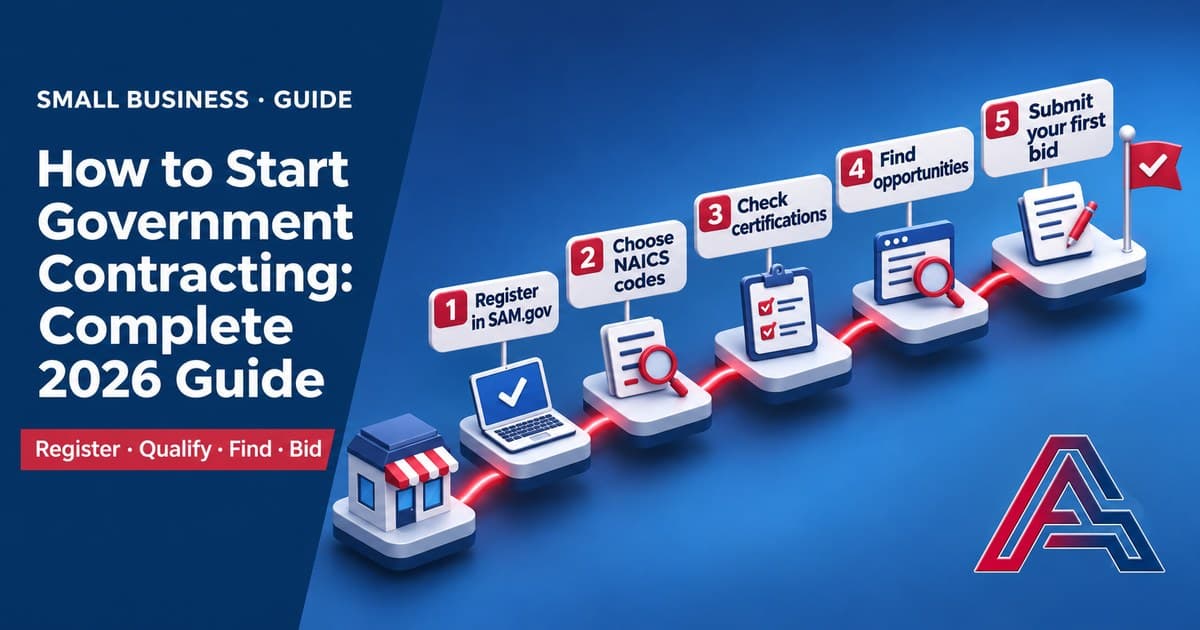
A step-by-step guide to entering the federal contracting market in 2026, covering SAM.gov registration, UEI and CAGE codes, NAICS selection, FPDS research, subcontracting pathways, and the regulatory changes reshaping market entry.
The Department of Defense LYNX platform is reshaping how small businesses enter the defense industrial base. Learn what DoD LYNX does, how it connects suppliers to mission-aligned opportunities, and what the broader 'Lynx' technology ecosystem means for government contractors.

Avoid the seven most common proposal writing mistakes that cost government contractors winnable bids. From compliance matrix failures to weak proof points, learn what separates winning proposals from also-rans.
Explore the state, local, and education (SLED) procurement market -- a $1.5 trillion opportunity that most federal contractors overlook. Learn the differences in procurement rules, cooperative purchasing vehicles, and strategies for breaking into SLED from a federal base.
The SLED market represents over $3.7 trillion in combined state and local government spending -- far larger than the federal contracting market. This guide covers the procurement methods, regulatory differences, entry strategies, and cooperative purchasing vehicles you need to capture your share.

A comprehensive guide to federal small business set-aside programs including 8(a), HUBZone, WOSB, SDVOSB, mentor-protege programs, and joint ventures. Learn how to qualify, compete, and grow strategically within the federal marketplace.
Cooperative purchasing vehicles like Sourcewell, NASPO ValuePoint, and OMNIA Partners give vendors access to thousands of government agencies through a single contract award. This guide explains how each works, how to get on contract, and how to leverage cooperative vehicles for SLED market growth.
A practical guide to teaming strategies in government contracting. Learn when to team, how to structure agreements, the differences between CTAs and subcontracting, and how to build partnerships that strengthen your competitive position.
Unsolicited proposals let vendors pitch innovative solutions to government agencies outside the formal RFP process. This guide covers when to use them, how to structure them, state-specific rules in Virginia, North Carolina, and Massachusetts, and common mistakes that derail otherwise strong submissions.
Learn how Bayesian probability analysis helps government contractors make data-driven Go/No-Go decisions. Understand the factors that drive win probability and how to improve your competitive position.
Federal contract recompetes represent significant revenue opportunities. Learn how to identify upcoming recompetes, assess incumbent vulnerability, and position your company for capture success.

Master the art and science of competitive pricing in government contracting. Learn how to analyze GSA rates, calculate wrap rates, and develop pricing strategies that maximize both your win probability and profitability.